
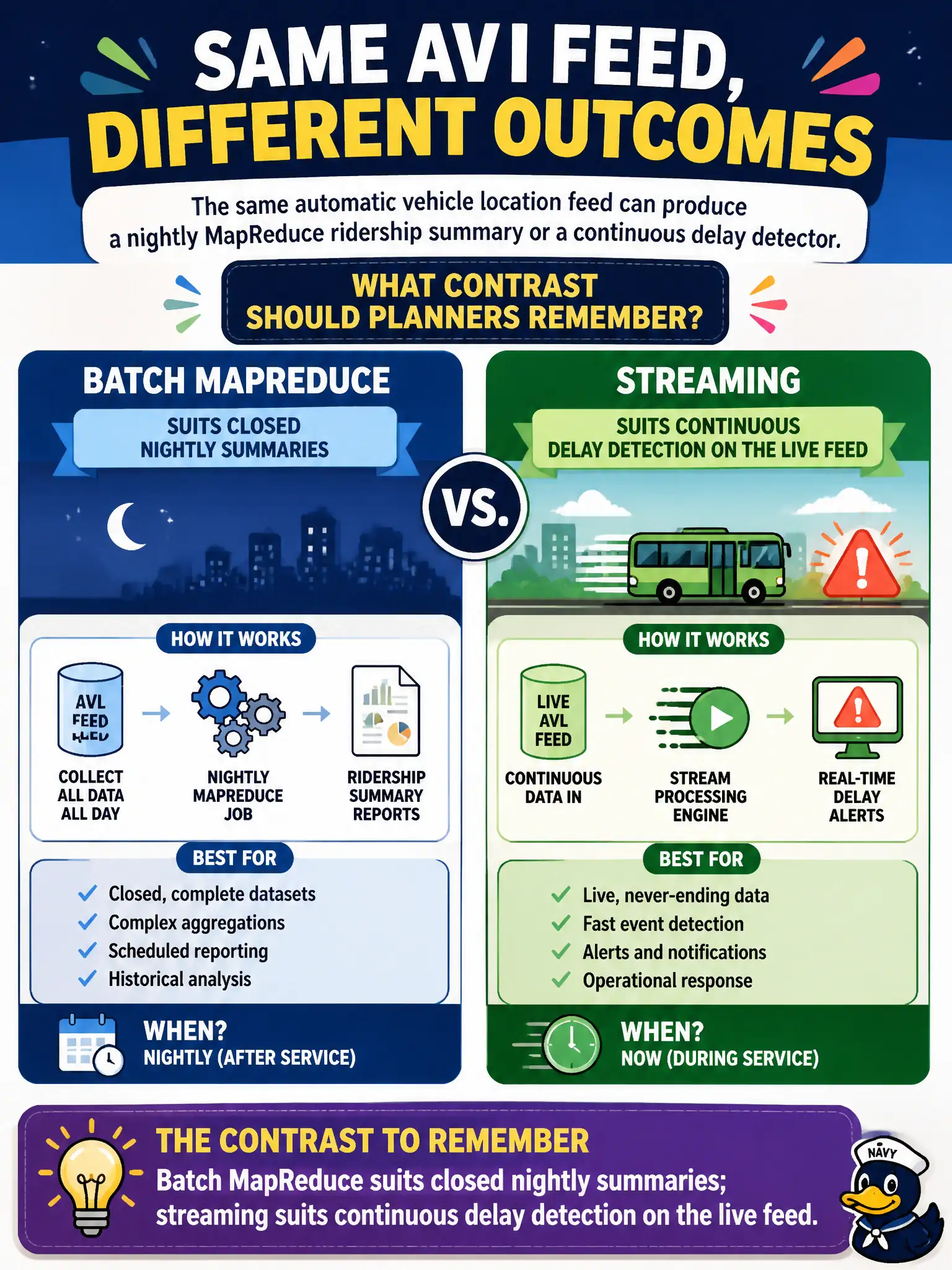
The same automatic vehicle location feed can produce a nightly MapReduce ridership summary or a continuous delay detector. What contrast should planners remember?
Select an answer to reveal the explanation.
Short Explanation
Same AVL hose, two jobs: one fills the nightly report bucket, the other watches delays as buses move. Batch MapReduce loves finished files; streaming loves the live trickle. They are not the same thing dressed differently.
Full Explanation
The same AVL feed can feed two different processing styles: batch MapReduce (or batch Spark) suits closed nightly ridership summaries, while streaming suits continuous delay detection on the live feed. Planners should remember the contrast rather than treating both as identical. Saying every MapReduce job is already a stream blurs batch boundaries and misleads latency expectations. Claiming nightly MapReduce is always faster than any streaming path for live delays confuses throughput of closed jobs with freshness for on-the-road alerts. Asserting streaming can only run after MapReduce deletes the AVL feed invents a false dependency. Exam caveat: architectures often run both—batch for audited daily totals, streaming for operational alerts—on shared ingest. Operational check: document two consumers of the AVL topic (nightly summary vs continuous delay detector), verify their freshness SLAs differ, and ensure neither blocks the other’s offset progress incorrectly. In production terms for batch versus streaming on the same AVL feed, assign an owning team, wire a dashboard that shows the pattern is healthy under peak civic load, and require a staging drill that rehearses failure and recovery before resident impact. Revisit the choice when traffic shape, retention, or integrity needs change, and keep a named rollback owner on the change record. Re-test both the happy path and the failure path for batch versus streaming on the same AVL feed after material dependency upgrades so regressions are caught before the next public release.