
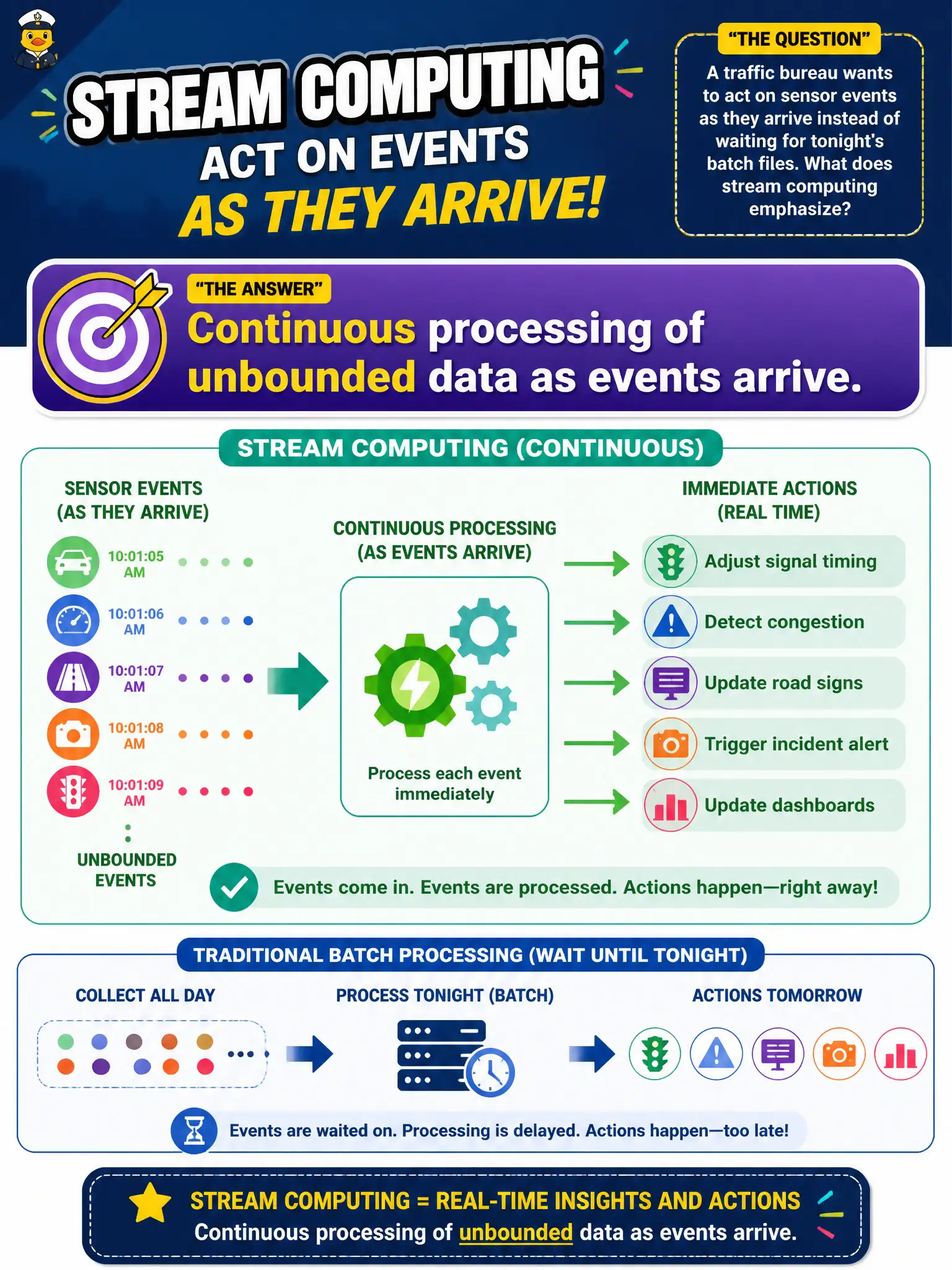
A traffic bureau wants to act on sensor events as they arrive instead of waiting for tonight’s batch files. What does stream computing emphasize?
Select an answer to reveal the explanation.
Short Explanation
Stream computing is the always-on hose, not the nightly dump truck. Events keep arriving and processing keeps going without waiting for a closed batch file. Yearly archives and paper tickets are the opposite vibe.
Full Explanation
Stream computing emphasizes continuous processing of unbounded data as events arrive, so a traffic bureau can act on sensor events now instead of waiting for tonight’s batch files. That shift is about timeliness and ongoing input, not closing a finite file first. Only yearly offline archives with no continuous input describe batch archival thinking, the opposite of streaming. Single-node spreadsheets that must finish before any sensor opens cannot keep up with live city feeds. Printing paper tickets before any digital event can be counted is an analog bottleneck, not stream architecture. Exam caveat: streaming still uses windows, state, and checkpoints—continuous does not mean unbounded memory or zero-latency miracles. Operational check: compare end-to-end latency from sensor event to action in a streaming path versus the nightly batch path, and confirm the streaming job runs indefinitely on an open feed without requiring a “file closed” signal. In production terms for continuous stream computing on sensors, assign an owning team, wire a dashboard that shows the pattern is healthy under peak civic load, and require a staging drill that rehearses failure and recovery before resident impact. Revisit the choice when traffic shape, retention, or integrity needs change, and keep a named rollback owner on the change record. Re-test both the happy path and the failure path for continuous stream computing on sensors after material dependency upgrades so regressions are caught before the next public release.