
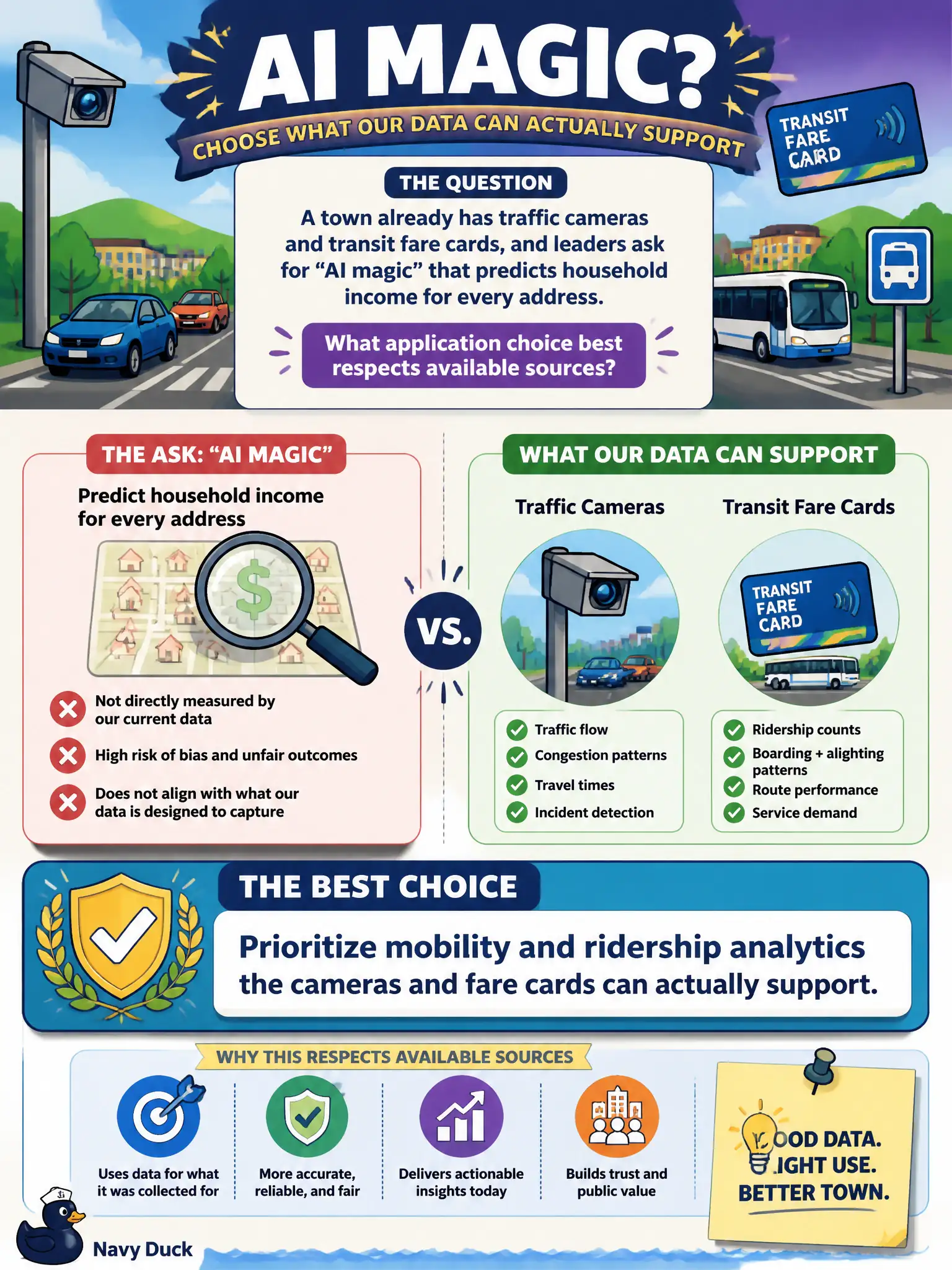
A town already has traffic cameras and transit fare cards, and leaders ask for “AI magic” that predicts household income for every address. What application choice best respects available sources?
Select an answer to reveal the explanation.
Short Explanation
Sources are the ingredients; applications are the recipe. Cameras and fare cards cook mobility insights, not a crystal ball of every household’s paycheck. Pick apps the city can actually feed.
Full Explanation
Big Data applications must be grounded in the source classes on hand. Traffic cameras and transit fare cards support mobility, ridership, and operations analytics; they do not automatically justify address-level income prediction. Leaders map feasible use cases to available person-to-machine and machine-to-machine feeds rather than inventing unsupported “AI magic” that residents did not consent to and sources cannot support.
Ignoring cameras to buy a new survey for every unconstrained wish-list model fails by concept: abandon existing sources without cause. Training income models solely on camera pixels because video “always” encodes wealth fails by concept: pixels do not reliably encode household income. Deleting fare cards so applications never depend on existing sources fails by concept: discarding usable civic sources is sabotage of grounding.
Exam caveat: Prioritize applications the cameras and fare cards can actually support—mobility/ridership—not unsupported income prediction from pixels or source deletion.
Operational check: Publish an allowed-use list for camera and fare data, reject income-prediction charters lacking lawful sources, and deliver ridership/mobility analytics first.