
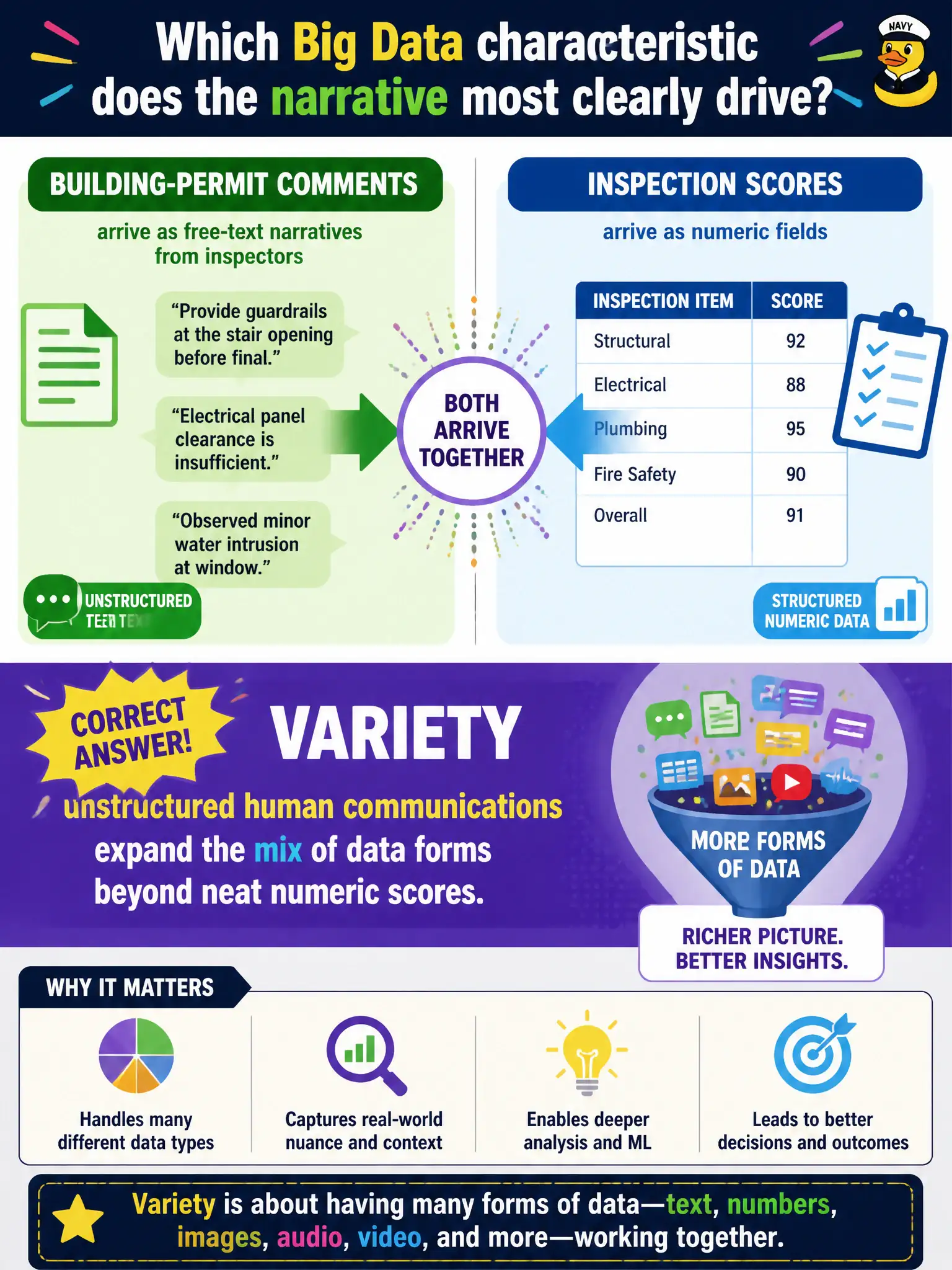
Building-permit comments arrive as free-text narratives from inspectors, while inspection scores arrive as numeric fields. Which Big Data characteristic does the narrative most clearly drive?
Select an answer to reveal the explanation.
Short Explanation
Numbers sit in tidy boxes; inspector notes wander all over the page. That mix is Variety — different shapes of data from the same civic process. Speed, size, or truthfulness alone do not explain the narrative form.
Full Explanation
Person-to-person and person-to-machine free text introduce unstructured forms alongside structured scores. Building-permit narratives from inspectors expand Variety beyond neat numeric inspection scores for the same workflow. Programs plan NLP and flexible schema strategies because structural diversity of human communications—not score columns alone—defines the source challenge for civic permitting.
Claiming only Velocity because comments always arrive faster than scores fails by concept: the stem contrasts forms, not guaranteed speed. Claiming only Volume because every comment is larger than any score table fails by concept: size is not the distinctive contrast. Claiming only Veracity because free text is always more accurate than numbers fails by concept: free text is not automatically more accurate.
Exam caveat: Unstructured narratives drive Variety beside structured scores—do not mislabel the contrast as only Velocity, Volume, or automatic Veracity superiority.
Operational check: Store narratives and scores with different processing paths, add NLP or coding for narratives, and keep both linked by permit ID for inspectors and planners. Document residual risk for civic operators and revisit after the next production change window.