
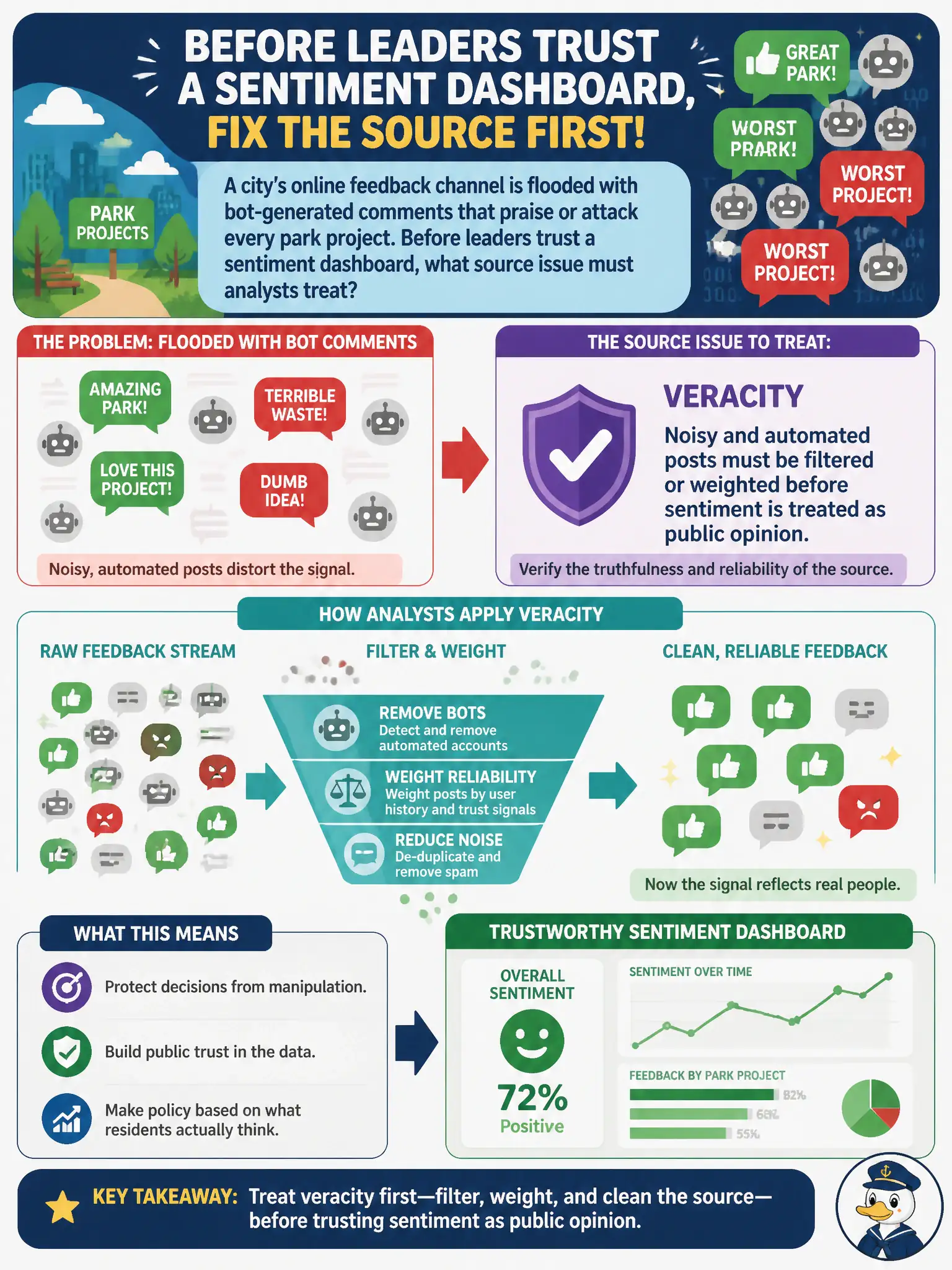
A city’s online feedback channel is flooded with bot-generated comments that praise or attack every park project. Before leaders trust a sentiment dashboard, what source issue must analysts treat?
Select an answer to reveal the explanation.
Short Explanation
Bots can clap or boo all day without living next to the park. Sentiment sources only help after veracity controls weed out noise and automation. More posts, faster posts, or emoji variety do not prove the crowd is real.
Full Explanation
Consumer-sentiment applications depend on truthful person-to-person and person-to-machine signals. Bot floods inflate volume and velocity while corrupting veracity, so park-project dashboards can misread public opinion. Analysts must filter or weight noisy automated posts before leaders treat aggregated sentiment as civic input. Volume, velocity, or variety without truthfulness controls leave councils acting on manufactured noise.
Treating volume alone as proof of accuracy fails by concept: more bot comments do not mean truer opinion. Treating velocity alone as proof posts are from residents fails by concept: speed does not authenticate authorship. Treating variety alone (emojis plus text) as removing authenticity needs fails by concept: format mix does not prove human residents wrote the posts.
Exam caveat: Veracity—authenticity filtering and weighting—comes before trusting sentiment dashboards; V/V/V without truth controls mislead.
Operational check: Apply bot and authenticity filters, show confidence bands on the sentiment dashboard, and brief leaders that unfiltered volume is not public opinion. Document residual risk for civic operators and revisit after the next production change window.