
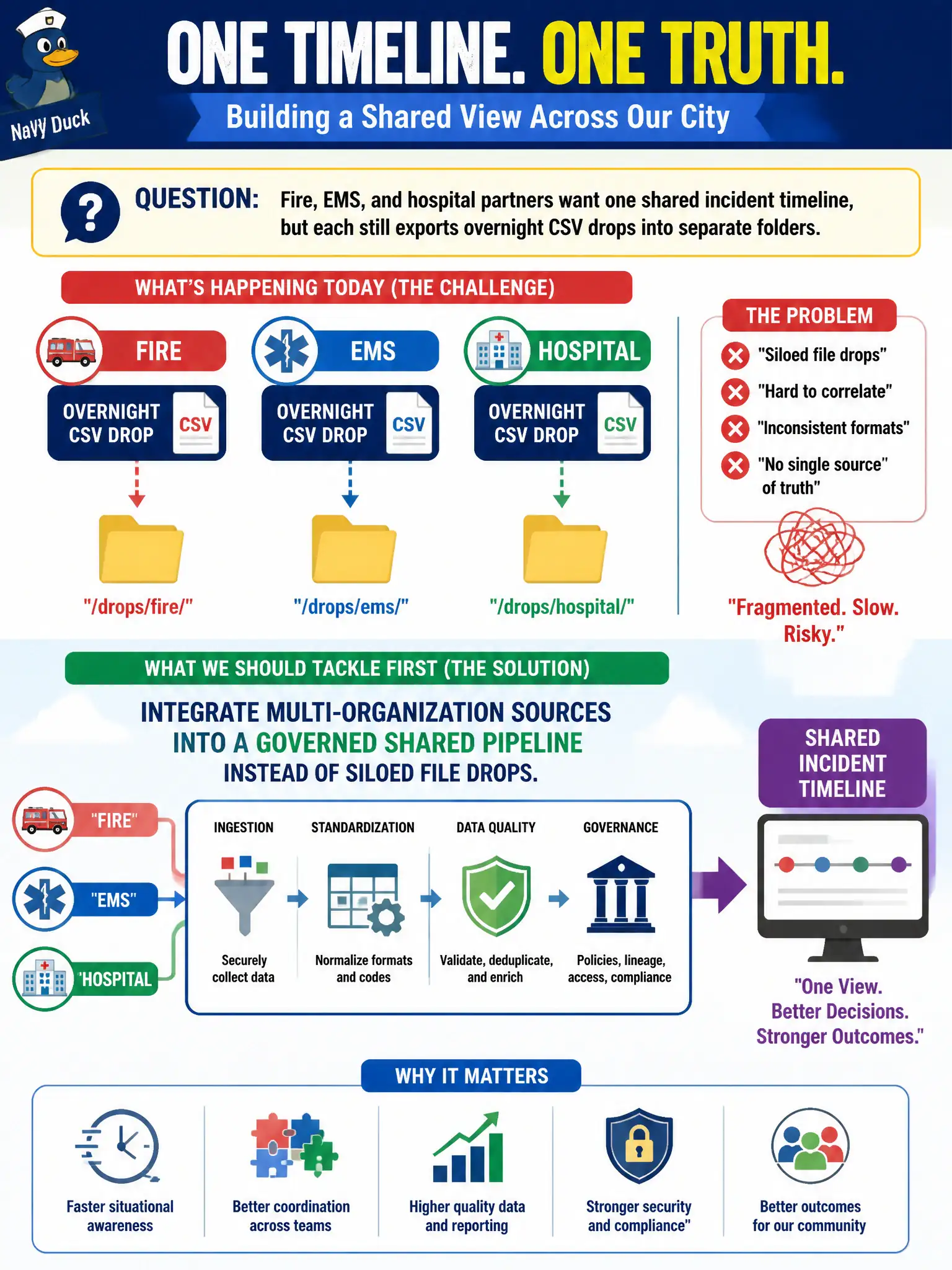
Fire, EMS, and hospital partners want one shared incident timeline, but each still exports overnight CSV drops into separate folders. What Big Data source challenge should the city tackle first?
Select an answer to reveal the explanation.
Short Explanation
Three agencies with three CSV dumps is not a shared timeline — it is three silos wearing the same calendar hat. Treat Fire, EMS, and hospital feeds as multi-organization sources that need a governed pipeline, not overnight folder copies. Until the sources join on purpose, analysts keep stitching yesterday’s files by hand.
Full Explanation
Cross-agency incident work fails when each organization remains a separate landing zone of overnight files. Fire, EMS, and hospital partners that only drop CSVs into separate folders never form one shared timeline for residents in crisis. The Big Data source challenge to tackle first is integrating multi-organization sources into a governed shared pipeline with schemas, identifiers, and refresh contracts while preserving partner identity.
Replacing every partner with a single vendor spreadsheet template and stopping shared timelines fails by concept: templates do not create a governed multi-org pipeline. Deleting historical incidents so folders start empty fails by concept: erasing history destroys longitudinal situational learning. Requiring hospitals to store fire radio audio as relational rows before any timeline work fails by concept: forcing unrelated media into rows is not the integration path.
Exam caveat: Integrate multi-organization P2M/M2M feeds through shared contracts—do not solve with template monocultures, history wipes, or forced media-to-row rituals.
Operational check: Define a shared incident identifier, publish refresh SLAs per partner, land feeds in one governed pipeline, and verify a single timeline view across fire, EMS, and hospital events.