
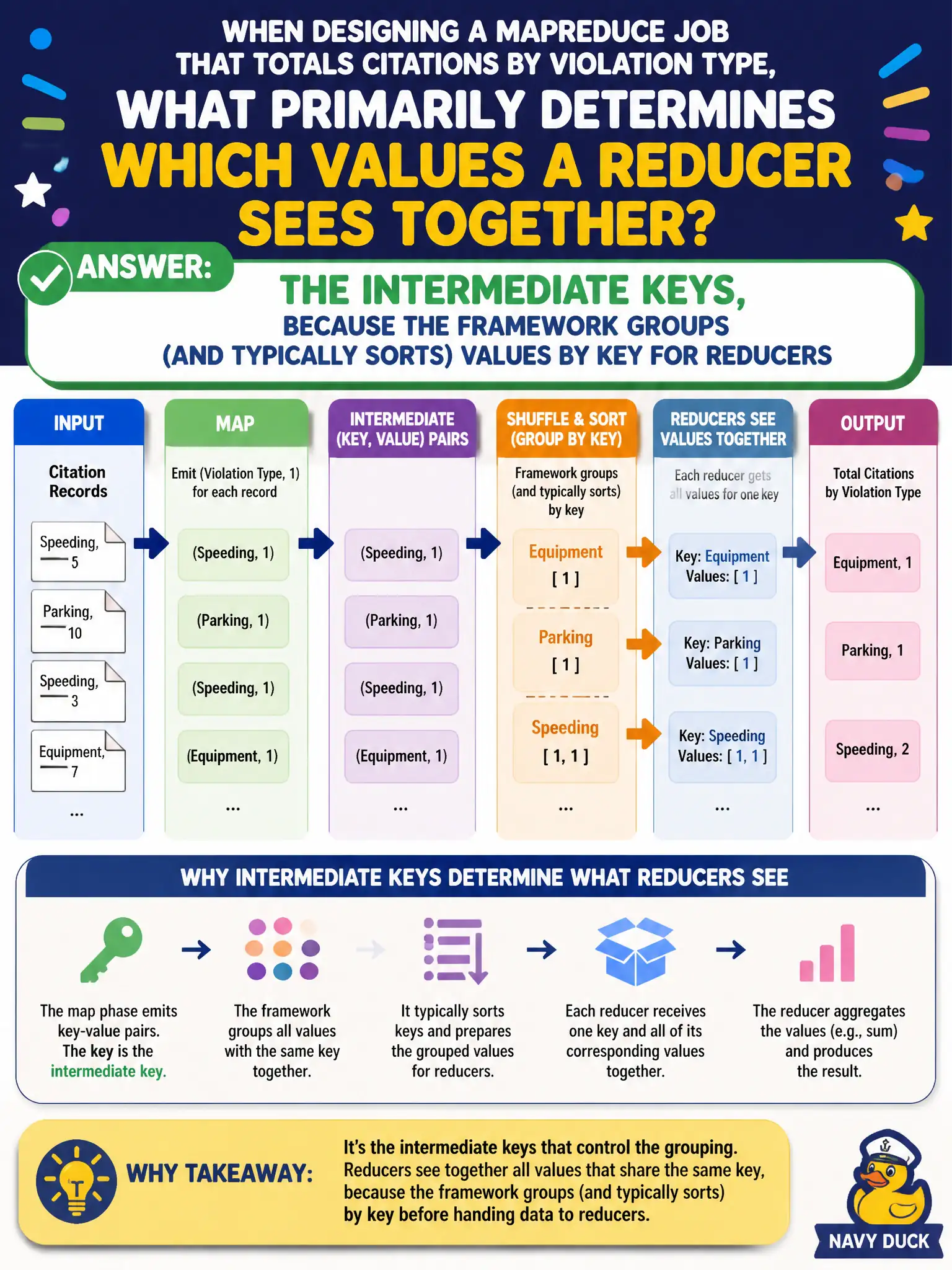
When designing a MapReduce job that totals citations by violation type, what primarily determines which values a reducer sees together?
Select an answer to reveal the explanation.
Short Explanation
The key on the sticky note is the meeting point—same violation type, same reducer group. Keys drive grouping and sort-before-reduce semantics. Portal colors and random filenames do not.
Full Explanation
When designing a MapReduce job that totals citations by violation type, intermediate keys primarily determine which values a reducer sees together because the framework groups (and typically sorts) values by key for reducers—key design is aggregation design. The color theme of the city's open-data portal CSS does not control reducer grouping. Random UUID filenames that ignore the emitted keys entirely would prevent meaningful aggregation by violation type. A rule that every reducer must process every key in the cluster contradicts partitioned reduce assignment. Exam caveat: choose map output keys as the grouping grain for the civic total you need. Operational check: emit violation-type as the intermediate key, confirm each reducer receives only its key set, and match totals to a citation control file before enforcement analytics publish. In municipal platform operations, record the rationale in the architecture decision record so future on-call staff know which pattern was chosen and which failure modes the rejected options would create for city services. Re-validate after the next maintenance window that monitoring, access paths, and recovery steps still match the documented design for agencies that depend on this platform.