
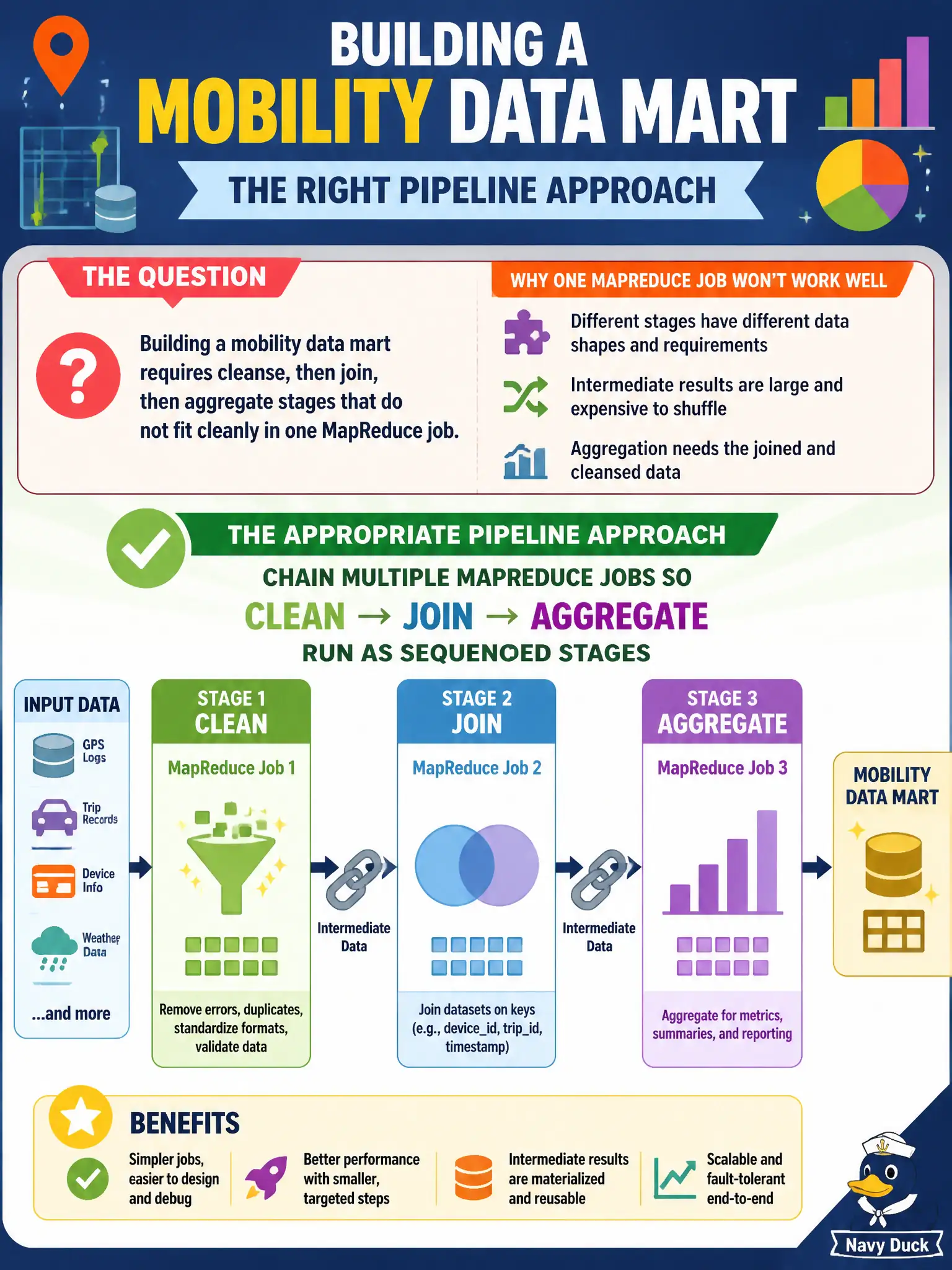
Building a mobility data mart requires cleanse, then join, then aggregate stages that do not fit cleanly in one MapReduce job. What pipeline approach is appropriate?
Select an answer to reveal the explanation.
Short Explanation
Big civic marts are more like a three-course meal than one blender dump. Chain MapReduce jobs—clean, then join, then aggregate—with HDFS between courses. Cookies and cloud trivia are not a pipeline.
Full Explanation
Building a mobility data mart that needs cleanse, then join, then aggregate stages that do not fit cleanly in one MapReduce job calls for chaining multiple MapReduce jobs so clean → join → aggregate run as sequenced stages with intermediate HDFS outputs. Forcing every stage into a single mapper with no intermediate HDFS outputs usually cannot express multi-stage joins and aggregations cleanly. Abandoning Hadoop to store all mobility facts only in browser cookies is not a platform architecture. Using AZ-900 flashcards as the only orchestration mechanism confuses certification study with pipeline design. Exam caveat: complex ETL is often a DAG of MapReduce (or successor) jobs, not one miraculous mapper. Operational check: implement the mobility mart as sequenced jobs with checked intermediate paths, fail the chain on stage error, and only publish the final aggregate when all stages succeed. In municipal platform operations, record the rationale in the architecture decision record so future on-call staff know which pattern was chosen and which failure modes the rejected options would create for city services. Re-validate after the next maintenance window that monitoring, access paths, and recovery steps still match the documented design for agencies that depend on this platform.