
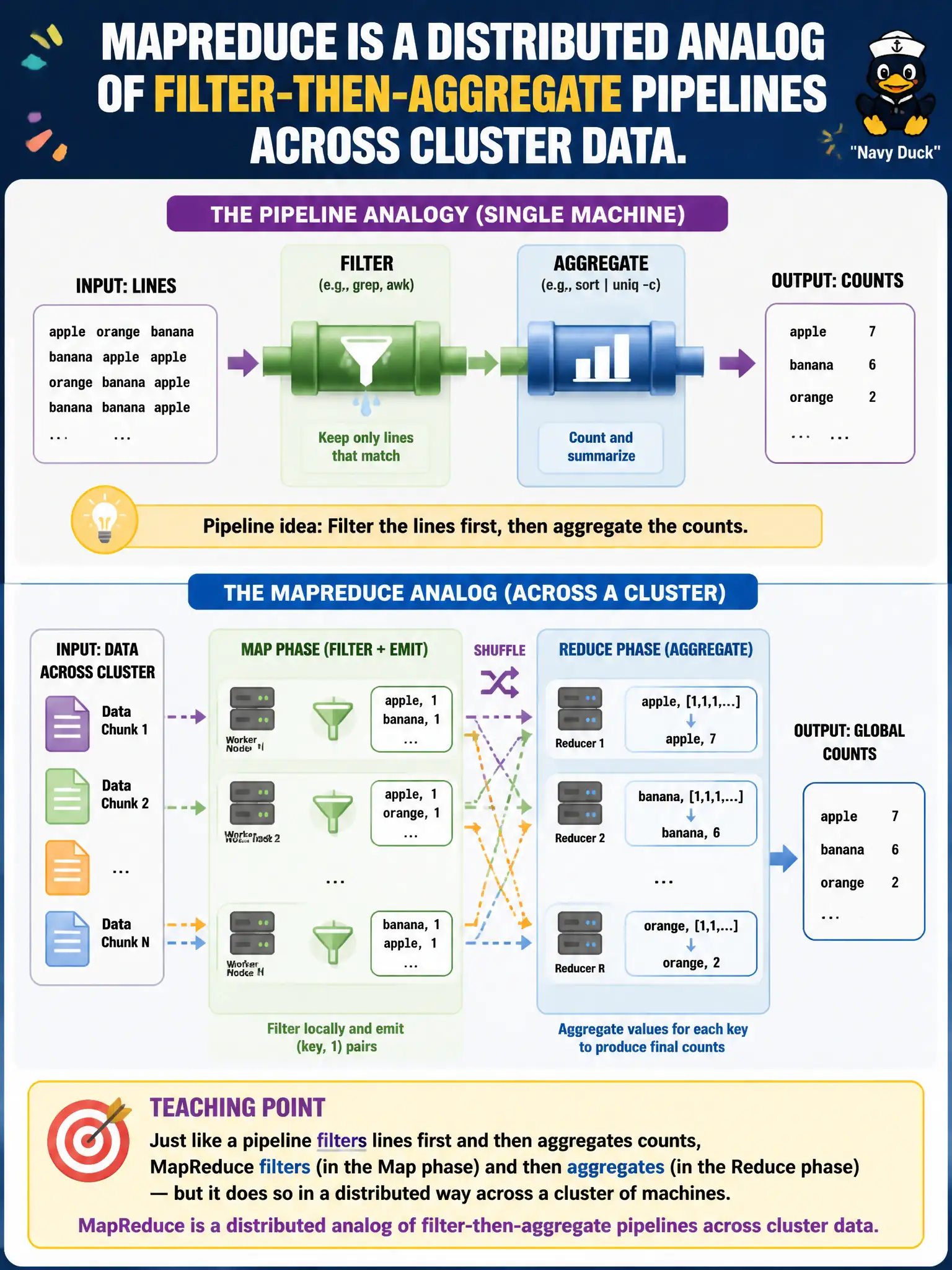
An instructor compares MapReduce to filtering lines with pipeline commands and then aggregating counts. What teaching point is that analogy meant to convey?
Select an answer to reveal the explanation.
Short Explanation
Locally you might grep then count; on a cluster MapReduce spreads that filter-then-total idea across many machines. The UNIX pipeline analogy teaches the shape—not that shell pipes replace HDFS. Keep the metaphor as a teaching aid, not a literal install plan.
Full Explanation
Comparing MapReduce to filtering lines with pipeline commands and then aggregating counts teaches that MapReduce is a distributed analog of filter-then-aggregate pipelines across cluster data—familiar civic Unix thinking scaled out to HDFS archives. MapReduce is not only a GUI installer that never processes distributed data on worker nodes. UNIX pipes do not permanently replace HDFS block storage on every analytics cluster. Filter-then-aggregate ideas are not confined to a single laptop shell; distributed scale is why MapReduce exists for cities. Exam caveat: the analogy is pedagogical for map-then-reduce, not a claim that shell pipes replace HDFS. Operational check: take a local grep|sort|uniq -c example on a sample 311 extract, then show the same logic as map/reduce on the cluster so analysts see the distributed analog clearly. In municipal platform operations, record the rationale in the architecture decision record so future on-call staff know which pattern was chosen and which failure modes the rejected options would create for city services. Re-validate after the next maintenance window that monitoring, access paths, and recovery steps still match the documented design for agencies that depend on this platform.