
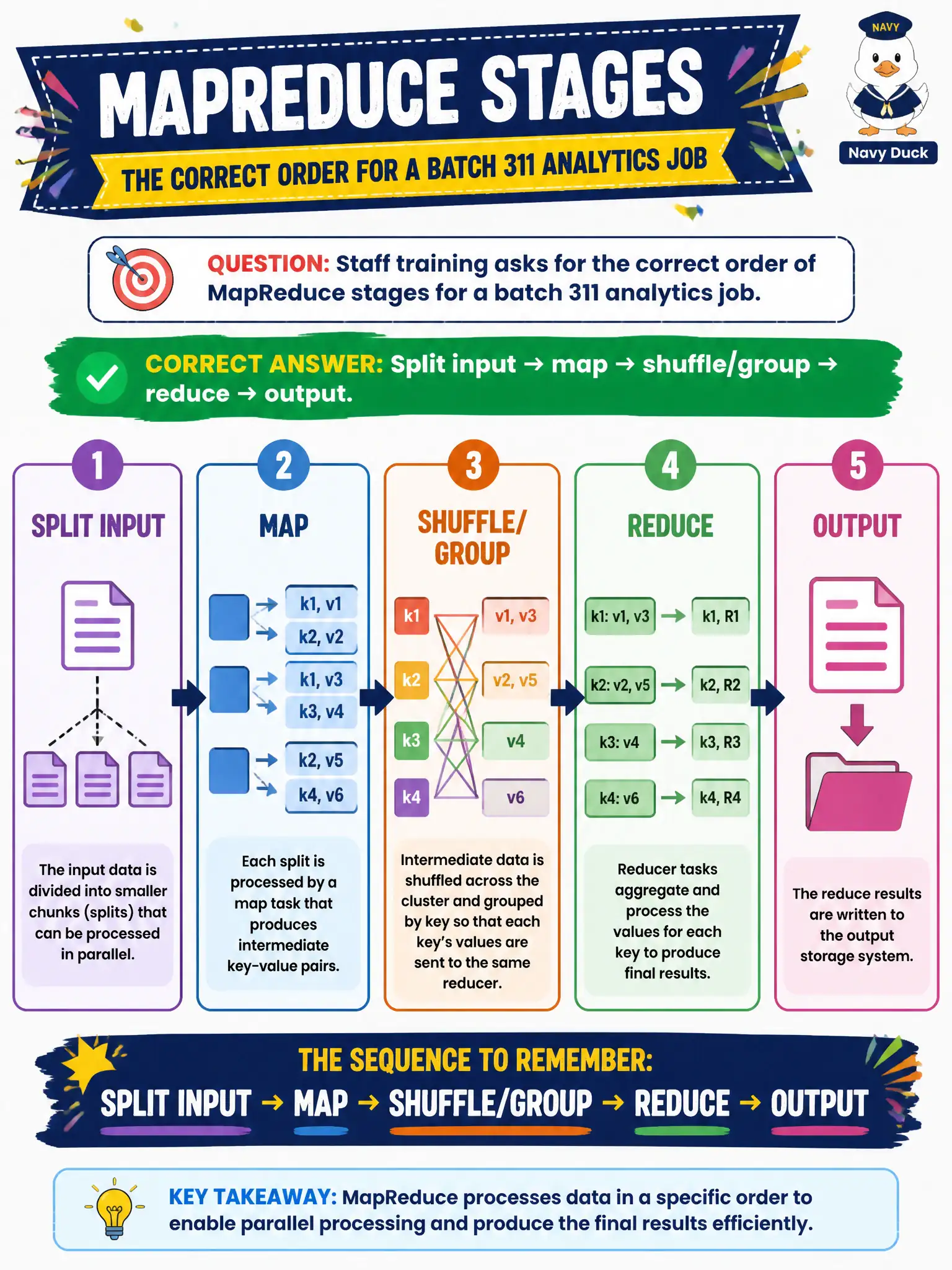
Staff training asks for the correct order of MapReduce stages for a batch 311 analytics job. Which sequence is correct?
Select an answer to reveal the explanation.
Short Explanation
Slice the mail, stamp each piece, sort by address, then tally per route, then file the totals. MapReduce follows that rhythm: split, map, shuffle/group, reduce, output. Starting with reduce or output first scrambles the pipeline.
Full Explanation
The correct MapReduce stage order for a batch 311 analytics job is split input → map → shuffle/group → reduce → output. Teaching staff that sequence prevents inverted pipeline designs that cannot run correctly on the city cluster. Reduce → map → delete HDFS → skip shuffle → output reverses and corrupts the processing model. Output → shuffle → map → split input → reduce starts at the end and misorders prerequisites for a working job. Shuffle/group → split input → output → map → reduce likewise scrambles dependencies that MapReduce requires. Exam caveat: memorize the canonical stage order; many distractors simply permute the stages. Operational check: walk a 311 job’s logs against the canonical order, and reject runbook diagrams that place reduce before map or omit shuffle/group before aggregation. In municipal platform operations, record the rationale in the architecture decision record so future on-call staff know which pattern was chosen and which failure modes the rejected options would create for city services. Re-validate after the next maintenance window that monitoring, access paths, and recovery steps still match the documented design for agencies that depend on this platform.