
During a citywide MapReduce job, something must assign map and reduce tasks to workers on the cluster. Which role description fits?
Select an answer to reveal the explanation.
Short Explanation
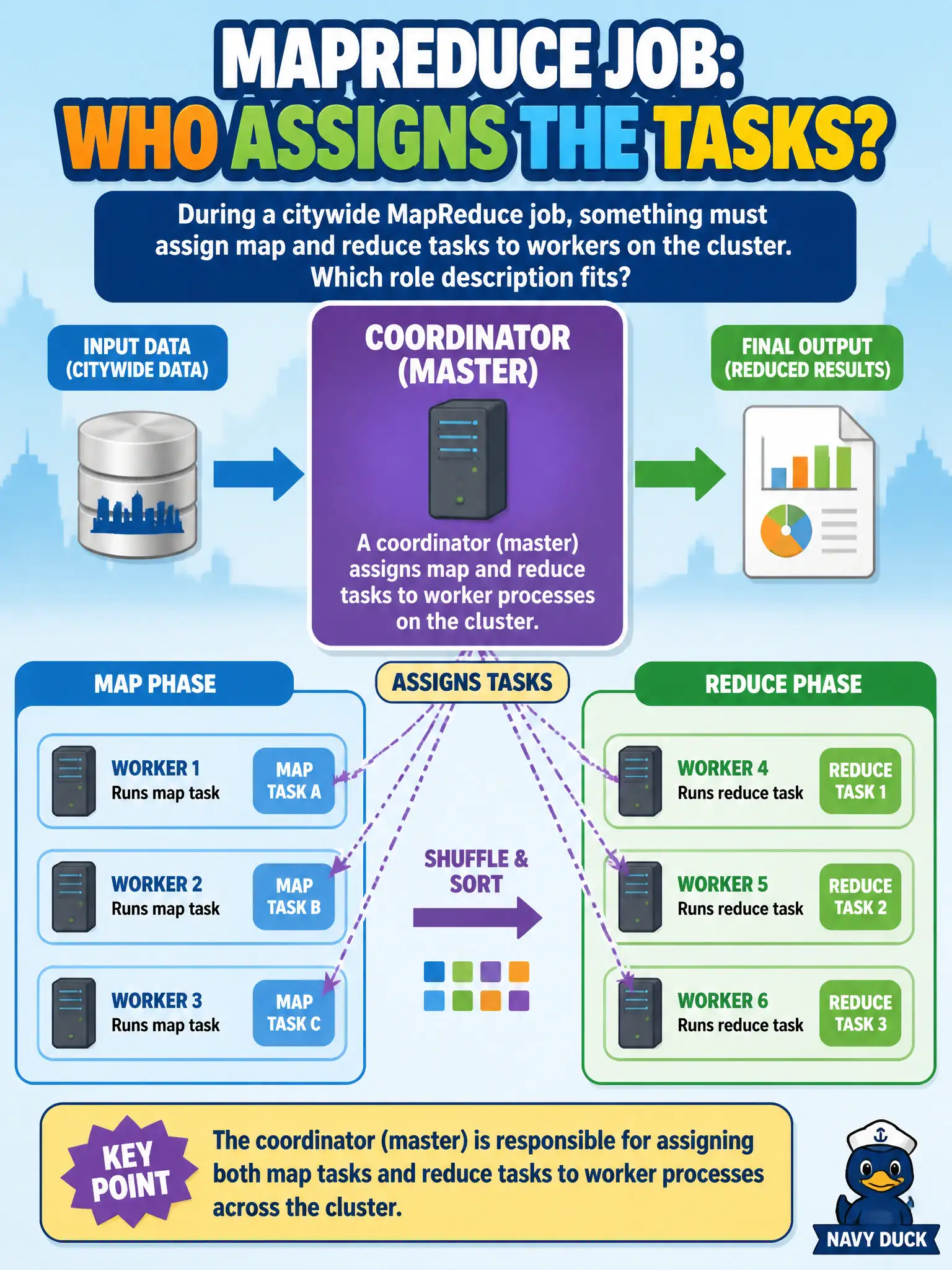
A foreperson hands out work packets; crews do the lifting. MapReduce uses a coordinator to assign map and reduce tasks to workers. Leaving every node to invent its own global plan is chaos, not a job.
Full Explanation
During a citywide MapReduce job, a coordinator (master) assigns map and reduce tasks to worker processes on the cluster—someone plans and tracks the work while workers execute tasks across municipal nodes. Every DataNode independently inventing the global job plan with no coordinator yields chaos rather than a coherent distributed job. Citizen open-data portals do not schedule MapReduce JVM tasks on the cluster as their primary architectural role. The NameNode alone does not execute all map and reduce functions inside its metadata process; that would conflate storage metadata with compute. Exam caveat: job coordination is distinct from HDFS NameNode metadata duties—do not merge the roles on the exam. Operational check: identify the job history or ApplicationMaster UI for a running civic job, confirm task assignments to workers, and document who to page when the coordinator versus workers fail. In municipal platform operations, record the rationale in the architecture decision record so future on-call staff know which pattern was chosen and which failure modes the rejected options would create for city services. Re-validate after the next maintenance window that monitoring, access paths, and recovery steps still match the documented design for agencies that depend on this platform.