
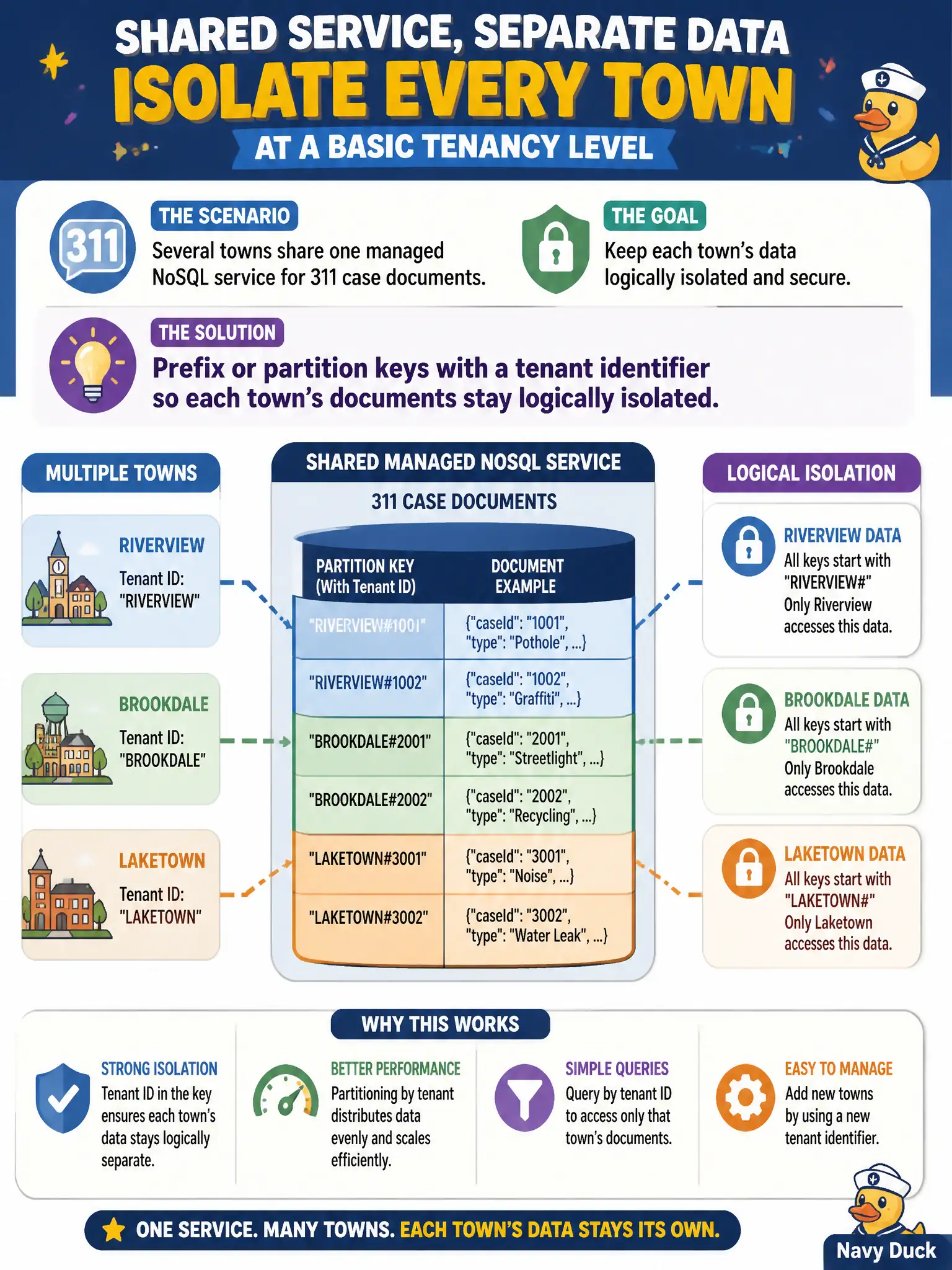
Several towns share one managed NoSQL service for 311 case documents. How should the platform isolate each town’s data at a basic tenancy level?
Select an answer to reveal the explanation.
Short Explanation
Shared NoSQL is fine if each town still has its own locker key. Put a tenant id in the partition or document key so Town A cannot casually walk into Town B’s cases. Same keys for everyone or one unkeyed blob is how isolation falls apart.
Full Explanation
When several towns share one managed NoSQL service for 311 case documents, basic tenancy isolation starts by prefixing or partitioning keys with a tenant identifier so each town’s documents stay logically separated in queries and access controls. Shared keys across towns invite accidental merges and cross-tenant reads. Giving every town the same document key so replicas “merge automatically” destroys isolation and corrupts case identity. Disabling authentication so towns share one global collection without filters is a security failure in multi-municipality platforms. Storing all towns under one unkeyed blob sorted only by free-text search provides neither reliable isolation nor predictable access paths. Exam caveat: key prefixing is necessary but not always sufficient—pair it with authz, encryption, and backup scoping per tenant for production civic clouds. Operational check: create cases for two tenant ids, query by partition/prefix, and verify each town’s credentials cannot read the other’s documents in the shared cluster. In production terms for tenant key isolation on shared 311 NoSQL, assign an owning team, wire a dashboard that shows the pattern is healthy under peak civic load, and require a staging drill that rehearses failure and recovery before resident impact. Revisit the choice when traffic shape, retention, or integrity needs change, and keep a named rollback owner on the change record. Re-test both the happy path and the failure path for tenant key isolation on shared 311 NoSQL after material dependency upgrades so regressions are caught before the next public release.