
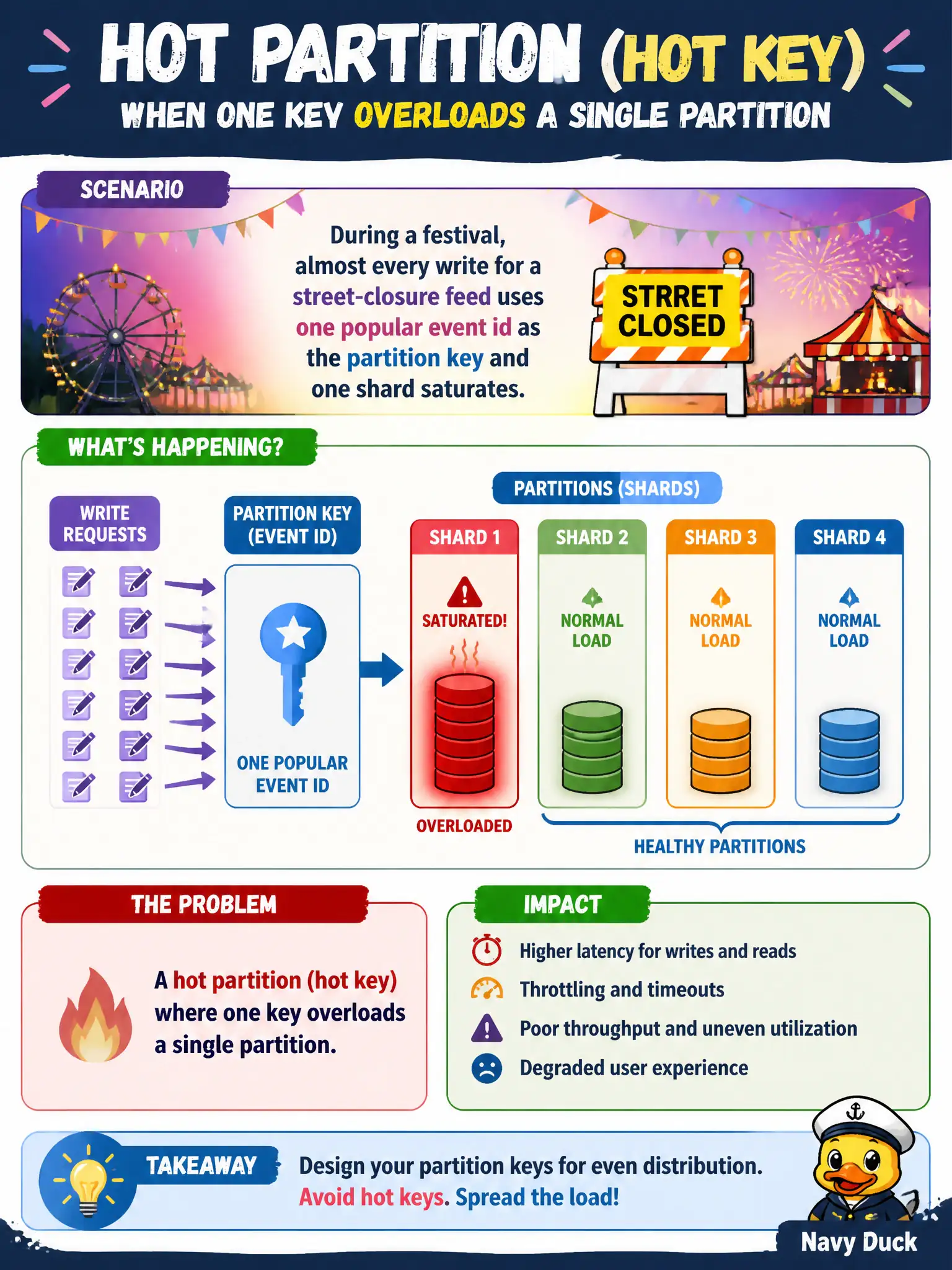
During a festival, almost every write for a street-closure feed uses one popular event id as the partition key and one shard saturates. What problem is this?
Select an answer to reveal the explanation.
Short Explanation
When one festival event id eats nearly every write, that partition becomes the crowded checkout lane. That is a hot key, not a CAP theorem gotcha or proof that partitioning does not matter. Spread the key design or you cook one shard.
Full Explanation
When almost every festival street-closure write uses one popular event id as the partition key, a single shard saturates—this is a hot partition (hot key) problem, not proof that NoSQL cannot store festival data. Throughput collapses because parallelism is wasted on one overloaded partition. Calling the situation a successful even distribution misunderstands the symptom. Blaming an HDFS NameNode failover caused by MapReduce shuffle alone mixes unrelated Hadoop failure modes into a NoSQL partitioning issue. Exam caveat: hot keys are fixed by redesigning keys (salted keys, higher cardinality, time buckets), not by blindly adding nodes while all writes still hash to one partition. Operational check: inspect partition-level metrics during the festival spike, identify the saturated key, redesign the write key to spread load (for example event id plus street segment or time bucket), and retest write latency under synthetic peak traffic. In production terms for hot-partition mitigation for festival feeds, assign an owning team, wire a dashboard that shows the pattern is healthy under peak civic load, and require a staging drill that rehearses failure and recovery before resident impact. Revisit the choice when traffic shape, retention, or integrity needs change, and keep a named rollback owner on the change record. Re-test both the happy path and the failure path for hot-partition mitigation for festival feeds after material dependency upgrades so regressions are caught before the next public release.