
A city wants high-scale citizen profile lookups in NoSQL but must keep tax billing in a relational system with strong ACID controls. What migration pattern fits?
Select an answer to reveal the explanation.
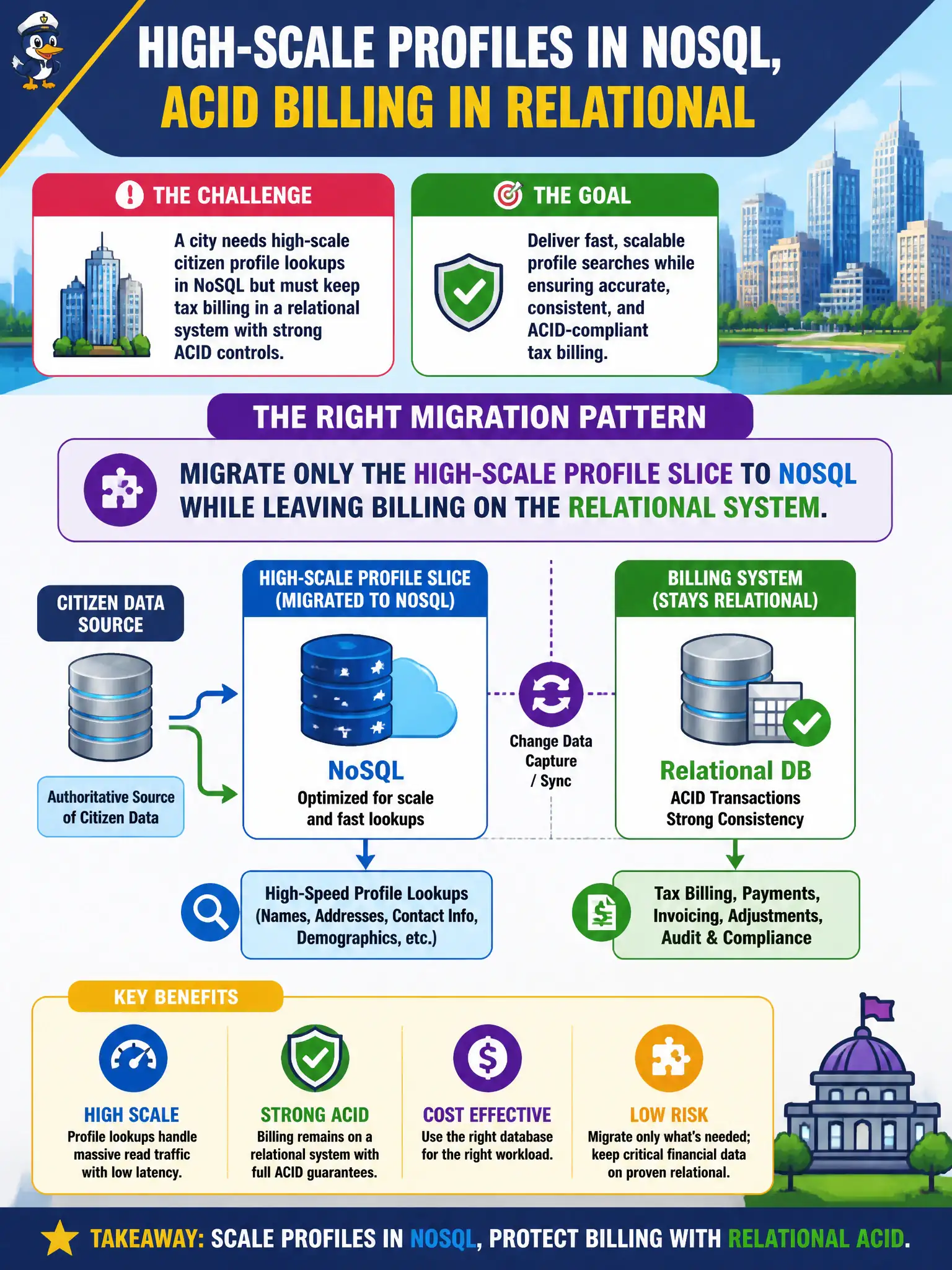
Short Explanation
You do not have to tip the whole city stack into NoSQL just because profiles got huge. Keep the tax ledger on the relational side for ACID, and park only the high-scale profile slice in NoSQL. All-or-nothing moves and CSV-only designs are the wrong swing of the hammer.
Full Explanation
High-scale citizen profile lookups can move to NoSQL while tax billing remains on a relational system with strong ACID controls—this selective migration keeps each workload on the store that matches its integrity and access needs. Migrate only the profile slice; leave billing where multi-row financial transactions are proven. Moving every municipal database into one graph store overnight, including billing ledgers, ignores ACID and reporting requirements and creates unnecessary cutover risk. Deleting the relational billing database once any NoSQL collection exists confuses pilot progress with completion of financial controls. Replacing both systems with a single nightly CSV export removes online serving entirely. Exam caveat: dual-running systems need clear ownership of citizen identity keys and reconciliation jobs so profile and billing views do not silently diverge. Operational check: prove profile reads hit NoSQL under load while a billing posting still commits atomically in the RDBMS, and document the integration contract between the two systems of record. In production terms for selective NoSQL migration beside ACID billing, assign an owning team, wire a dashboard that shows the pattern is healthy under peak civic load, and require a staging drill that rehearses failure and recovery before resident impact. Revisit the choice when traffic shape, retention, or integrity needs change, and keep a named rollback owner on the change record. Re-test both the happy path and the failure path for selective NoSQL migration beside ACID billing after material dependency upgrades so regressions are caught before the next public release.