
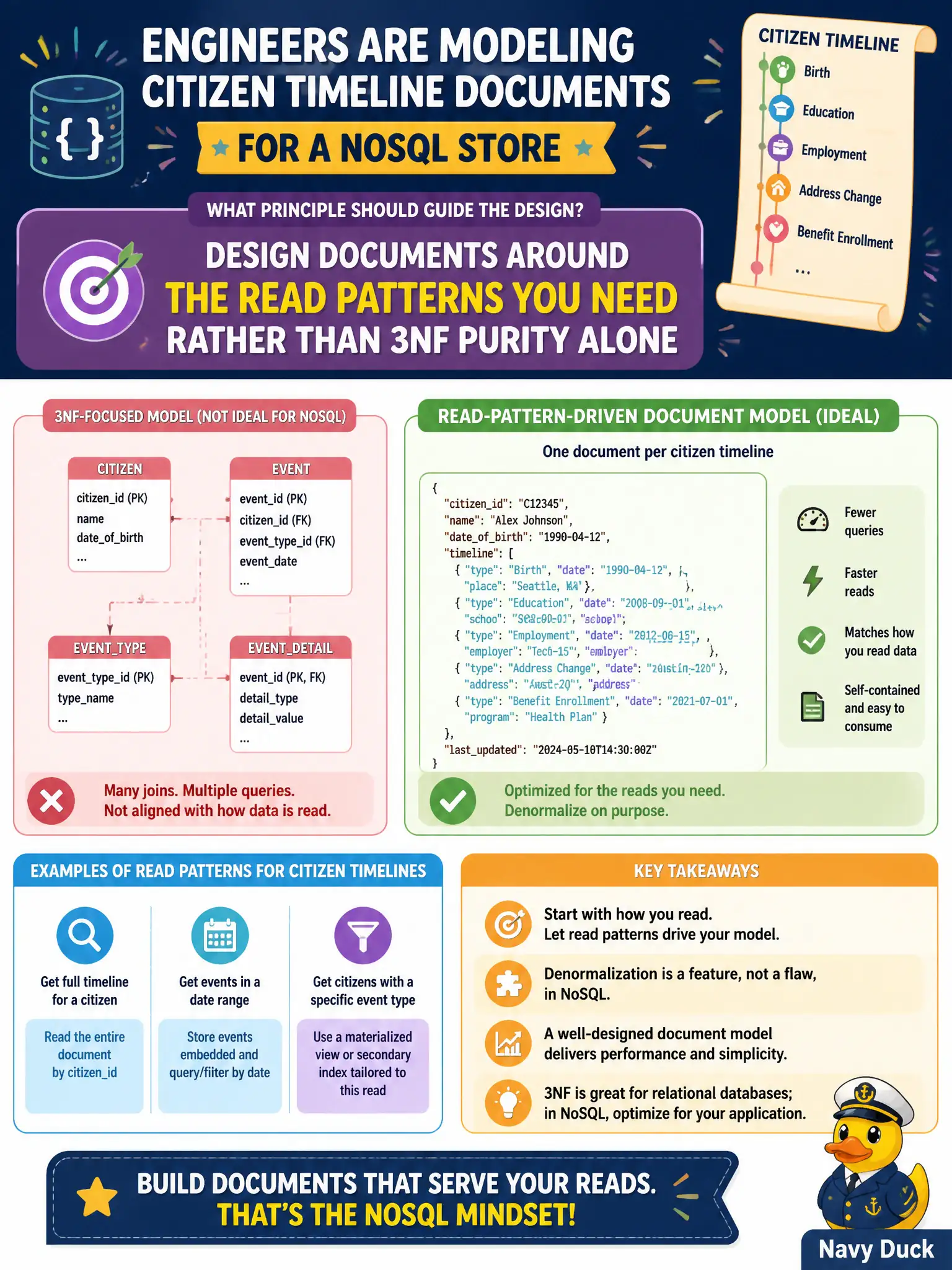
Engineers are modeling citizen timeline documents for a NoSQL store. Which modeling principle should guide the design?
Select an answer to reveal the explanation.
Short Explanation
NoSQL modeling asks how you'll read the data before chasing third-normal-form purity. If the portal always grabs a whole citizen timeline, nest it that way. Shape the document for the query, not for textbook purity.
Full Explanation
Citizen timeline documents should be designed around the read patterns you need rather than third normal form purity alone. The portal often needs to fetch a whole timeline together, so the document should be shaped so that primary read is efficient. NoSQL document design commonly denormalizes for those reads. Normalizing timelines into separate entities and joining for each read forces the store to reconstruct the timeline on every request, which fights the store's strengths and multiplies round trips. Duplicating nothing even when the portal always reads the full timeline together prioritizes write elegance over read latency citizens feel. Ignoring how the application queries and normalizing only for write purity produces elegant schemas that fail operational service-level agreements. Exam caveat: denormalization implies update discipline—define how shared attributes stay consistent when duplicated across documents. Operational check: sketch the top portal queries, design one document shape that satisfies the primary timeline read in a single get, load sample citizens, and measure read latency versus a normalized multi-get alternative. In production terms for read-pattern document modeling, assign an owning team, wire a dashboard that shows the pattern is healthy under peak civic load, and require a staging drill that rehearses failure and recovery before resident impact. Revisit the choice when traffic shape, retention, or integrity needs change, and keep a named rollback owner on the change record. Re-test both the happy path and the failure path for read-pattern document modeling after material dependency upgrades so regressions are caught before the next public release.