
Analysts still run SQL-like Hive queries over lake data that also feeds a NoSQL serving tier for the citizen portal. What role does Hive play in this syllabus-style framing?
Select an answer to reveal the explanation.
Short Explanation
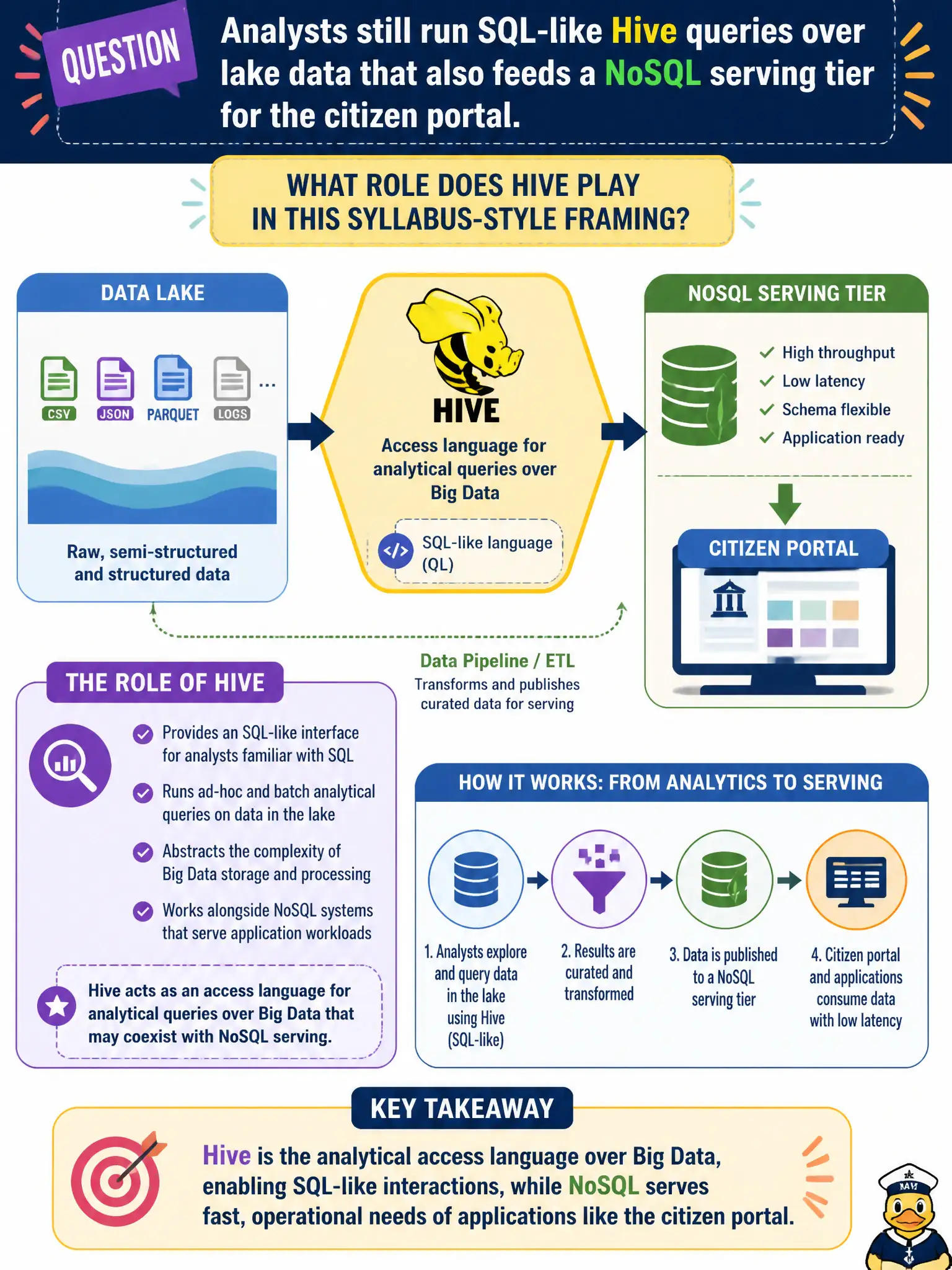
Hive is the SQL-ish flashlight for poking around big files in the Hadoop world. The portal can still serve from NoSQL while analysts query with Hive. Two lanes, same city data.
Full Explanation
In syllabus-style Big Data framing, Hive provides SQL-like analytical access over lake or Hadoop-scale data and can coexist with a NoSQL serving tier that answers citizen portal clicks. Hive is not the millisecond portal engine; it is the analytical language/layer over bulk data that may also be copied or projected into NoSQL for serving. Claiming Hive must replace the NoSQL tier and answer every portal click in milliseconds confuses batch/analytical latency with online serving. Calling Hive only a physical hard-disk brand is a distractor that ignores its role in the Hadoop ecosystem. Saying Hive forbids any data from also being served through NoSQL invents a false exclusivity—pipelines commonly feed both. Exam caveat: know the division of labor—Hive/Spark SQL for analytics, NoSQL for keyed serving—not which logo “wins.” Operational check: trace one municipal dataset from lake tables queried by Hive through the job that publishes a serving projection into the portal’s NoSQL store, and verify SLAs differ for each path. In production terms for Hive analytics beside NoSQL serving, assign an owning team, wire a dashboard that shows the pattern is healthy under peak civic load, and require a staging drill that rehearses failure and recovery before resident impact. Revisit the choice when traffic shape, retention, or integrity needs change, and keep a named rollback owner on the change record. Re-test both the happy path and the failure path for Hive analytics beside NoSQL serving after material dependency upgrades so regressions are caught before the next public release.