
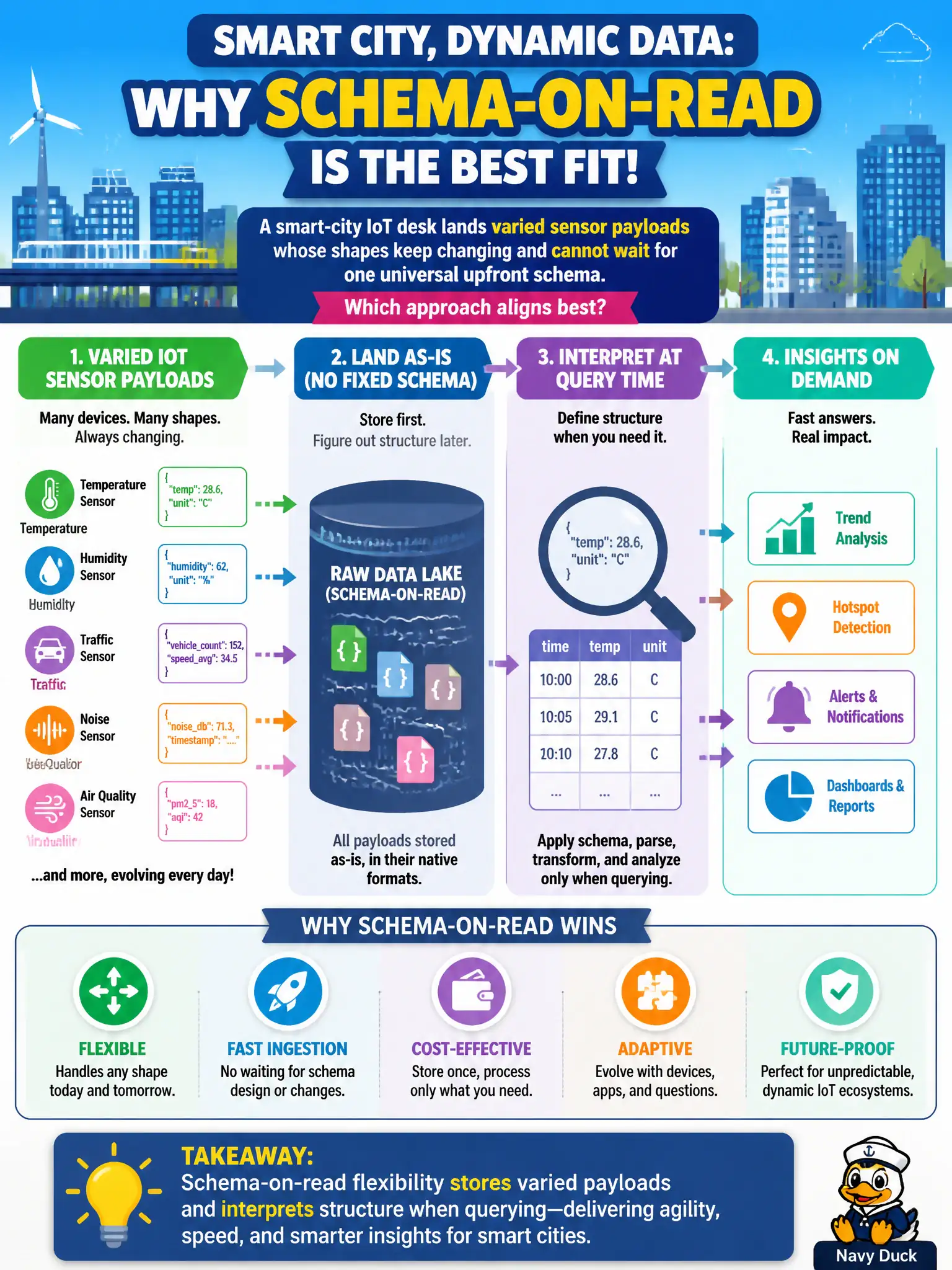
A smart-city IoT desk lands varied sensor payloads whose shapes keep changing and cannot wait for one universal upfront schema. Which approach aligns best?
Select an answer to reveal the explanation.
Short Explanation
Sensors are messy and change their outfits often. Schema-on-read means land the data first and figure out the shape when you query. Waiting for a perfect universal schema just piles unread packets at the door.
Full Explanation
Smart-city IoT payloads change shape as vendors and sensor firmware evolve, so schema-on-read flexibility—store varied payloads now, interpret structure when querying—aligns with landing data that cannot wait for one universal upfront schema. That pattern keeps the civic ingest path open while analytics refine interpretation. Schema-on-write that rejects any payload missing every column defined years ago blocks new sensors and recreates rigid ETL gates. Manual retyping into a printed ledger before storage does not scale to IoT rates and introduces human error. Deleting all IoT feeds until every vendor agrees on one permanent table design freezes innovation and leaves operations blind. Exam caveat: schema-on-read still needs contracts, version fields, and validation for safety-critical readings; flexibility is about timing of enforcement, not abandoning quality. Operational check: ingest two sensor firmware versions with different optional fields into the landing zone, run a query that projects a common core plus coalesced optionals, and confirm neither version was dropped at the gate. In production terms for schema-on-read for evolving IoT payloads, assign an owning team, wire a dashboard that shows the pattern is healthy under peak civic load, and require a staging drill that rehearses failure and recovery before resident impact. Revisit the choice when traffic shape, retention, or integrity needs change, and keep a named rollback owner on the change record. Re-test both the happy path and the failure path for schema-on-read for evolving IoT payloads after material dependency upgrades so regressions are caught before the next public release.