
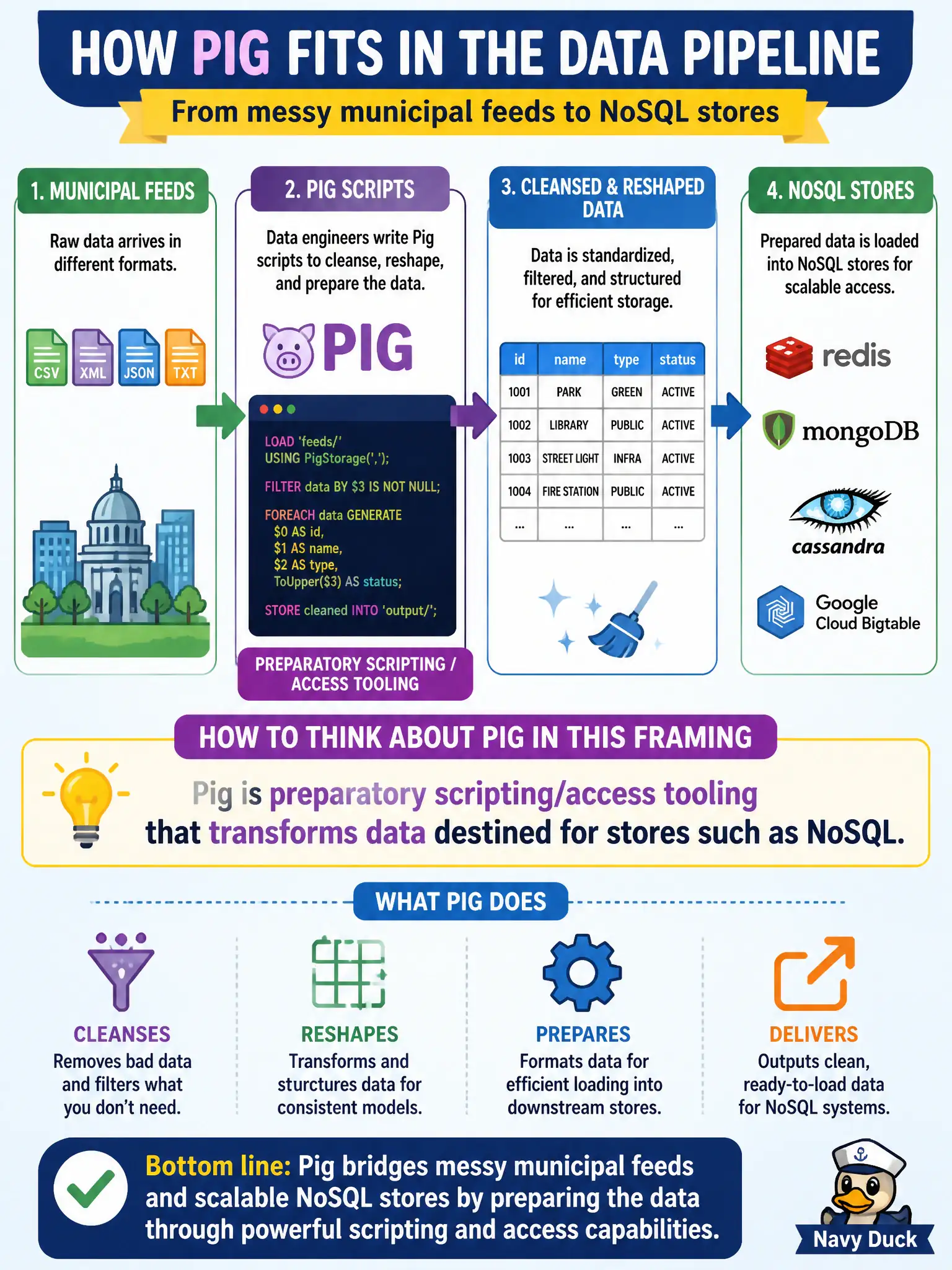
Data engineers use Pig scripts to cleanse and reshape municipal feeds before loading them into NoSQL stores. How is Pig best characterized in this framing?
Select an answer to reveal the explanation.
Short Explanation
Pig scripts are the prep cooks—clean, reshape, then plate the data for NoSQL. They are not the restaurant dining room citizens see. Get the feed tidy before it lands in the serving store.
Full Explanation
Pig, in BDPC-style ecosystem framing, is preparatory scripting/access tooling used to cleanse and reshape feeds before they land in stores such as NoSQL. It sits in the transform path, not in the citizen UI and not as a CAP control plane. Characterizing Pig as a citizen-facing mobile UI framework for 311 apps misplaces it entirely outside the data-processing stack. Calling Pig a CAP theorem formula that replaces consistency settings confuses a processing language with distributed-systems trade-offs. Describing Pig as a graph query language that only traverses fraud edges mixes it up with graph databases and query DSLs. Exam caveat: Hive and Pig are both Hadoop-era access/transform tools; questions often contrast SQL-like Hive with scripting-oriented Pig without demanding code fluency. Operational check: review a municipal ingest runbook and identify where Pig (or equivalent ETL scripting) reshapes raw feeds prior to NoSQL load, then confirm the serving store is not being asked to perform that heavy cleansing on read. In production terms for Pig-style prep before NoSQL load, assign an owning team, wire a dashboard that shows the pattern is healthy under peak civic load, and require a staging drill that rehearses failure and recovery before resident impact. Revisit the choice when traffic shape, retention, or integrity needs change, and keep a named rollback owner on the change record. Re-test both the happy path and the failure path for Pig-style prep before NoSQL load after material dependency upgrades so regressions are caught before the next public release.