
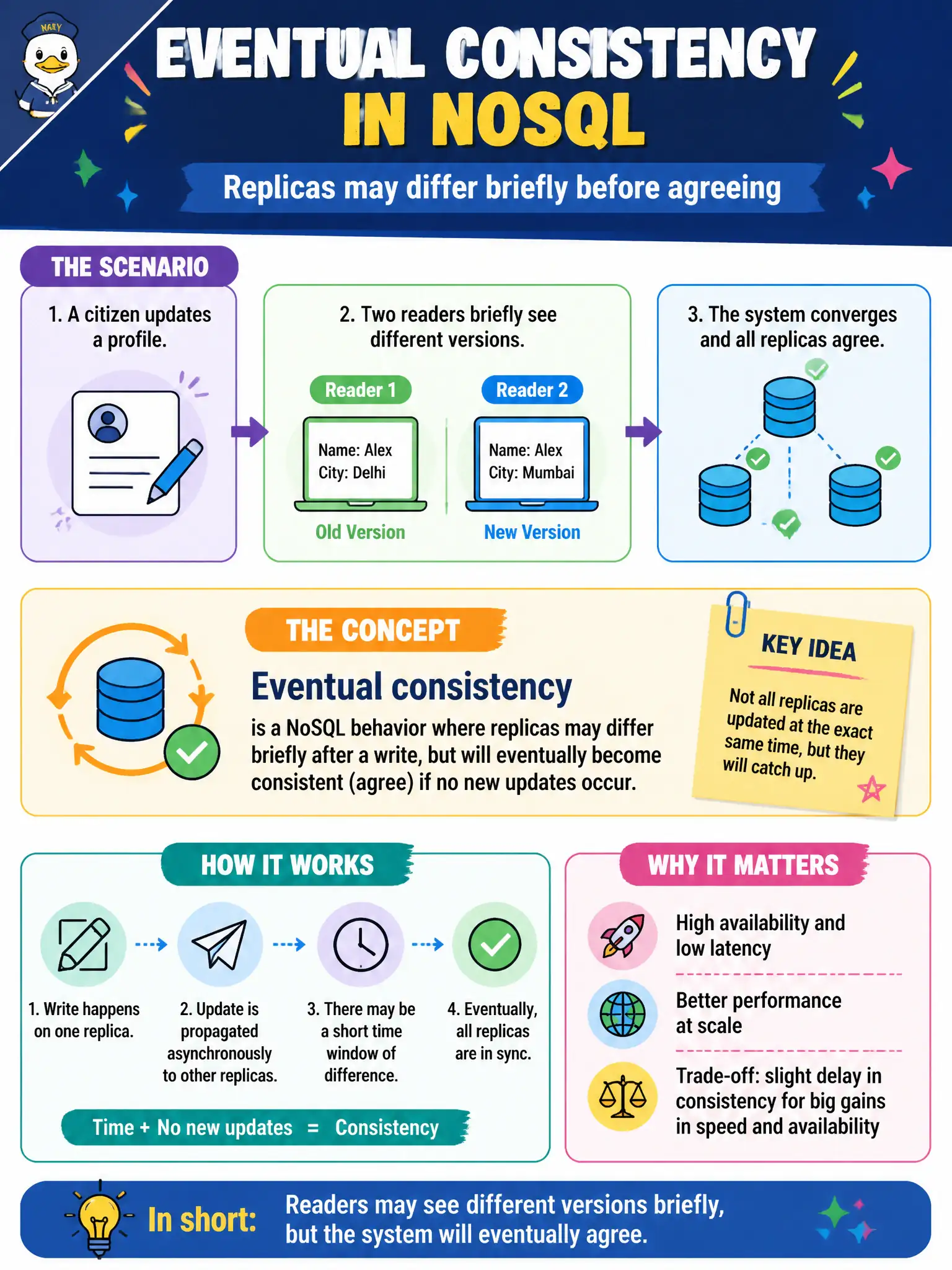
After a citizen updates a profile, two readers briefly see different versions before the system converges. What NoSQL behavior does this illustrate?
Select an answer to reveal the explanation.
Short Explanation
Sometimes one phone shows the new address a beat before another does—that is eventual consistency. Replicas catch up; they just are not identical every millisecond. Totally normal in many NoSQL setups.
Full Explanation
When two readers briefly see different profile versions after an update before replicas agree, the behavior illustrated is eventual consistency: temporary divergence is allowed, then the system converges. Many civic NoSQL deployments accept that window for scalable multi-replica writes. Immediate global locking that forbids any temporary divergence describes a strong consistency / pessimistic approach, not the observed brief disagreement. Guaranteed identical reads on every replica at every instant is the strong-consistency ideal, which contradicts the scenario’s temporary mismatch. Automatic conversion of profiles into immutable paper forms is unrelated to distributed replica semantics. Exam caveat: eventual consistency is not “no consistency”—it is a timed or reconciliation-based path to agreement; workloads like ballot display may still require stronger reads. Operational check: update a profile on one replica in a multi-region lab, issue concurrent reads against another region, measure the convergence window, and decide whether the portal must request a stronger consistency level for sensitive fields. In production terms for eventual consistency on profile replicas, assign an owning team, wire a dashboard that shows the pattern is healthy under peak civic load, and require a staging drill that rehearses failure and recovery before resident impact. Revisit the choice when traffic shape, retention, or integrity needs change, and keep a named rollback owner on the change record. Re-test both the happy path and the failure path for eventual consistency on profile replicas after material dependency upgrades so regressions are caught before the next public release.