
Which description best matches Apache Cassandra as commonly presented in Big Data NoSQL syllabi?
Select an answer to reveal the explanation.
Short Explanation
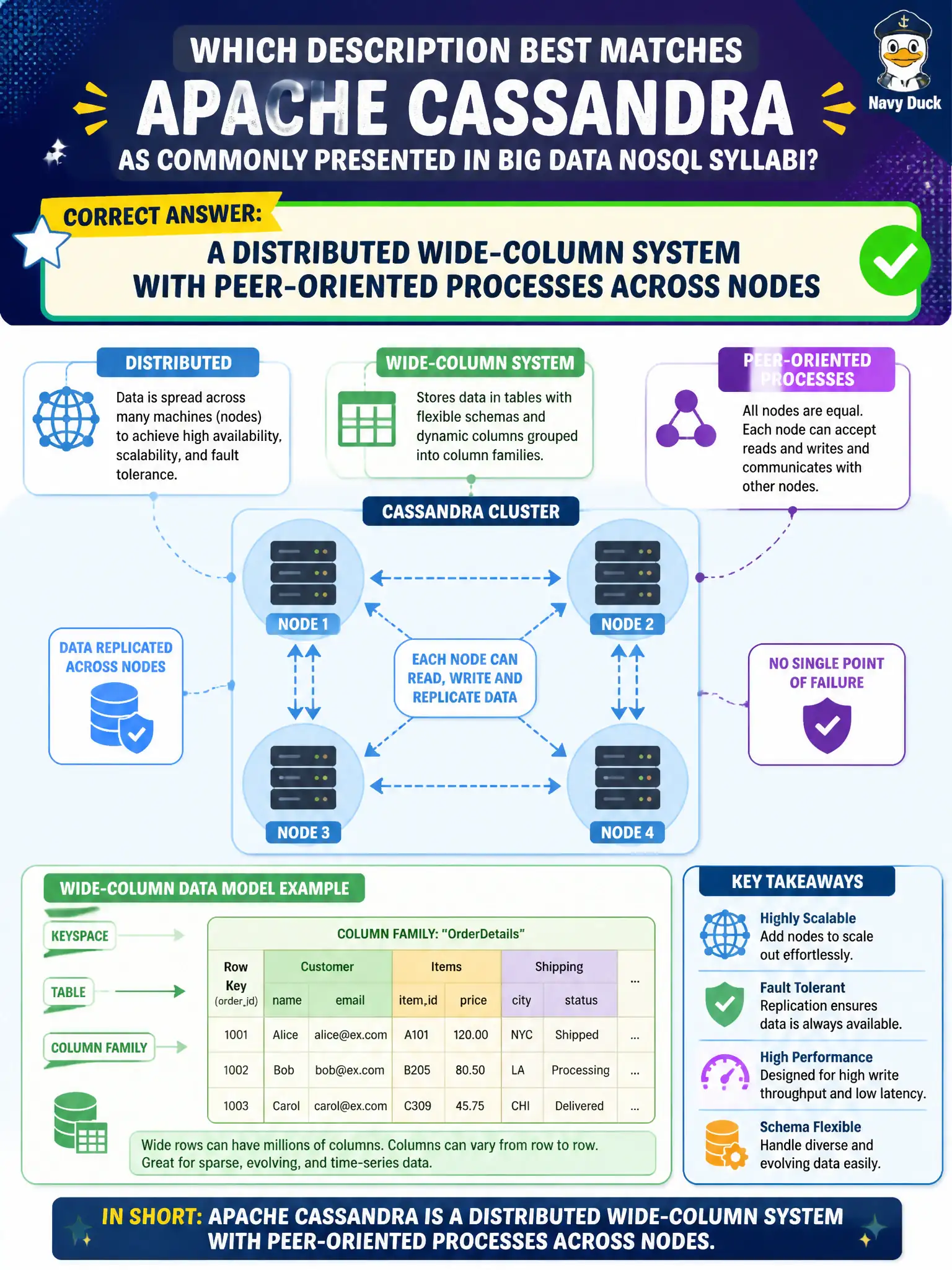
Cassandra is the peer-to-peer wide-column workhorse you hear about in Big Data class. Nodes share the load instead of one lonely master doing everything. Think distributed columns, not a desktop spreadsheet.
Full Explanation
In Big Data NoSQL syllabi, Apache Cassandra is commonly presented as a distributed wide-column system with peer-oriented processes across nodes—no single centralized master owning all writes in the classic sense of the teaching model. That distributed, scale-out framing is what municipal architects should recognize on exam items. Describing it as a single-node desktop spreadsheet with mandatory foreign keys misstates both the data model and the deployment topology. Calling it a centralized master-only RDBMS that cannot span servers confuses it with traditional relational primaries. Treating it as a batch-only tape archive with no online query path ignores its role as an online distributed datastore. Exam caveat: product details evolve, but CertiProf-style BDPC questions emphasize the distributed wide-column and peer/clustered nature versus RDBMS stereotypes. Operational check: in lab notes, identify Cassandra’s partitioning and replication settings for a multi-node cluster and contrast them with a single-primary relational deployment used for the city’s ledger. In production terms for distributed Cassandra-style wide-column clusters, assign an owning team, wire a dashboard that shows the pattern is healthy under peak civic load, and require a staging drill that rehearses failure and recovery before resident impact. Revisit the choice when traffic shape, retention, or integrity needs change, and keep a named rollback owner on the change record. Re-test both the happy path and the failure path for distributed Cassandra-style wide-column clusters after material dependency upgrades so regressions are caught before the next public release.