
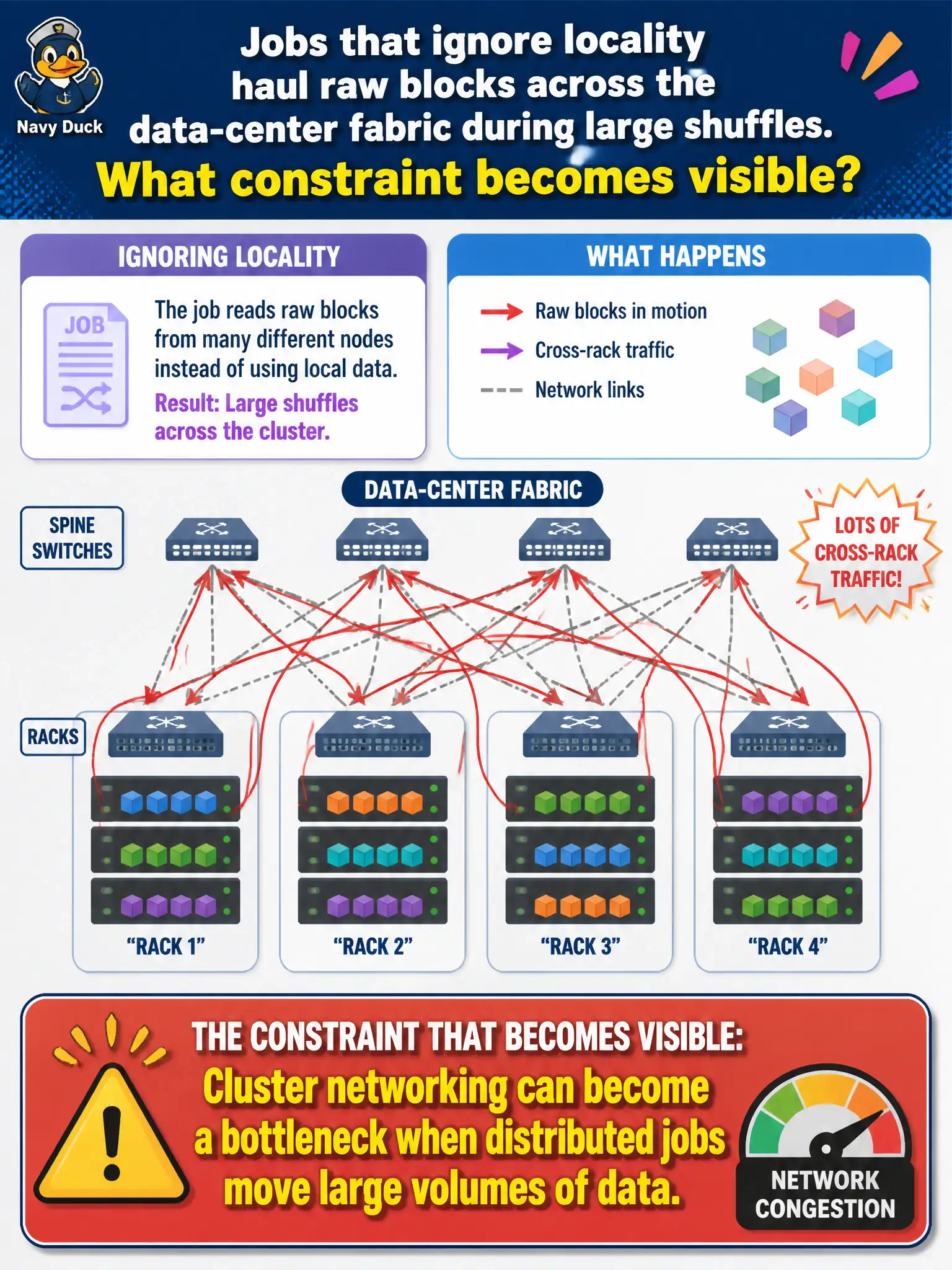
Jobs that ignore locality haul raw blocks across the data-center fabric during large shuffles. What constraint becomes visible?
Select an answer to reveal the explanation.
Short Explanation
If every truck takes the same two-lane bridge, the bridge is the bottleneck—not the warehouses. Ignoring locality floods switches with shuffle traffic, so the network shows up as a real cluster limit. Pretending Ethernet never matters in Hadoop is fiction.
Full Explanation
When jobs ignore locality and haul raw blocks across the data-center fabric during large shuffles, cluster networking can become a visible bottleneck for distributed municipal workloads moving large volumes of analytical data. Network capacity is not irrelevant on the false claim that HDFS never uses Ethernet links—clusters depend on the network heavily for reads and shuffle. Citizen Wi-Fi SSIDs are not the limiting factor for cluster shuffle performance inside the municipal data center. CPU cores do not permanently disappear when any packet crosses a switch; that claim is nonsensical engineering. Exam caveat: network is a first-class constraint alongside CPU, memory, and disk in Big Data architectures. Operational check: monitor shuffle bytes and fabric utilization during large jobs, improve locality or map-output compression, and size switches for analytical east-west traffic—not only citizen edge Wi-Fi. In municipal platform operations, record the rationale in the architecture decision record so future on-call staff know which pattern was chosen and which failure modes the rejected options would create for city services. Re-validate after the next maintenance window that monitoring, access paths, and recovery steps still match the documented design for agencies that depend on this platform.