
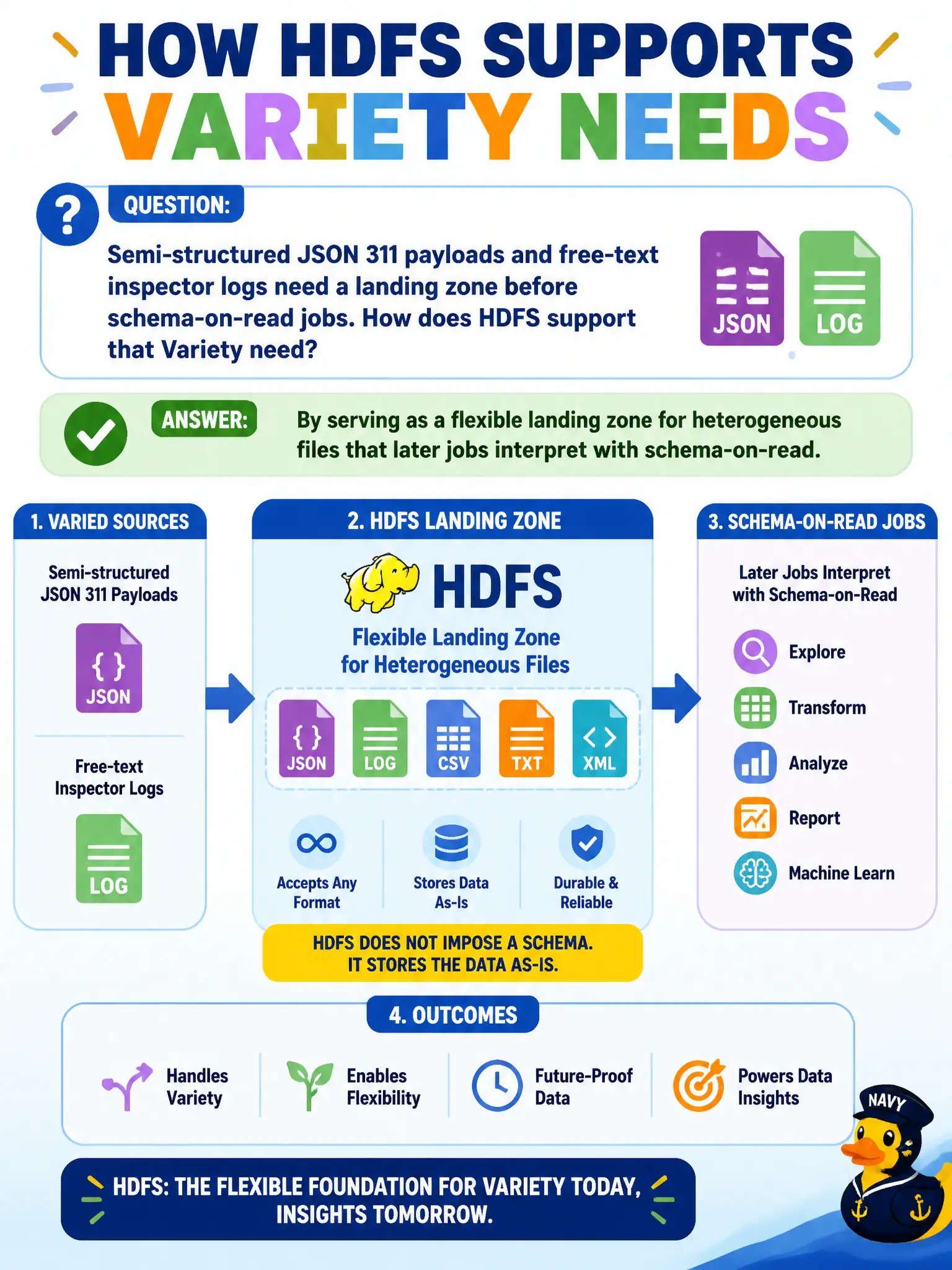
Semi-structured JSON 311 payloads and free-text inspector logs need a landing zone before schema-on-read jobs. How does HDFS support that Variety need?
Select an answer to reveal the explanation.
Short Explanation
A loading dock can take crates of many shapes before anyone unpacks them. HDFS plays that dock for Variety: JSON and text logs can land first; schema-on-read jobs sort meaning later. Demanding one OLTP schema at the curb blocks the Variety story.
Full Explanation
HDFS supports Variety by serving as a flexible landing zone for heterogeneous files—semi-structured JSON 311 payloads and free-text inspector logs—that later jobs interpret with schema-on-read, which fits messy municipal source diversity before curation. Requiring every file to match one rigid OLTP schema before any byte may land blocks realistic Variety and delays analytics for inspectors and 311. Accepting only JPEG images and rejecting JSON or text outright contradicts a general-purpose analytical landing zone. Converting Variety into a single mandatory relational key at the city firewall is neither feasible nor an accurate HDFS capability statement. Exam caveat: schema-on-read landing on HDFS is how Variety is often handled before curated models and marts. Operational check: land raw JSON and text in governed raw zones, catalog them, apply schema-on-read in Hive or Spark jobs, and promote curated tables only after validation for open-data and operations use. In municipal platform operations, record the rationale in the architecture decision record so future on-call staff know which pattern was chosen and which failure modes the rejected options would create for city services. Re-validate after the next maintenance window that monitoring, access paths, and recovery steps still match the documented design for agencies that depend on this platform.