
Planning, transit, and public-health teams all want CPU and memory on the same city Hadoop cluster. What is YARN’s primary role?
Select an answer to reveal the explanation.
Short Explanation
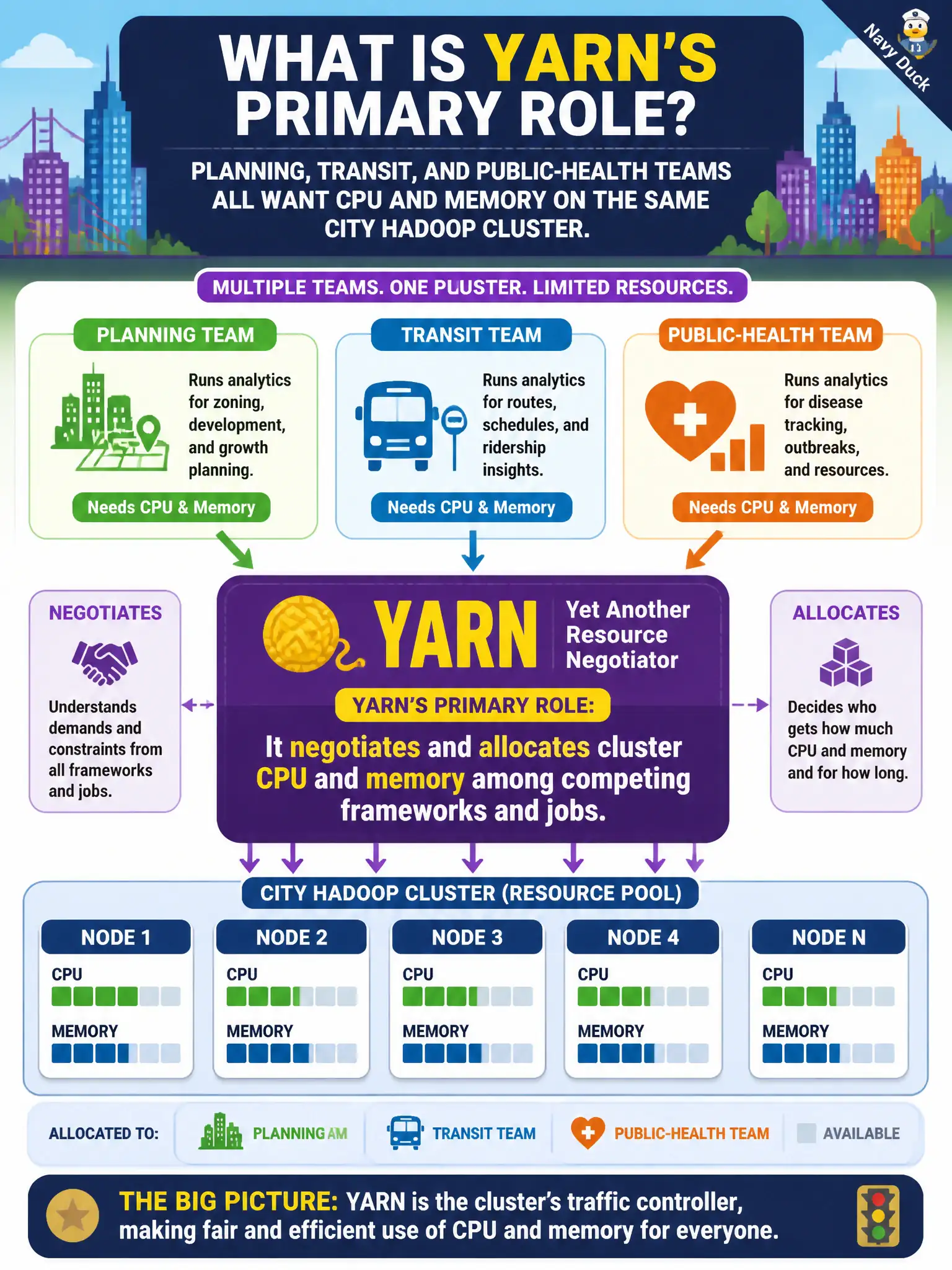
Picture a fair front desk handing out meeting rooms when three departments show up at once. YARN is that desk for the cluster: it negotiates CPU and memory so MapReduce, Spark, and friends can share one yard. It is not a file system replacement or a citizen app store.
Full Explanation
When planning, transit, and public-health teams compete for the same city Hadoop cluster, YARN’s primary role is to negotiate and allocate cluster CPU and memory among competing frameworks and jobs so multi-tenant civic workloads can share hardware fairly. YARN does not replace HDFS so that all municipal files live only in application memory—durable storage remains a separate concern. Encrypting every CSV cell before analysts open spreadsheets locally is a data-protection control, not YARN’s resource-management mission. Publishing open-data portals and citizen mobile apps without a cluster is an application-delivery concern outside YARN’s allocator role. Exam caveat: YARN is the cluster resource negotiator; it is not HDFS, not encryption tooling, and not the open-data CMS. Operational check: define queues for planning, transit, and public health, submit concurrent jobs, and verify YARN enforces capacity or fair-share limits under contention. In municipal platform operations, record the rationale in the architecture decision record so future on-call staff know which pattern was chosen and which failure modes the rejected options would create for city services. Re-validate after the next maintenance window that monitoring, access paths, and recovery steps still match the documented design for agencies that depend on this platform.