
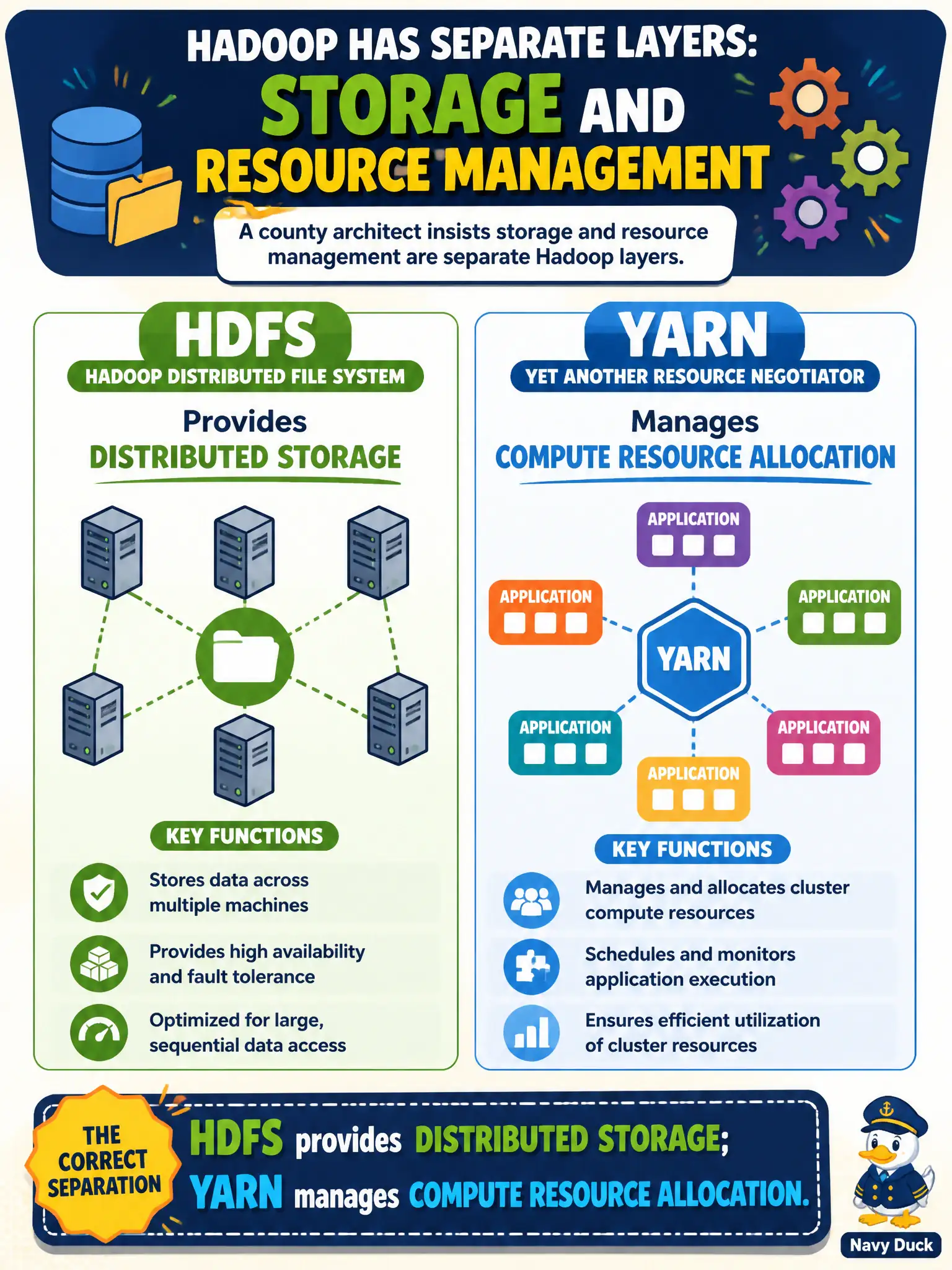
A county architect insists storage and resource management are separate Hadoop layers. Which statement correctly separates HDFS from YARN?
Select an answer to reveal the explanation.
Short Explanation
Storage shelves and a room-booking calendar are different tools. HDFS is the shelves for distributed files; YARN is the calendar that hands out CPU and memory. Collapsing them into one blurry service muddies county architecture reviews.
Full Explanation
Separating Hadoop layers correctly means HDFS provides distributed storage while YARN manages compute resource allocation—storage and resource management remain distinct concerns for county architects designing shared platforms. YARN does not store durable file blocks while HDFS only schedules MapReduce CPU slots; those responsibilities are reversed in that incorrect claim. HDFS and YARN are not identical services that must run as a single merged daemon process. HDFS does not replace YARN whenever the cluster runs more than one Spark job; multiple frameworks still rely on YARN for resources while reading HDFS data. Exam caveat: keep storage (HDFS) and resource management (YARN) mentally separate even when both ship in one distribution. Operational check: document which SLAs and failure domains belong to HDFS versus YARN in the county runbook, and assign separate on-call checks for under-replicated blocks versus pending containers. In municipal platform operations, record the rationale in the architecture decision record so future on-call staff know which pattern was chosen and which failure modes the rejected options would create for city services. Re-validate after the next maintenance window that monitoring, access paths, and recovery steps still match the documented design for agencies that depend on this platform.