
Data scientists want to try new Spark job ideas without risking the production civic lake. Which cloud practice best fits that need?
Select an answer to reveal the explanation.
Short Explanation
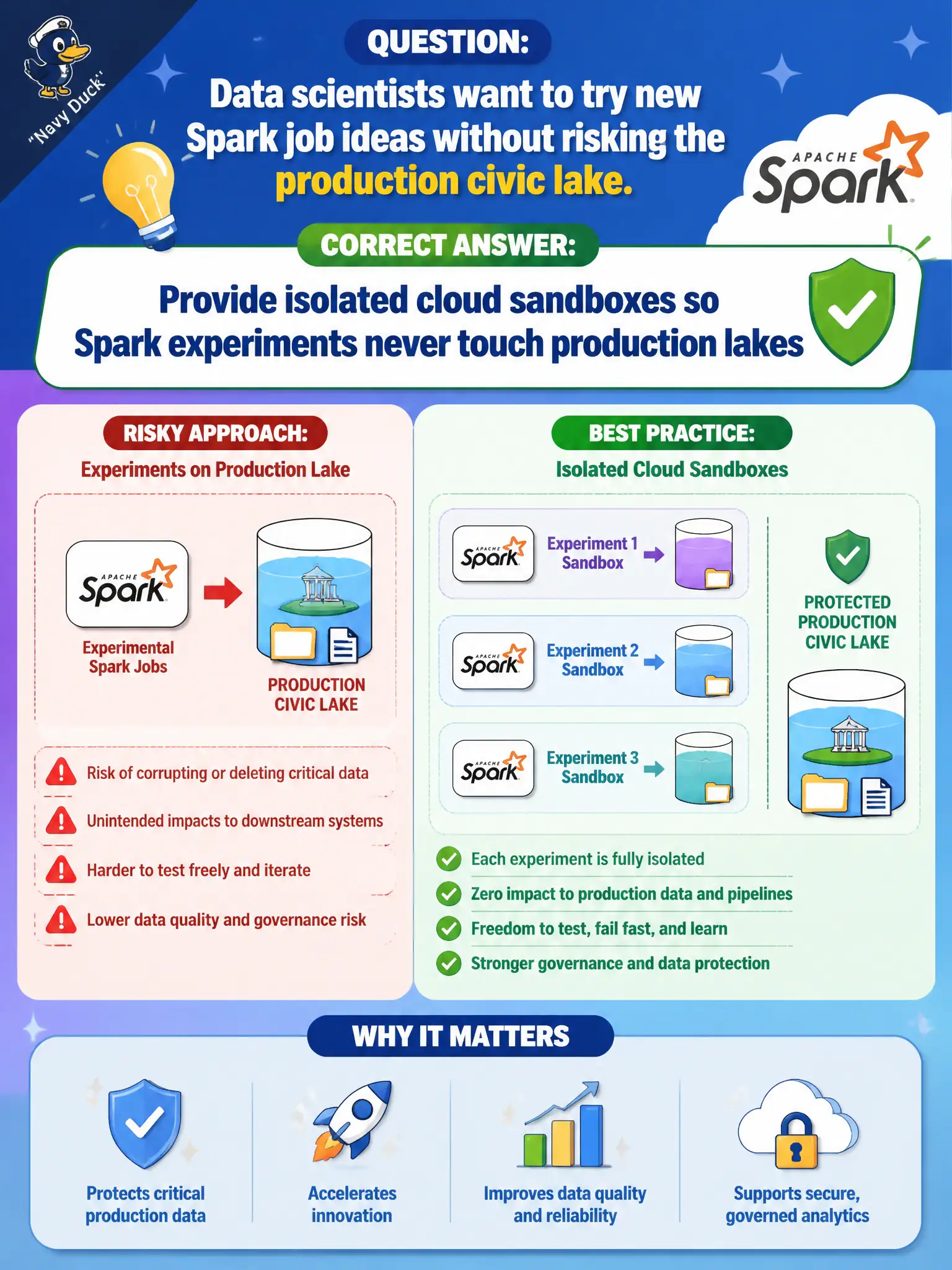
Practice fields exist so the real stadium turf stays intact. Cloud sandboxes give Spark playpens that never write the production lake. Prod write access and laptop PII copies are the opposite of safe experimentation.
Full Explanation
Isolated cloud sandboxes let data scientists try new Spark job ideas without risking the production civic lake. Separation of experiment and production paths is a basic cloud governance practice for municipalities that must protect resident data and operational jobs. Sandboxes should use masked or synthetic data wherever possible and expire when trials end so they do not become shadow lakes.
Granting unrestricted write access to production lake paths for faster experiments invites accidental overwrite and compliance failures under deadline pressure. Disabling all non-production accounts so experiments run only at midnight in production collapses environments and multiplies risk to citizens’ data. Copying production citizen PII onto personal laptops for offline trials creates unmanaged sprawl and breach exposure outside cloud controls.
Exam caveat: sandboxes still need IAM, egress controls, and cost limits—isolation from production is necessary but not sufficient if personal exports remain possible. Operational check: attempt a Spark write from the sandbox role into a production lake path and confirm it is denied; run the same job successfully against sandbox storage with non-production data.