
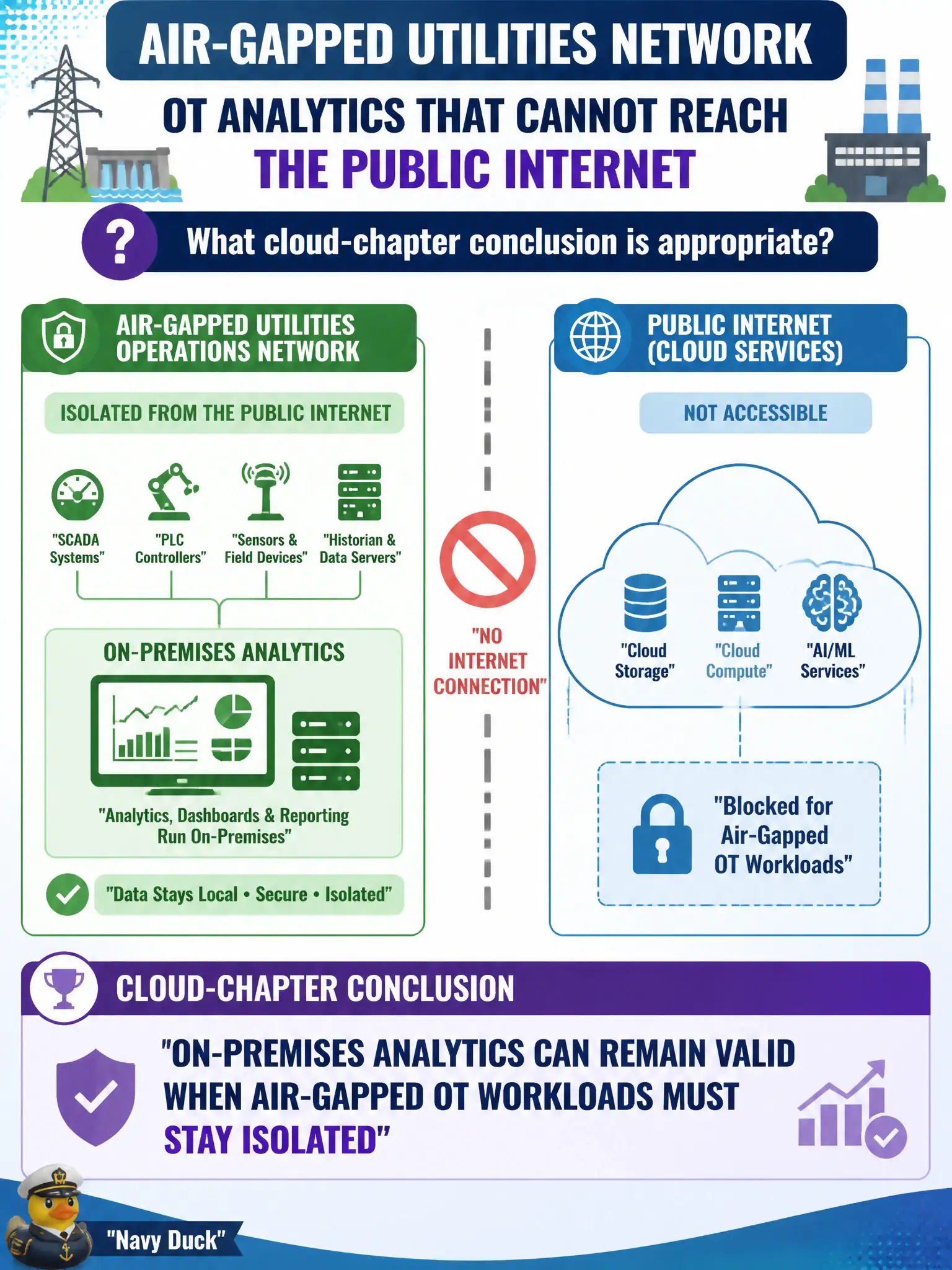
An air-gapped utilities operations network needs OT analytics that cannot reach the public internet. What cloud-chapter conclusion is appropriate?
Select an answer to reveal the explanation.
Short Explanation
Some control rooms stay behind locked doors on purpose. Air-gapped utility OT analytics can stay on-prem when isolation rules say so. Cloud is powerful, not a mandatory stamp for every workload.
Full Explanation
On-premises analytics remain valid when air-gapped OT workloads on a utilities operations network cannot reach the public internet. Cloud chapters do not require every civic workload to leave isolation boundaries that safety and security policy mandate for operational technology. BDPC expects candidates to recognize isolation-driven placement exceptions without treating them as “legacy failure.”
Requiring every Big Data workload to move to public cloud to count as modern ignores OT air-gap realities and can create unsafe connectivity pressure. Mirroring air-gapped OT data live to a public SaaS for convenience can violate isolation and safety policy in a single misconfigured path. Treating public cloud as the only acceptable home for utility sensor analytics overstates cloud dogma and understates operational technology constraints.
Exam caveat: on-prem OT analytics still need patching, access control, and carefully designed one-way transfer patterns if any data later lands in enterprise lakes—air-gap is not an excuse for weak local security. Operational check: verify the OT analytics enclave has no unapproved path to the public internet, document any diode or manual export process, and ensure enterprise cloud lakes never require direct OT connectivity.