
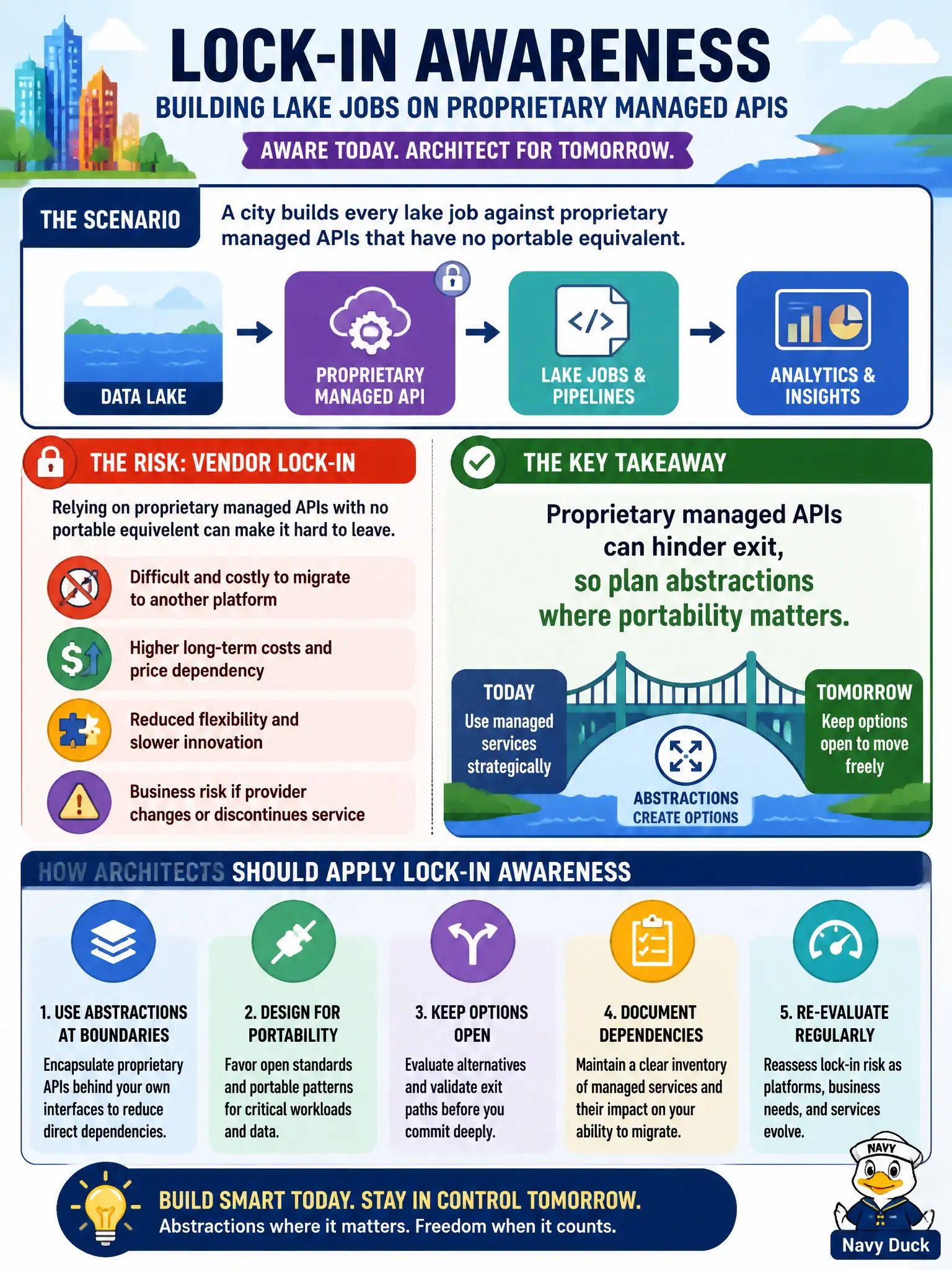
A city builds every lake job against proprietary managed APIs that have no portable equivalent. What lock-in awareness should architects apply?
Select an answer to reveal the explanation.
Short Explanation
Custom-shaped keys only open one landlord’s doors. Heavy use of proprietary managed APIs can make leaving a cloud painful later. Where portability matters, put abstractions and open formats between the city and the vendor-specific bits.
Full Explanation
Heavy dependence on proprietary managed APIs with no portable equivalent can hinder exit from a cloud provider, so architects should plan abstractions and open formats where portability matters for the municipal lake. Lock-in awareness is part of cloud Big Data judgment, not hostility to managed services that accelerate delivery. Cities should know which seams they can afford to weld shut versus keep portable.
Proprietary APIs do affect exit options for municipal analytics when every job is written against non-portable interfaces. Lock-in is not limited to office productivity suites; Big Data platforms and managed streaming APIs create real migration cost later. Exit planning remains necessary even when the first invoice looks inexpensive, because switching costs appear after systems are deeply embedded.
Exam caveat: not every API must be abstracted—commodity open formats for data at rest often matter more than wrapping every control-plane call—but critical pipelines deserve an intentional portability decision. Operational check: inventory top jobs for provider-specific APIs, classify each as acceptable lock-in or needing an abstraction/open-format boundary, and document a rough exit effort for the hard-welded set.