
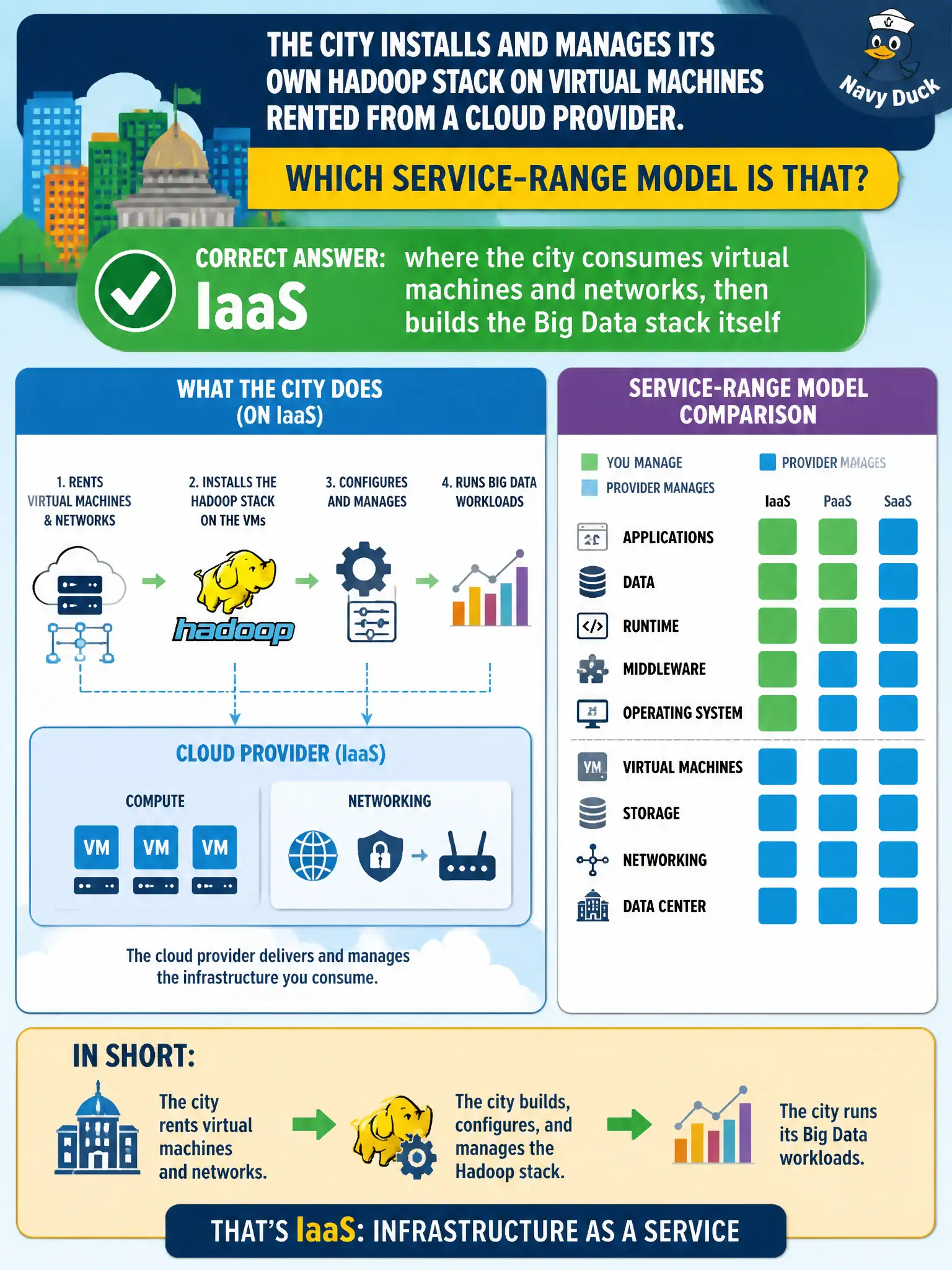
The city installs and manages its own Hadoop stack on virtual machines rented from a cloud provider. Which service-range model is that?
Select an answer to reveal the explanation.
Short Explanation
IaaS is renting the empty apartment—VMs and network—then moving in your own Hadoop furniture. You own the stack install; the provider owns the iron abstraction. DIY Big Data on cloud VMs is classic IaaS.
Full Explanation
Infrastructure as a Service supplies virtual machines and networks while the city installs and manages its own Hadoop stack on that rented capacity. The provider abstracts iron; the customer owns the Big Data middleware and day-to-day operations above the VM line. Recognizing IaaS among Chapter 9 service-range models is required BDPC cloud awareness for municipal architects choosing how much stack to operate.
SaaS delivers finished applications the city mostly configures, which does not match installing and operating Hadoop yourself on rented VMs. PaaS further abstracts frameworks so teams mainly deploy jobs against managed APIs, rather than building the full cluster stack on infrastructure VMs. A model with no virtual machines where the provider owns every application layer by default describes a higher service range than IaaS and mislabels the city’s DIY stack work.
Exam caveat: running Hadoop on IaaS still means the city patches brokers, tunes clusters, and owns availability above the hypervisor—cloud location does not by itself equal managed Big Data. Operational check: inventory which layers the city patches on the rented VMs (OS, Hadoop, Spark) versus which layers the provider owns, and label that boundary explicitly as IaaS in architecture and support documents.