
Sensitive resident datasets must stay on-premises, but the city wants to burst heavy model training into public cloud capacity. Which model describes that design?
Select an answer to reveal the explanation.
Short Explanation
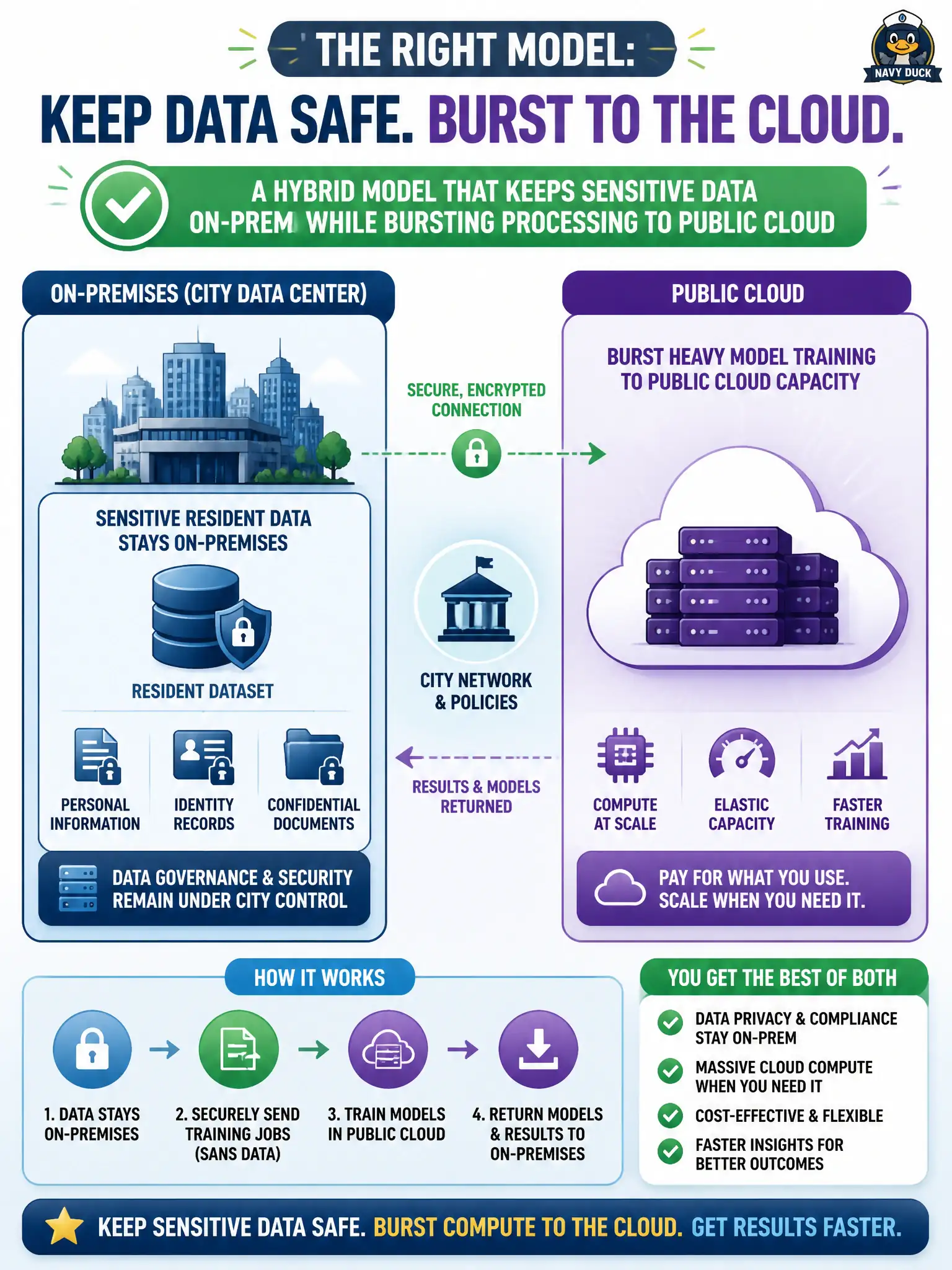
Hybrid is the split house: crown jewels stay on-prem, heavy lifting can burst to public cloud. Sensitive resident data need not block all elastic compute. Two sides, one coordinated plan.
Full Explanation
Hybrid cloud keeps sensitive resident datasets on-premises or in private capacity while bursting heavy model training into public cloud compute. That split lets municipalities honor data-placement rules without abandoning elastic training capacity when grant timelines tighten. Chapter 9 presents hybrid as the coordinated model for sensitivity-aware placement across civic estates.
Public-only cloud with all sensitive data replicated worldwide by default violates the residency and sensitivity constraint in the scenario. Abandoning cloud entirely whenever any dataset is sensitive forgoes burst capacity that hybrid is designed to provide for heavy training. Storing every dataset only on removable media with no compute tier is not a hybrid analytics architecture and fails both local control and elastic processing goals.
Exam caveat: hybrid designs need clear data-flow rules—what may leave on-prem, how it is anonymized or tokenized, and how training outputs return—otherwise burst paths become accidental exfiltration paths. Operational check: run a burst training job that pulls only approved non-sensitive or transformed features into public cloud capacity, confirm raw sensitive resident records remain on-prem, and audit the transfer path end to end.