
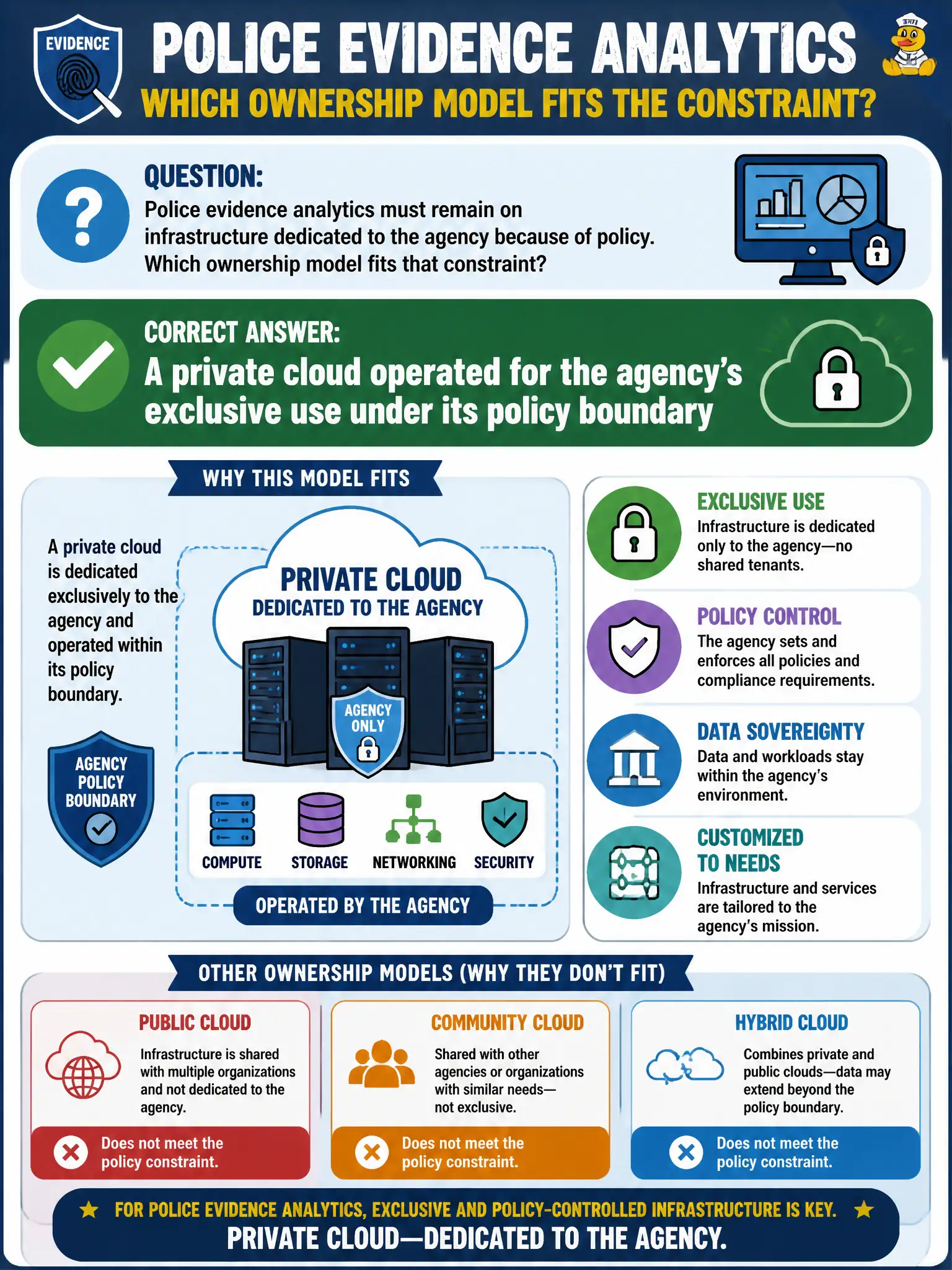
Police evidence analytics must remain on infrastructure dedicated to the agency because of policy. Which ownership model fits that constraint?
Select an answer to reveal the explanation.
Short Explanation
Evidence analytics often need a private cloud—capacity dedicated to the agency’s fence line. Same virtualization ideas, tighter ownership and policy. Not every workload belongs on the open public mall.
Full Explanation
A private cloud operated for the agency’s exclusive use fits police evidence analytics that must remain on infrastructure dedicated to the agency’s policy boundary. Virtualization and self-service may still apply, but ownership and control stay inside a tighter fence than a multi-tenant public mall. Chapter 9 contrasts private with public and hybrid placements for sensitive civic workloads that carry custody and chain-of-evidence expectations.
An unauthenticated public sandbox shared with any internet tenant fails confidentiality and custody expectations for evidence analytics. Consumer social-media hosting with no municipal controls is not an agency ownership model and cannot satisfy policy auditors. Anonymous volunteer laptops scattered across the county cannot provide accountable, dedicated infrastructure for evidence processing or reliable audit trails.
Exam caveat: private cloud still requires patching, capacity planning, and insider-threat controls; “private” is not automatically “secure enough” without operational discipline and access reviews. Operational check: confirm evidence analytics compute and storage identities cannot be reached by unrelated agency tenants, and validate that access reviews and custody logs match the private policy boundary claimed.