
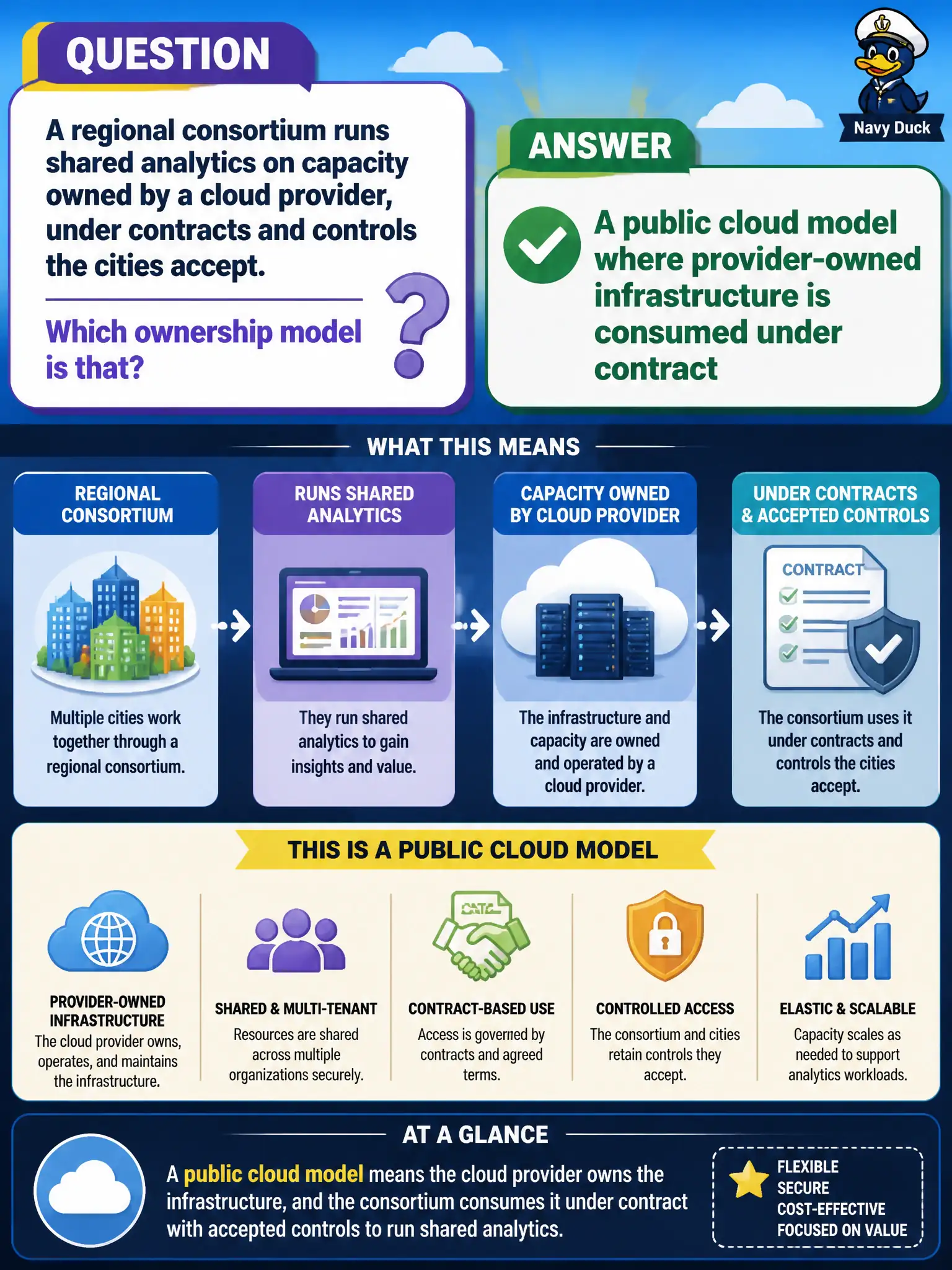
A regional consortium runs shared analytics on capacity owned by a cloud provider, under contracts and controls the cities accept. Which ownership model is that?
Select an answer to reveal the explanation.
Short Explanation
Public cloud means you rent the provider’s shared mall of capacity under contract—not your own sealed basement. Consortiums often do this for regional analytics with policy controls layered on. Ownership sits with the provider; governance sits with the cities.
Full Explanation
A public cloud model means a provider owns the underlying infrastructure and the regional consortium consumes shared analytics capacity over the network under contracts and controls the cities accept. Ownership sits with the provider; governance, classification, and acceptable-use duties still sit with the municipalities. Chapter 9 expects recognition of public cloud as one ownership option for Big Data platforms serving civic consortia.
An air-gapped private cloud that never uses provider-owned infrastructure is a different ownership model with a tighter fence line. A personal laptop pool with no shared provider account is ad-hoc computing, not public cloud tenancy. A purely on-premises tape archive with no network analytics services fails both the cloud and the analytics consumption aspects of the scenario.
Exam caveat: “public cloud” does not imply publicly readable data; contractual controls, IAM, encryption, and residency clauses still apply to civic tenants on shared provider infrastructure. Operational check: review the consortium contract and IAM boundary to confirm provider-owned infrastructure is consumed under city-accepted controls, and verify citizen datasets are not exposed merely because the ownership model is public cloud.