
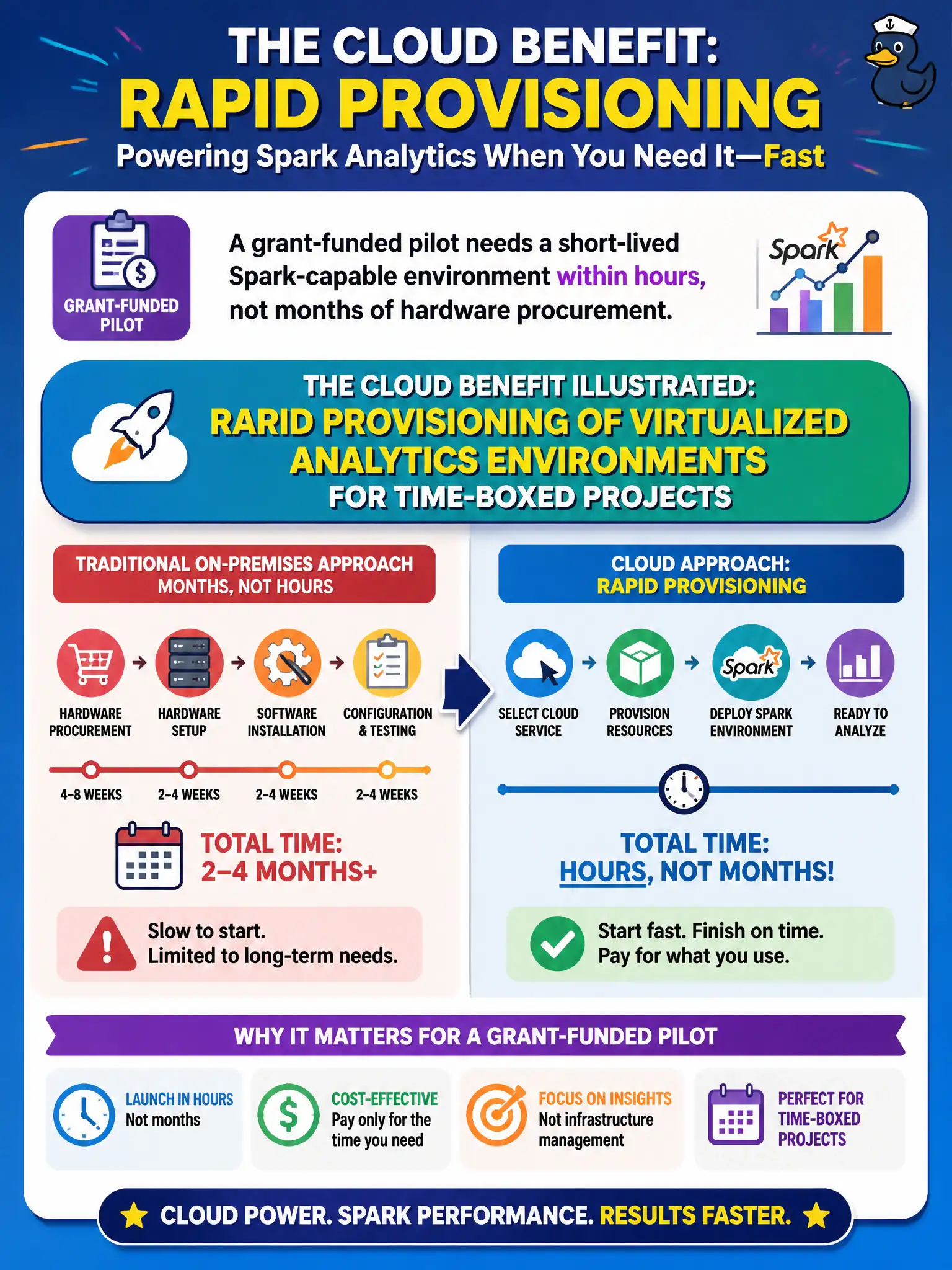
A grant-funded pilot needs a short-lived Spark-capable environment within hours, not months of hardware procurement. Which cloud benefit is illustrated?
Select an answer to reveal the explanation.
Short Explanation
Grants do not wait for cement trucks. Cloud speed means standing up a Spark-capable sandbox in hours for a pilot, then tearing it down. Fast start is the benefit.
Full Explanation
Rapid provisioning of virtualized analytics environments lets a grant-funded pilot stand up Spark-capable capacity within hours instead of waiting months for hardware procurement. Time-boxed civic projects depend on that speed: create, experiment, document results, and tear down. Chapter 9 lists rapid provisioning alongside elasticity and cost flexibility as core cloud benefits for municipal innovation.
Mandatory multi-year hardware lead times before any cluster exists are the procurement friction cloud provisioning avoids for short grants. Requiring on-site construction of a new datacenter wing for every pilot is disproportionate for short-lived experiments and burns calendar time the grant will not wait for. Blocking temporary environments so only perpetual clusters are allowed forces unnecessary permanence and cost onto exploratory work.
Exam caveat: rapid does not mean uncontrolled—pilots still need identity, networking, data-handling rules, and an expiration date so sandboxes do not become shadow production lakes. Operational check: request a time-boxed Spark sandbox through the city’s cloud catalog, confirm usable capacity appears within the published SLA window, and verify automatic or ticketed teardown at pilot end.