
IT wants Hadoop- or Spark-style stacks without tying every node to a named physical rack forever. What cloud underpinning enables that flexibility?
Select an answer to reveal the explanation.
Short Explanation
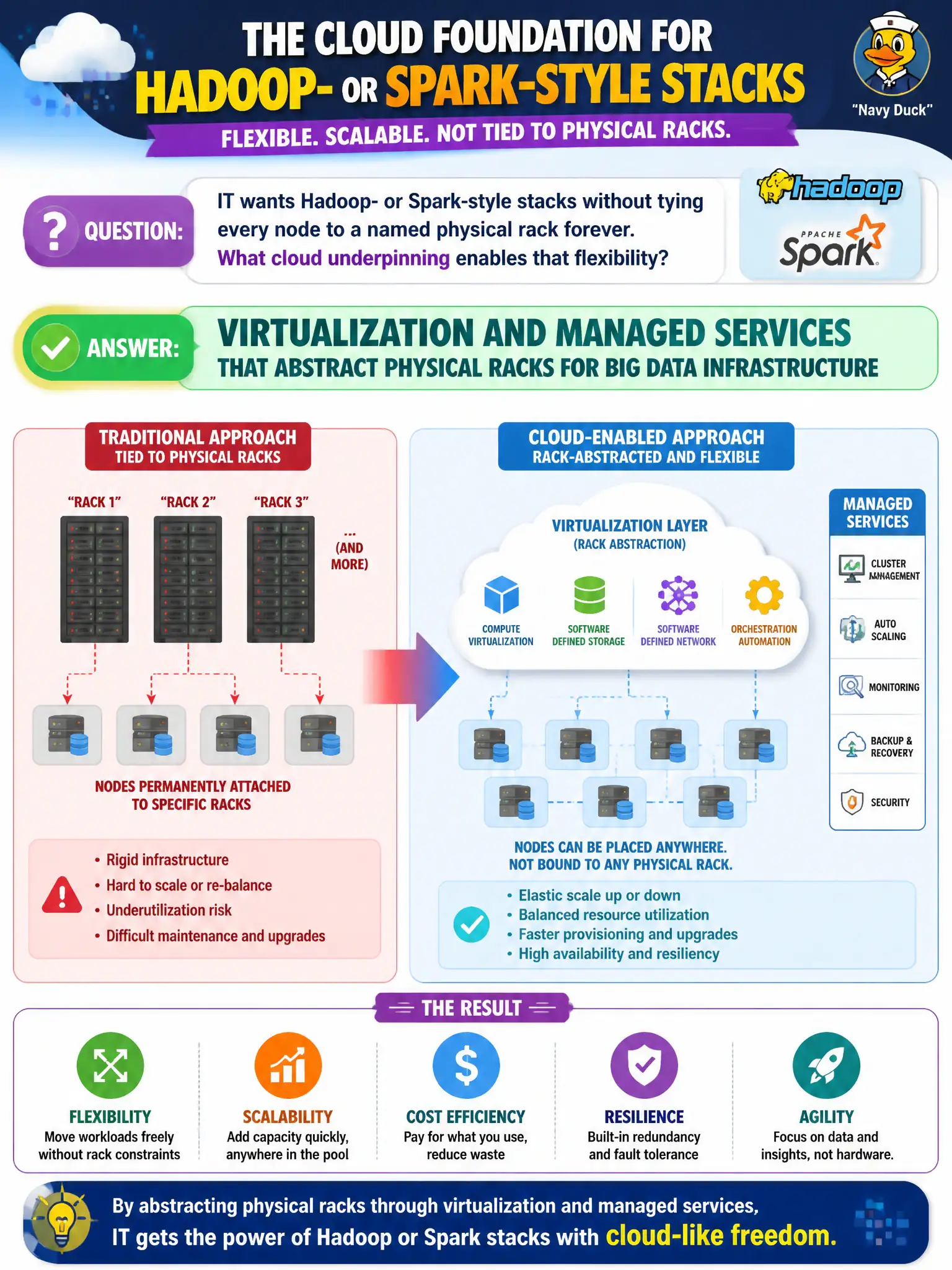
Virtualization is the stage curtain—Hadoop and Spark nodes appear as VMs or managed services without owning a forever rack map. Physical iron still exists; you just stop babysitting every bolt. That is cloud infrastructure under the stack.
Full Explanation
Virtualization and managed services abstract physical racks so Hadoop- or Spark-style stacks are not permanently glued to named chassis. Cities can reassign capacity, replace failed hosts underneath, and consume higher-level managed offerings without redrawing a forever rack map for every node. That underpinning is the Chapter 9 infrastructure story beneath cloud Big Data for municipal IT organizations.
Hard-coding hostnames to concrete chassis that can never be reassigned fights the flexibility virtualization provides and recreates physical lock-in. Banning virtual machines so every process touches bare metal only may suit niche performance cases but is not the cloud underpinning that enables elastic Big Data estates. Requiring analysts to reserve entire buildings before any cluster starts confuses facilities planning with virtualized infrastructure provisioning.
Exam caveat: virtualization does not remove the need for capacity planning, noisy-neighbor awareness, or understanding where managed services shift operational responsibility to the provider. Operational check: migrate or recreate a non-production Spark worker onto different underlying host capacity without changing the job’s logical cluster identity, confirming the abstraction holds for operators.