
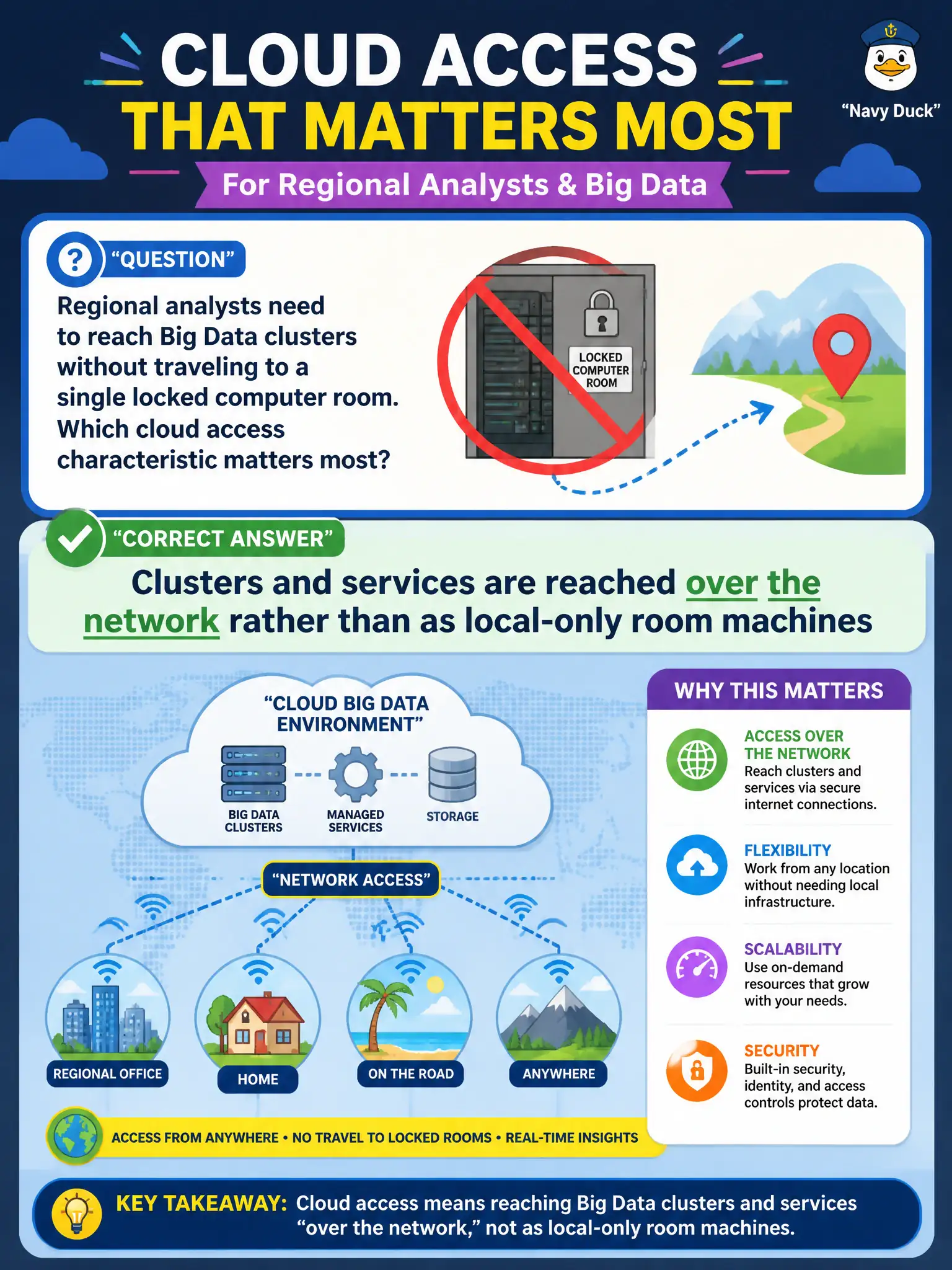
Regional analysts need to reach Big Data clusters without traveling to a single locked computer room. Which cloud access characteristic matters most?
Select an answer to reveal the explanation.
Short Explanation
Cloud Big Data is a network service, not a pilgrimage to one locked room. You reach the cluster over the wire the way you reach a shared utility. Access from afar is part of the model.
Full Explanation
A defining trait of cloud Big Data platforms is that clusters and services are reached over the network rather than as local-only room machines. Network delivery lets analysts across agencies use shared platforms remotely under identity and policy controls, which is how regional civic consortia actually work day to day. That access model is foundational Chapter 9 awareness for municipal deployments of Hadoop-, Spark-, and lake-style stacks.
Requiring resources to be used only while standing inside the originating datacenter cage contradicts remote network access and defeats multi-office analytics. Insisting all processing run offline on removable drives hand-carried between offices is sneakernet, not cloud service access. Forcing analysts to install every physical disk in their cubicles before queries run collapses the platform back into personal hardware farms.
Exam caveat: network reachability must still be bounded by private connectivity, identity, and data-residency controls; “reachable over the network” does not mean anonymously open to the entire internet. Operational check: from an authorized remote analyst workstation, authenticate to the cloud analytics endpoint and run a read-only query without entering the datacenter floor, then confirm unauthorized networks are blocked.