
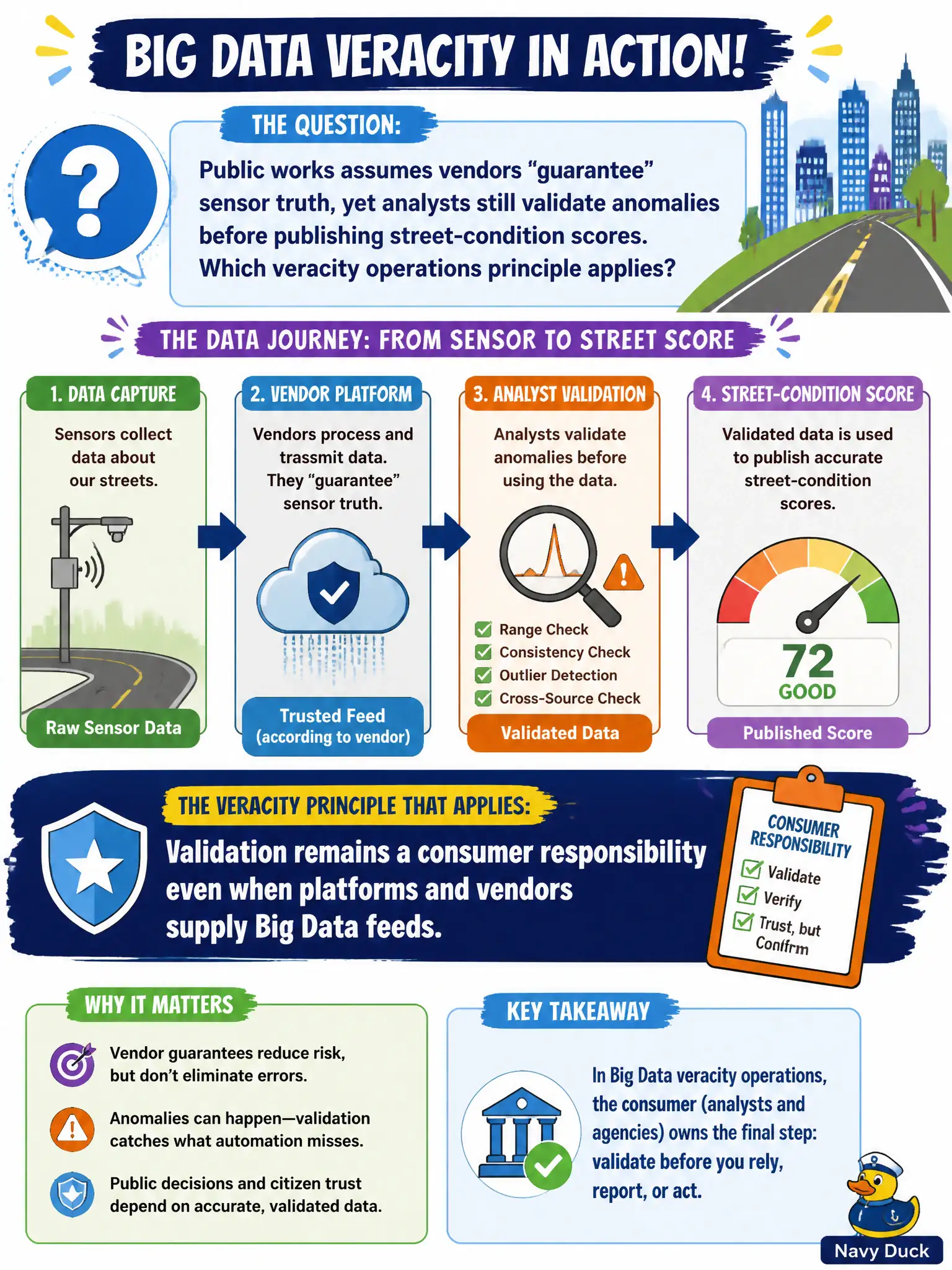
Public works assumes vendors "guarantee" sensor truth, yet analysts still validate anomalies before publishing street-condition scores. Which veracity operations principle applies?
Select an answer to reveal the explanation.
Short Explanation
A vendor warranty is not a magic wand that makes every weird reading true. Analysts still poke the anomalies because veracity is partly on the people using the feed. Trust, then verify—especially before street scores go public.
Full Explanation
Veracity operations treat data quality as an ongoing responsibility of consumers and stewards, not something fully outsourced by buying a platform or signing a vendor guarantee. Public works analysts validating anomalies before publishing street-condition scores exemplify that shared duty for civic trust. Residents and councils act on those scores; unchecked publication undermines integrity.
Vendor contracts permanently removing any need to check anomalies fails by concept: contracts do not erase consumer validation. Publishing without validation to prove platform trust fails by concept: unchecked release is not proof of trustworthiness. Ending veracity work at sensor power-on fails by concept: quality is continuous through the analytic lifecycle.
Exam caveat: Validation remains a consumer and steward responsibility even when vendors supply feeds—power-on and contracts do not retire anomaly checks.
Operational check: Require anomaly review criteria and sign-off before street-condition scores publish, log overridden vendor readings, and keep a named data steward for each sensor-fed civic score. Document residual risk for civic operators and revisit after the next production change window.