
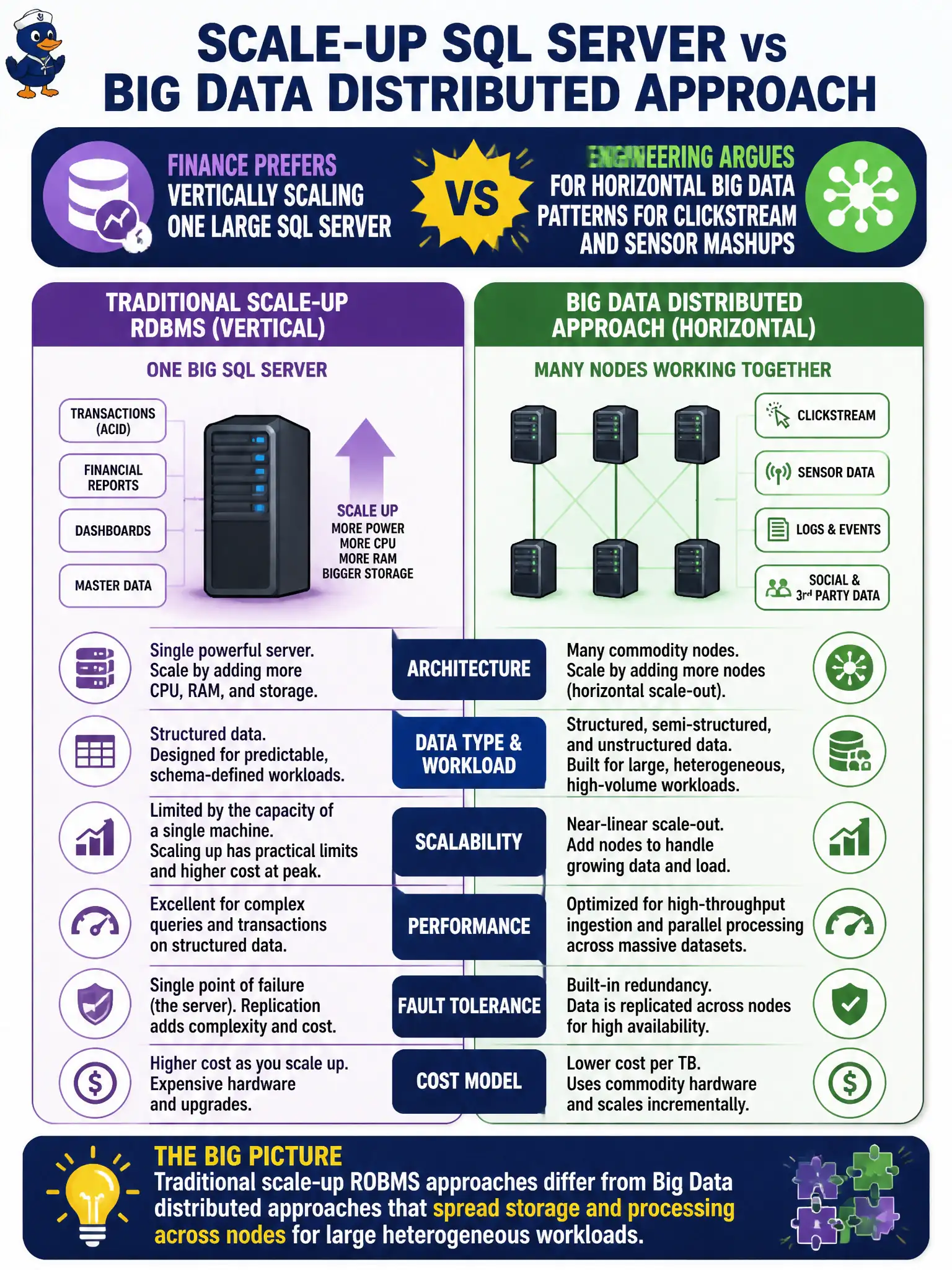
Finance prefers vertically scaling one large SQL server; engineering argues for horizontal Big Data patterns for clickstream and sensor mashups. Which comparison is most accurate?
Select an answer to reveal the explanation.
Short Explanation
One giant SQL fridge versus a warehouse of cooperating shelves—that is scale-up versus horizontal Big Data thinking. Clickstreams mashed with sensors often need the shelf farm, not just a bigger fridge. The approaches are different tools, not twins.
Full Explanation
Traditional architectures often emphasize vertical scale of relational systems, while Big Data patterns emphasize distributed storage and parallel processing across nodes for large, heterogeneous workloads such as click and sensor mashups. Finance preferring one large SQL server versus engineering arguing for horizontal patterns for civic mashups is a paradigm comparison, not a claim that one approach is identical or always superior.
Claiming scale-up and horizontal approaches are always identical in cost and failure modes fails by concept: they differ. Claiming horizontal patterns forbid any SQL under every circumstance fails by concept: SQL engines can still appear in Big Data estates. Claiming a single vertically scaled RDBMS always outperforms distributed approaches on heterogeneous high-scale mashups fails by concept: that absolutism is false for many mashup cases.
Exam caveat: Compare scale-up RDBMS versus distributed Big Data approaches clearly—different cost and failure behavior, not a universal SQL ban or universal RDBMS win.
Operational check: For clickstream-sensor mashups, prototype both a scaled-up RDBMS path and a distributed path against measured data sizes and join complexity, then document cost and failure-mode differences for finance and engineering.