
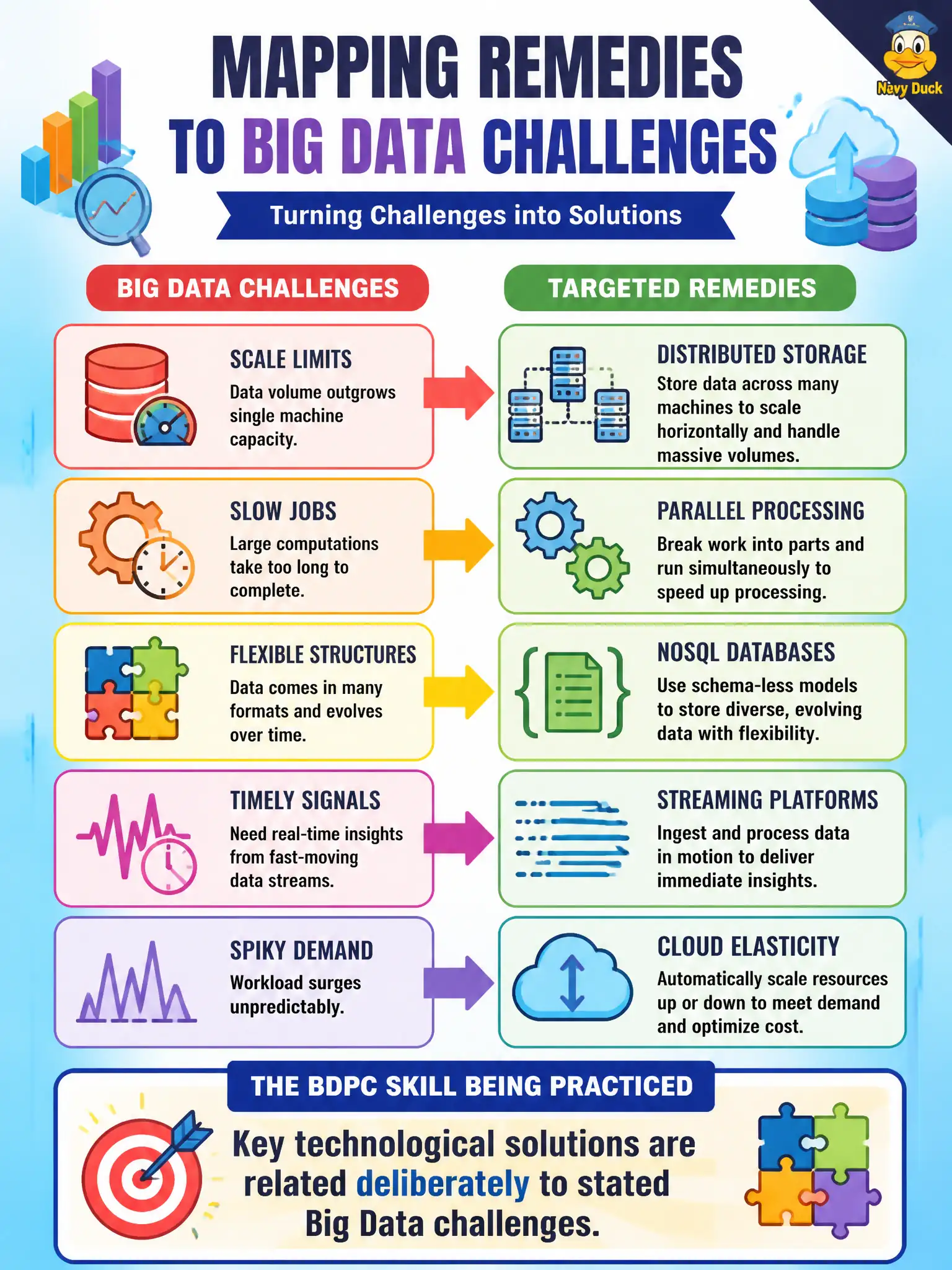
After naming challenges, the team maps remedies: distributed storage for scale limits, parallel processing for slow jobs, NoSQL for flexible structures, streaming for timely signals, and cloud elasticity for spiky demand. Which statement best captures the BDPC skill being practiced?
Select an answer to reveal the explanation.
Short Explanation
Once you name the bruise, you pick the bandage that fits—storage for "too big," parallelism for "too slow," NoSQL for "too bendy," streams for "too late," cloud stretch for "too spiky." Matching remedies to pains is the skill. Random logos or deleting metadata do not count as mapping.
Full Explanation
BDPC expects learners to relate key technological solutions deliberately to stated Big Data challenges. Distributed storage for scale, parallel processing for slow jobs, NoSQL for flexible structures, streaming for timely signals, and cloud elasticity for spiky demand are solution-to-challenge mappings. Civic teams practice that skill so tool choices follow diagnosed pains rather than random purchases.
Saying challenges and solutions should never be related and tools chosen at random fails by concept: deliberate mapping is the skill. Saying only marketing slogans map to challenges fails by concept: technical patterns are what BDPC relates. Claiming cloud elasticity solves schema drift by deleting all metadata fails by concept: elasticity addresses variable load, not schema governance via metadata erasure.
Exam caveat: Map solutions to named challenges accurately; elasticity does not equal schema-governance-by-deletion, and slogans are not substitutes for patterns.
Operational check: For each listed civic pain, write the matching pattern (storage, parallelism, NoSQL, streaming, elasticity) and reject purchases that cannot name which challenge they address. Document residual risk for civic operators and revisit after the next production change window.