
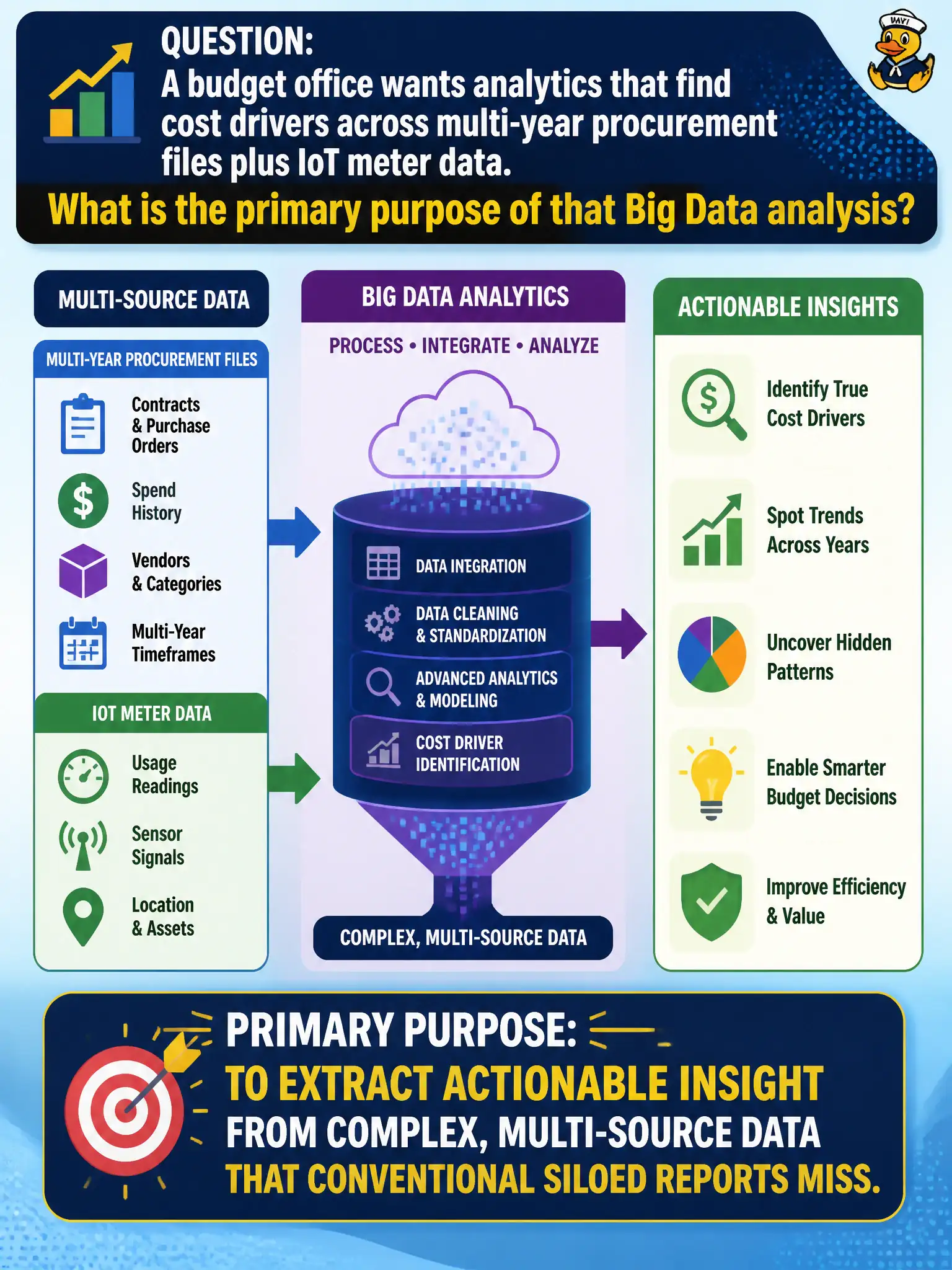
A budget office wants analytics that find cost drivers across multi-year procurement files plus IoT meter data. What is the primary purpose of that Big Data analysis?
Select an answer to reveal the explanation.
Short Explanation
The point of mashing procurement history with meter feeds is not prettier fireworks—it is finding what actually drives cost. Big Data analysis earns its keep when someone can act on a driver they could not see in siloed reports. Skip the vanity metrics; chase the lever.
Full Explanation
Analyzing Big Data aims to extract actionable insight from complex, multi-source datasets. Combining multi-year procurement with IoT meters can reveal cost drivers hidden when each source is reviewed alone. A budget office seeking that mashup is pursuing civic fiscal insight—where money and consumption actually interact—not animation for its own sake.
Proving that IoT meters must replace every procurement record fails by concept: sources complement each other; meters do not erase procurement history. Maximizing chart animations regardless of decision value fails by concept: purpose is insight for decisions. Avoiding extraction of actionable insight fails by concept: that contradicts the purpose of analysis.
Exam caveat: Primary purpose is actionable insight from complex multi-source data—not wholesale source replacement, animation contests, or deliberate non-insight.
Operational check: Define the cost-driver questions the mashup must answer, require a decision owner for each insight, and measure whether procurement-plus-meter views change budget actions within a review cycle. Document residual risk for civic operators and revisit after the next production change window. Confirm owners, SLAs, and rollback criteria in the runbook.