
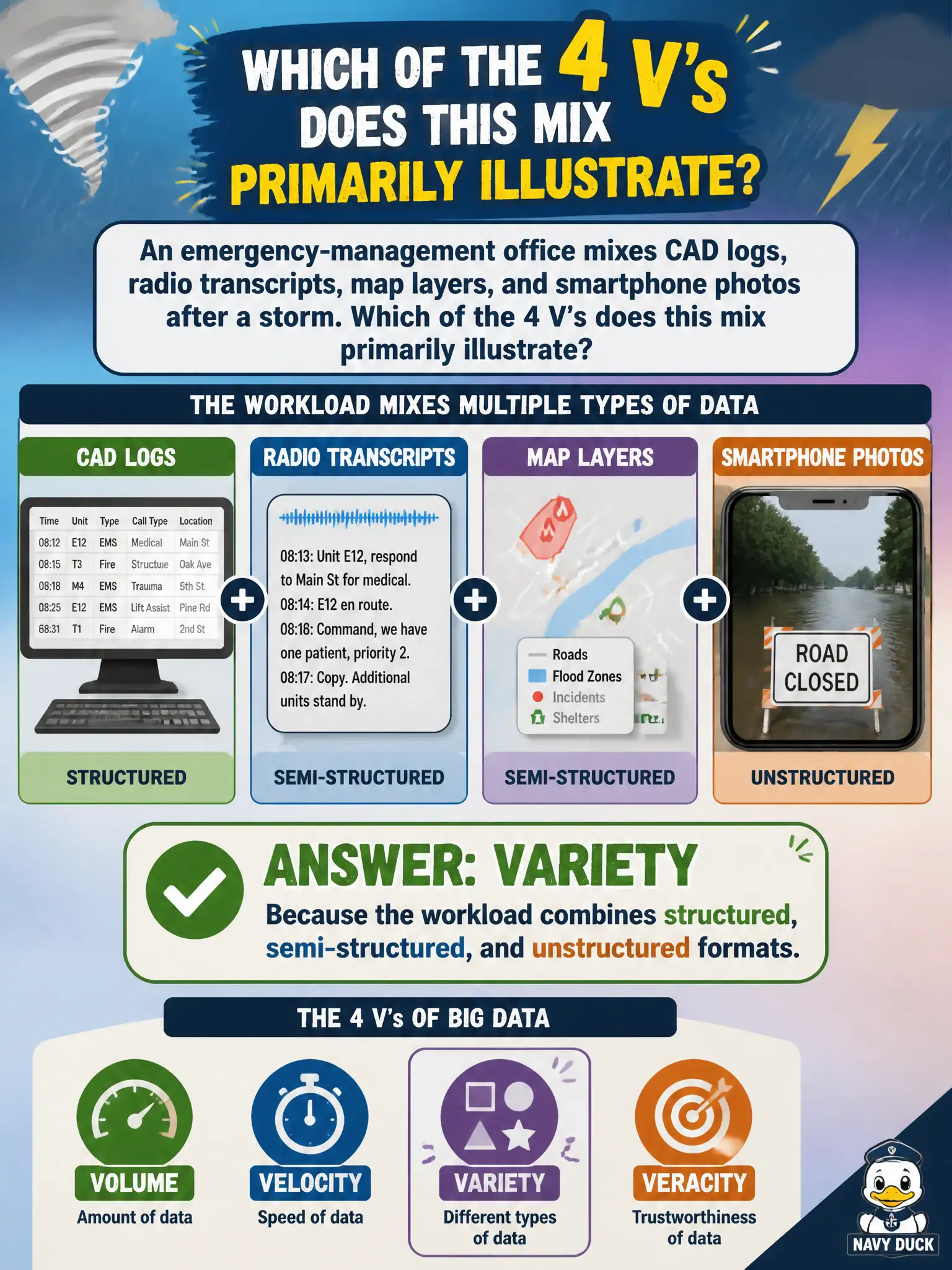
An emergency-management office mixes CAD logs, radio transcripts, map layers, and smartphone photos after a storm. Which of the 4 V's does this mix primarily illustrate?
Select an answer to reveal the explanation.
Short Explanation
CAD tables, radio talk, maps, and phone photos are four different "languages" in one incident folder. That mix is Variety—many shapes of data, not one tidy table. Bulk or speed might also show up in a storm, but the stem's spotlight is the format zoo.
Full Explanation
Variety is the 4 V for heterogeneous data types and structures—structured CAD logs, semi-structured or textual transcripts, geospatial layers, and unstructured photos. An emergency-management office fusing those formats after a storm is a textbook civic Variety scenario: one incident, many shapes of evidence. Response quality depends on joining those languages, not on pretending they are one tidy table.
Framing the mix as Volume only because of a tiny CSV fails by concept: the stem emphasizes format diversity, not a single small file. Framing it as Velocity only because of a once-a-year archive fails by concept: static annual archives are not the story. Framing it as Veracity only with perfect guaranteed truth and no format mix fails by concept: the stem is about heterogeneous formats, not guaranteed truth.
Exam caveat: Variety addresses structural and format heterogeneity; identify it when the stem highlights mixed structured, semi-structured, and unstructured civic sources.
Operational check: Catalog post-storm source types by structure class, plan ingest parsers and storage for each, and avoid forcing all emergency evidence into one brittle schema before analysis. Document residual risk for civic operators and revisit after the next production change window.