
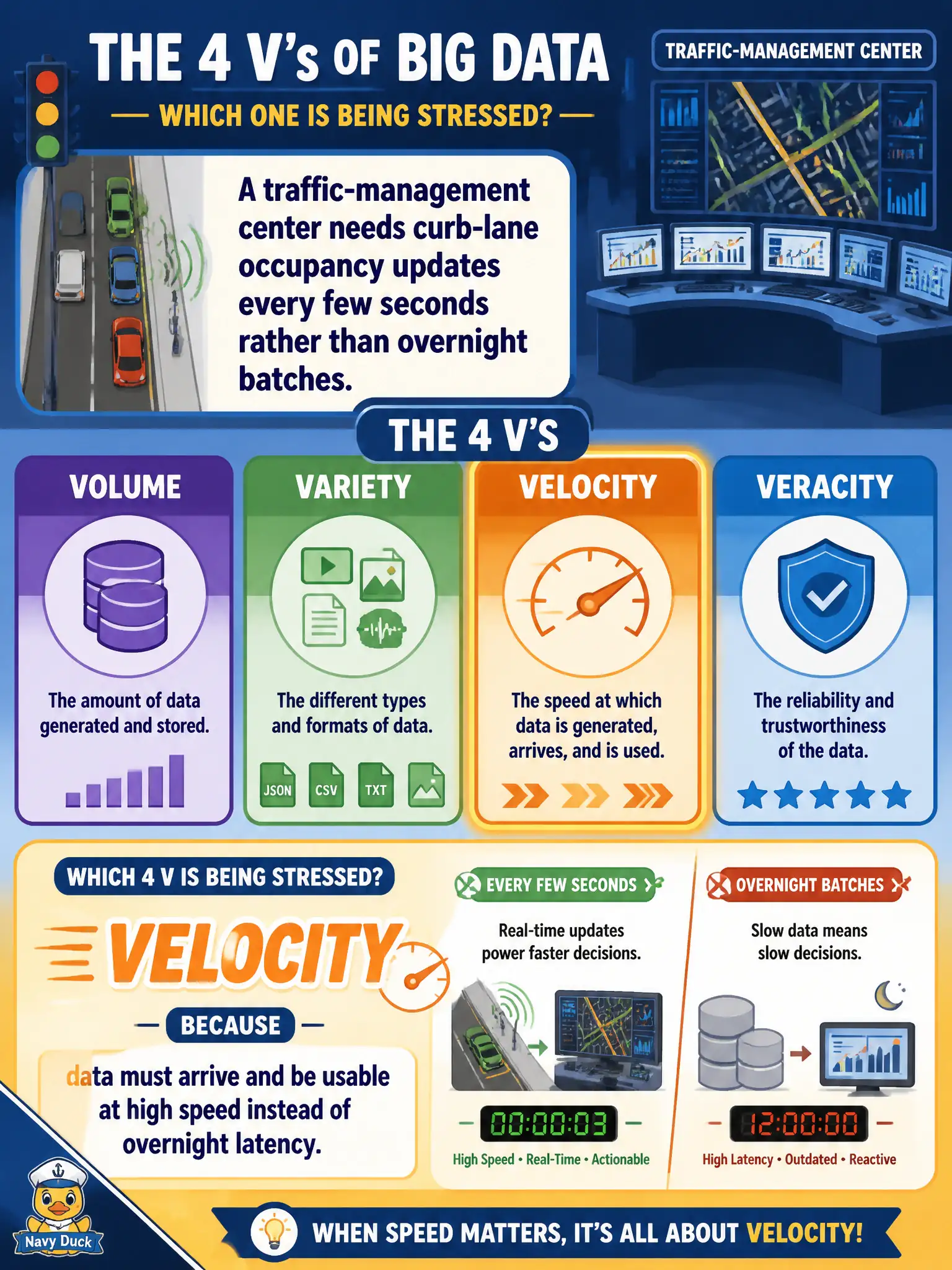
A traffic-management center needs curb-lane occupancy updates every few seconds rather than overnight batches. Which of the 4 V's does this requirement primarily stress?
Select an answer to reveal the explanation.
Short Explanation
Overnight batch is a slow river; curb occupancy every few seconds is a fire hose. That timing demand is Velocity—how fast the data shows up and has to be usable. Bulk archives or rumor fights are different headaches.
Full Explanation
Velocity characterizes high-speed data arrival and processing needs. Requiring curb-lane occupancy every few seconds rather than overnight batches is a velocity-driven requirement for a traffic-management center. Civic curb and congestion decisions that must react within seconds cannot wait for a morning batch job.
Treating the requirement as Volume alone because of archival tape capacity fails by concept: the stem stresses freshness cadence, not storage size. Treating it as Veracity alone because of rumor control fails by concept: trustworthiness is not the named constraint. Treating it as Variety alone because of PDF-versus-spreadsheet mix fails by concept: format heterogeneity is not what the stem describes.
Exam caveat: Velocity is about how fast data must arrive and become usable; do not confuse it with scale, trust, or format mix when the stem is about second-level occupancy updates.
Operational check: Compare overnight batch latency to the operational SLA for curb occupancy, instrument end-to-end ingest-to-dashboard time, and provision streaming or near-real-time paths only where that Velocity is justified. Document residual risk for civic operators and revisit after the next production change window.