
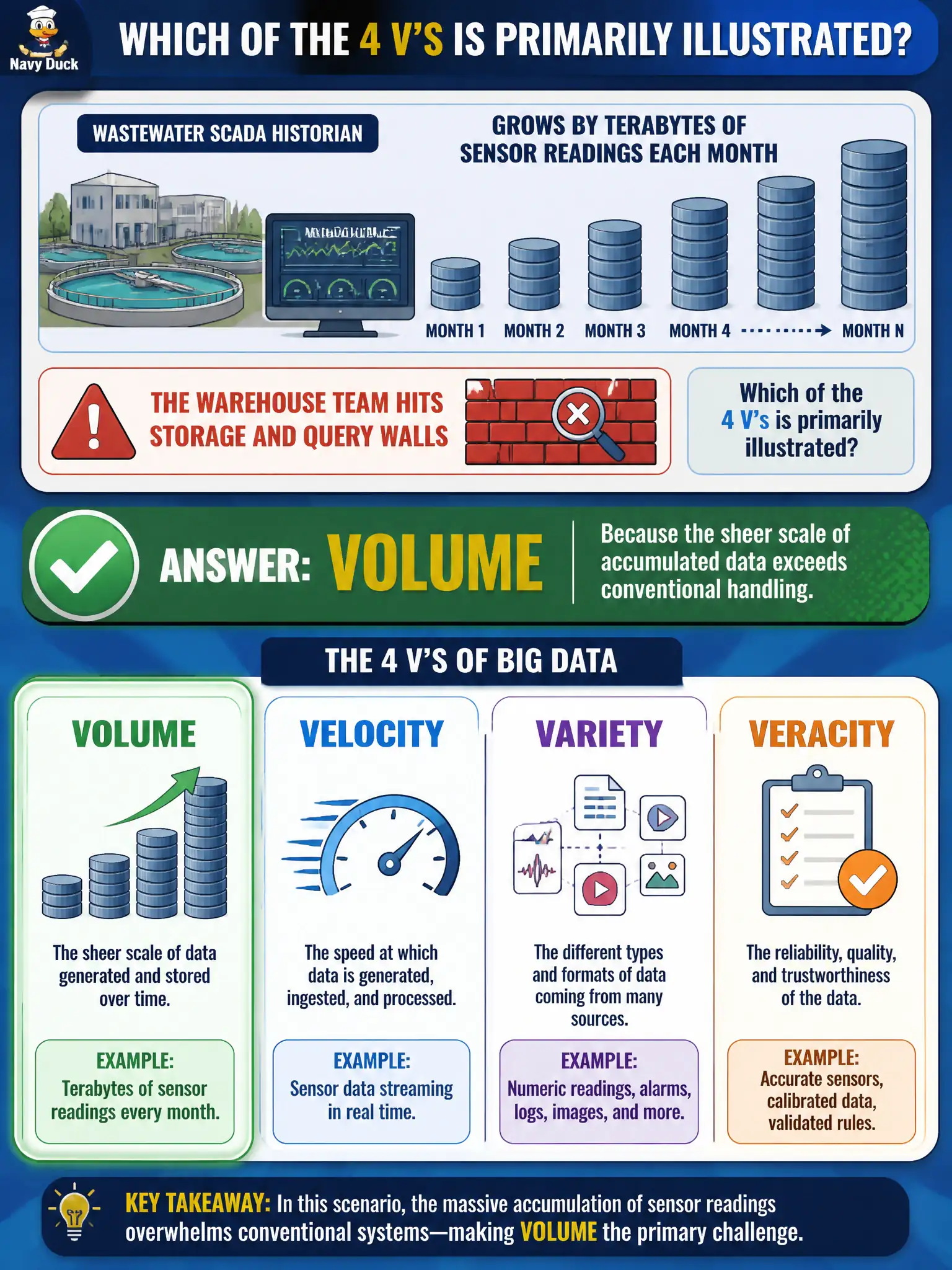
A wastewater SCADA historian grows by terabytes of sensor readings each month, and the warehouse team hits storage and query walls on the conventional platform. Which of the 4 V's is primarily illustrated?
Select an answer to reveal the explanation.
Short Explanation
When the tank of readings fills faster than the old shelves can hold, that is Volume waving hello. Terabytes piling up until storage and queries groan is the classic "too much" V. Speed rumors or schema soup would be other V's—this story is about sheer bulk.
Full Explanation
Volume is the 4 V that describes data scale that outstrips conventional storage and processing. A wastewater SCADA historian adding terabytes of sensor readings monthly until the warehouse hits storage and query walls is a classic Volume stress signal. Civic utilities must plan capacity and architecture around that sheer accumulation of plant telemetry, not rename the pain as something else.
Calling the primary issue Velocity because the stem only mentions sub-second dashboards fails by concept: the stem highlights terabyte growth and warehouse walls, not refresh-speed alone. Calling it Variety because of vendor schema conflicts fails by concept: conflicting schemas are not the pain named here. Calling it Veracity because of rumor disputes fails by concept: trustworthiness is not the primary constraint described.
Exam caveat: Match the V to the stem's primary pain—here accumulated scale exceeding conventional handling—without forcing unrelated Vs onto the scenario.
Operational check: Trend historian growth, warehouse storage headroom, and query failure rates; if scale is the breaker, label the driver Volume and size distributed storage or retention policies accordingly. Document residual risk for civic operators and revisit after the next production change window.