
A regional transit agency asks which operational domains sit inside Big Data's practical reach. Which answer best reflects BDPC breadth?
Select an answer to reveal the explanation.
Short Explanation
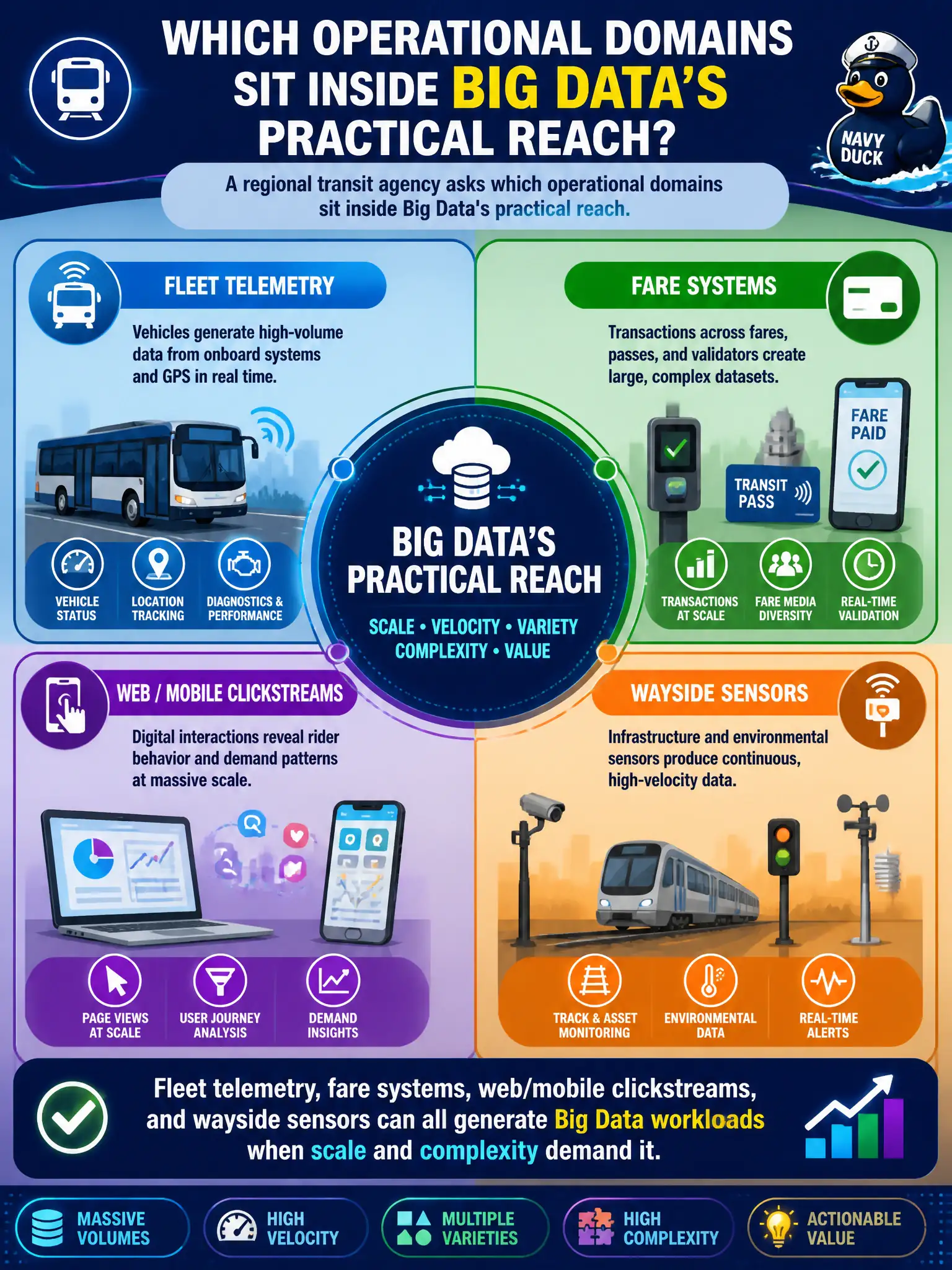
Transit is a buffet of Big Data appetizers: buses talking, fare gates clicking, apps tapping, sensors humming. Any of those domains can cross the Big Data line when the scale gets ugly. It is not a website-only or marketing-only club.
Full Explanation
BDPC presents Big Data as broadly applicable across operational domains, not confined to a single channel such as web marketing. For a regional transit agency, fleet telemetry, fare systems, web and mobile clickstreams, and wayside sensors can each generate Big Data workloads when scale and complexity demand it. That civic breadth matches how modern transit actually operates for riders and maintainers.
Limiting Big Data to website analytics alone fails by concept: fleet and fare systems routinely produce volume and velocity that stress conventional tools. Restricting Big Data to small HR payroll tables fails by concept: tiny, tidy tables are often conventional, not the breadth of transit operations. Claiming sensors are always out of scope because Big Data is marketing-only fails by concept: operational sensor feeds are core civic Big Data sources.
Exam caveat: Practical reach spans multiple operational domains when the 4 V characteristics overwhelm conventional tooling—not website-only, payroll-only, or marketing-only silos.
Operational check: Inventory transit domains (fleet, fare, digital, sensors), note which already strain current platforms, and prioritize pilots where measured Volume, Velocity, or Variety justify Big Data investment.