
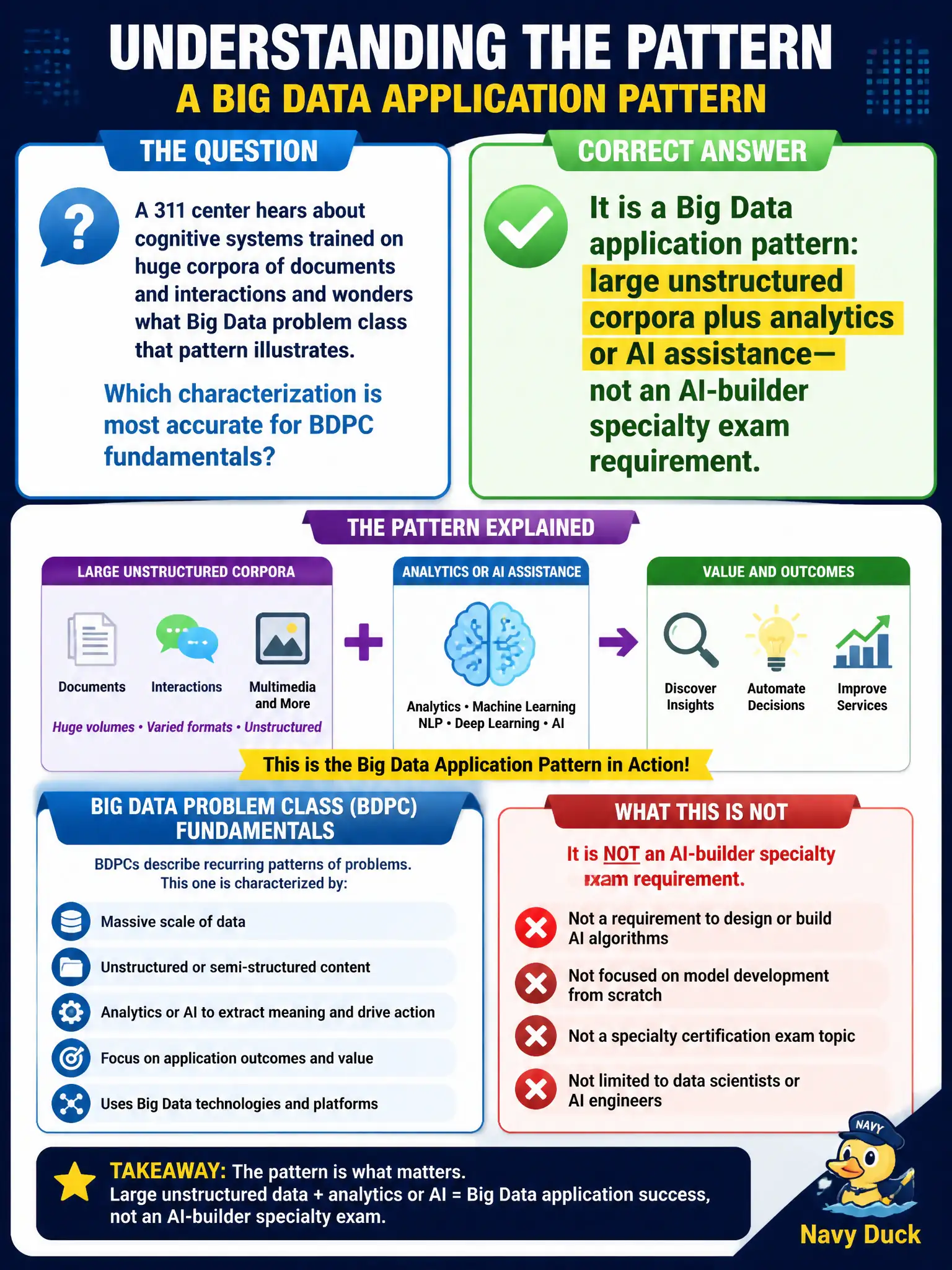
A 311 center hears about cognitive systems trained on huge corpora of documents and interactions and wonders what Big Data problem class that pattern illustrates. Which characterization is most accurate for BDPC fundamentals?
Select an answer to reveal the explanation.
Short Explanation
Think of a librarian who has read every memo in the building and can still point you to the right shelf—that is the pattern, not "go invent a neural network from zero." Huge document piles plus assistive analytics are a classic Big Data use case. The 311 team needs the concept, not a builder bootcamp.
Full Explanation
Cognitive systems trained on large unstructured corpora of documents and interactions exemplify a Big Data application pattern: massive text or interaction histories combined with analytics or AI assistance. A 311 center can recognize that pattern as problem-class awareness—how large civic knowledge bases might assist callers—without turning BDPC into an AI-engineer specialty mandate. The civic takeaway is recognizing the application class inside the Big Data ecosystem.
Requiring the city to build its own deep-learning framework from scratch fails by concept: pattern recognition is not a build-your-own-framework exam. Treating the topic as only a networking certification with no Big Data angle fails by concept: large corpora plus assistance are squarely Big Data application territory. Claiming such systems replace all structured 311 ticket data forever fails by concept: structured tickets remain essential operational records alongside unstructured assistance.
Exam caveat: BDPC wants professional recognition of the application pattern, not construction of custom deep-learning stacks or dismissal of structured civic ticket data.
Operational check: Map which 311 knowledge sources are unstructured corpora versus structured tickets, decide where assistive analytics could help agents, and keep ticket systems of record intact under governance.