
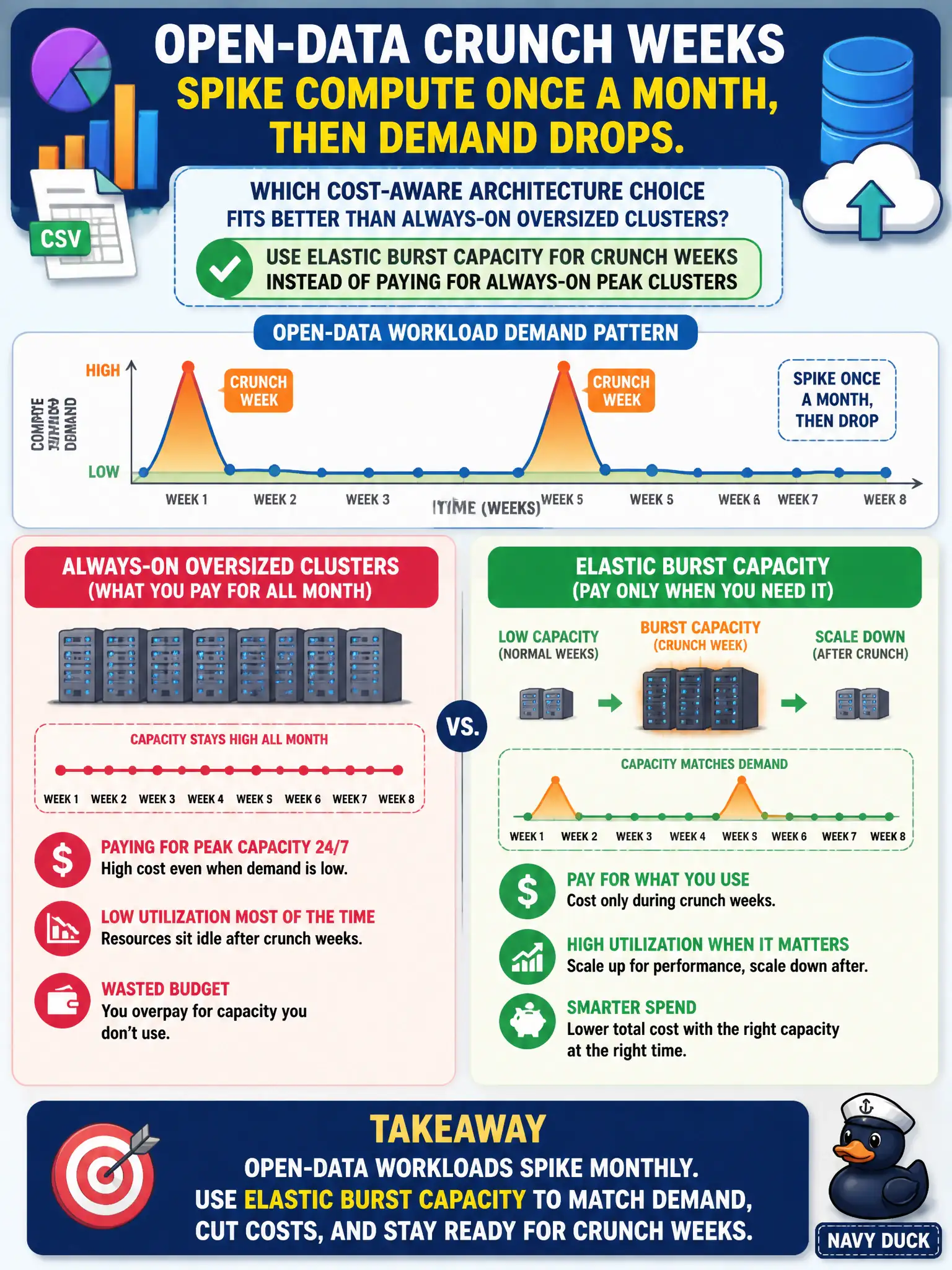
Open-data crunch weeks spike compute once a month, then demand drops. Which cost-aware architecture choice fits better than always-on oversized clusters?
Select an answer to reveal the explanation.
Short Explanation
Paying for a stadium that is full one weekend a month is rough on the budget. Burst when the open-data crunch hits, then shrink back down.
Full Explanation
Open-data crunch weeks that spike compute once a month and then drop favor elastic burst capacity over always-on oversized clusters. Cost-aware municipal architecture sizes for baseline demand, bursts for publication peaks, and returns capacity when demand falls so taxpayers are not funding idle peak hardware year-round. Purchasing permanent peak capacity for the busiest hour of the year and leaving it idle wastes budget that could fund other civic services or dataset quality work. Banning monthly open-data publications merely to keep cluster utilization charts flat subordinates transparency goals to idle metrics and harms public accountability. Running every crunch exclusively on a single underpowered workstation overnight fails scale, reliability, and repeatability for citywide open-data releases. Exam caveat: elasticity and burst patterns—whether cloud autoscaling or temporary on-prem expansion—are architectural cost levers, not merely negotiated vendor discounts. Operational check: profile last quarter’s open-data job peaks, configure autoscaling or temporary cluster expansion for crunch week, cap always-on nodes at baseline, tag burst spend to the publication program, and report cost-per-release to finance after each cycle.