
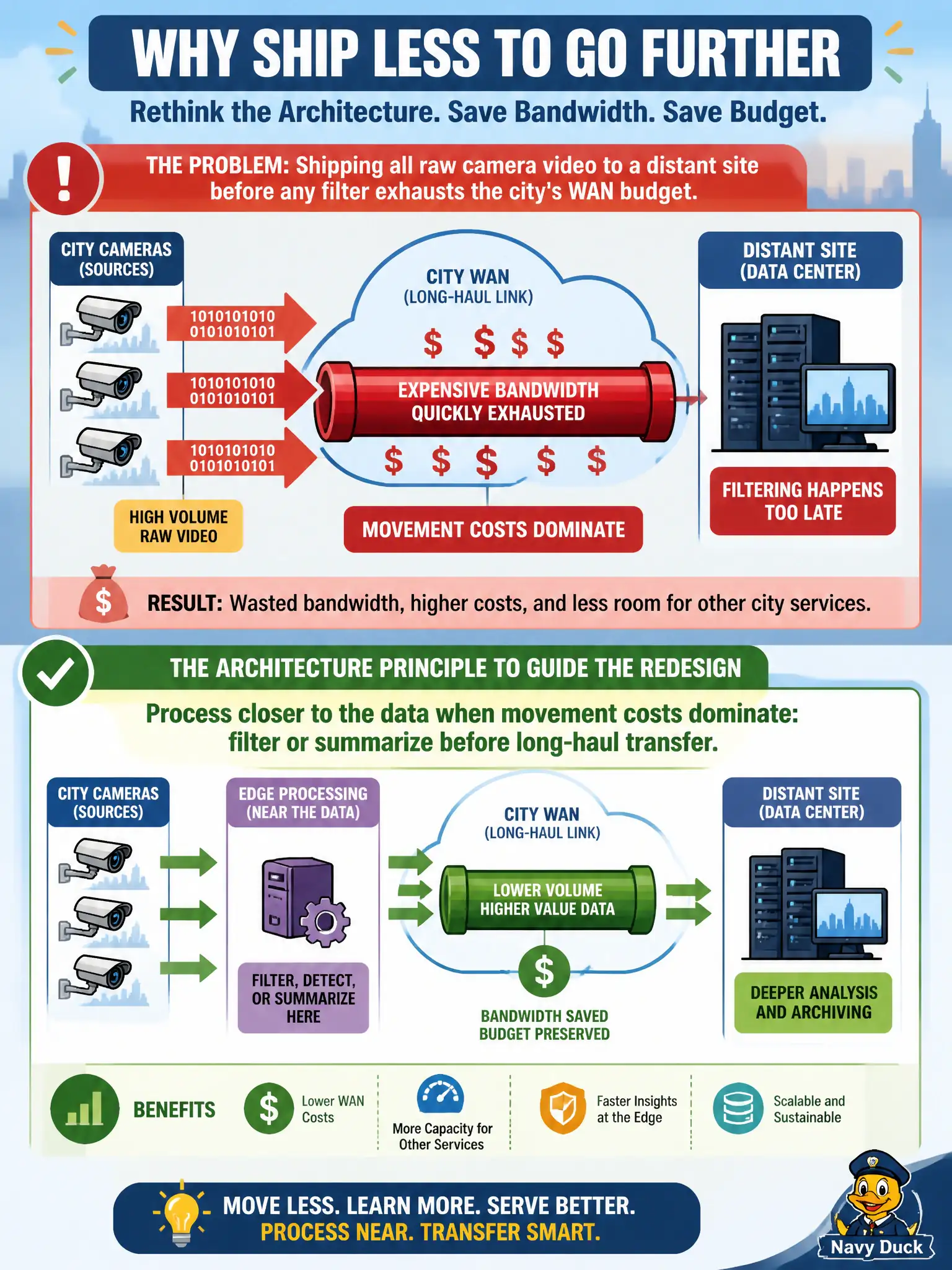
Shipping all raw camera video to a distant site before any filter exhausts the city’s WAN budget. What architecture principle should guide the redesign?
Select an answer to reveal the explanation.
Short Explanation
Hauling every raw camera frame across town before looking at it is like mailing whole haystacks to find a needle. Filter close to the cameras, then ship the small answers. The WAN will thank you.
Full Explanation
Data locality and movement-cost awareness are core architecture concerns. When camera video volume dominates WAN capacity, designs filter, sample, or summarize near the source before long-haul transfer. Architecture must place processing relative to where bulky civic media is born so budgets fund insight, not endless byte shipping.
Always moving every byte to the farthest region first to maximize network spend fails by concept: that is anti-cost design. Disabling edge filtering because WAN cost is unrelated to architecture fails by concept: movement cost is an architecture input. Storing nothing locally and re-downloading full video for every dashboard click fails by concept: that inflates cost without analytic gain.
Exam caveat: Process closer to the data when movement costs dominate—filter/summarize before long-haul; do not maximize distant copies or re-fetch full video per click.
Operational check: Measure WAN cost of raw video haul, deploy edge filter or summarize jobs, ship only derived features/clips needed centrally, and confirm dashboards no longer pull full remote video per click. Document residual risk for civic operators and revisit after the next production change window.