
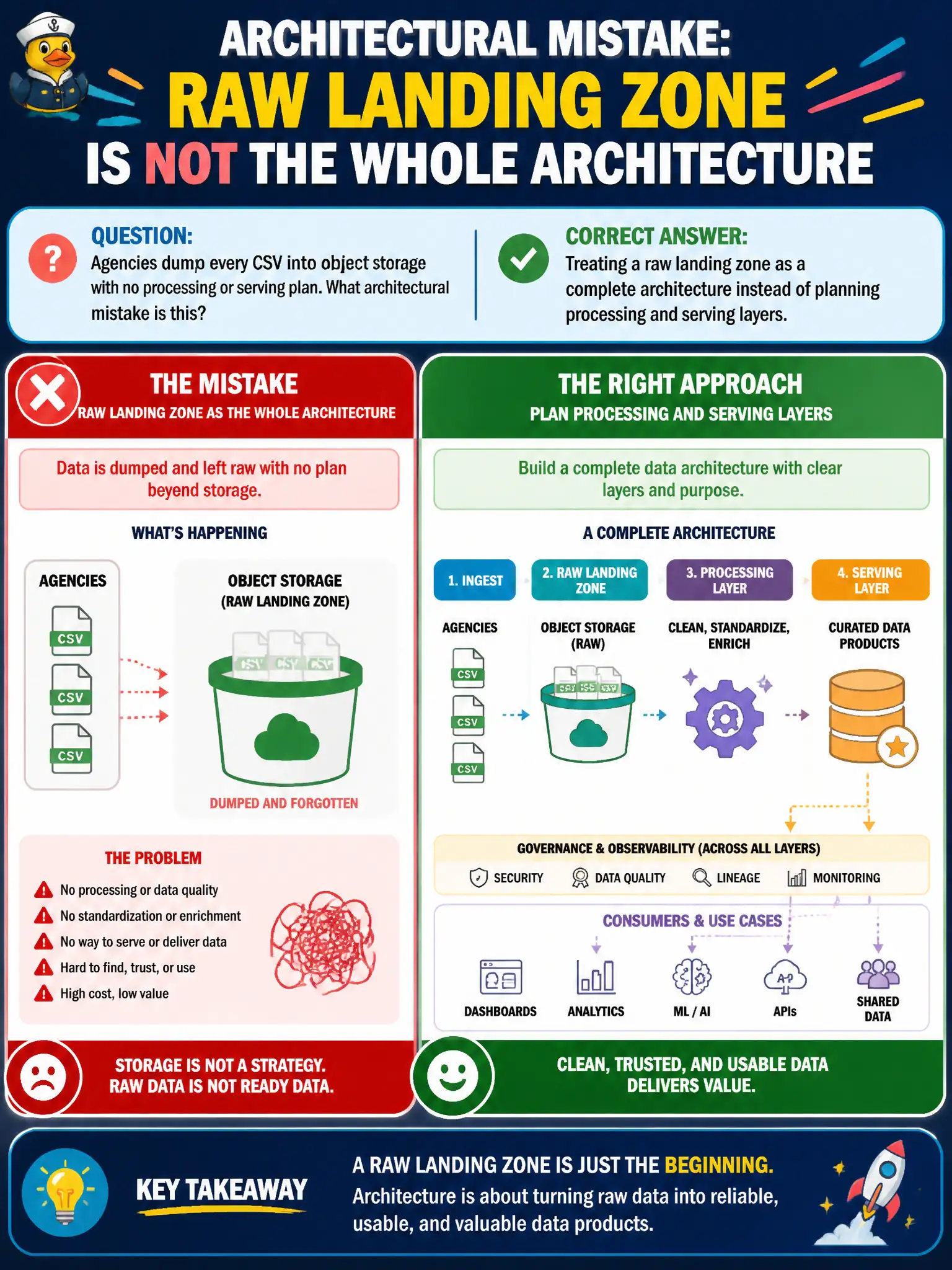
Agencies dump every CSV into object storage with no processing or serving plan. What architectural mistake is this?
Select an answer to reveal the explanation.
Short Explanation
A pile of CSVs in a bucket is a driveway, not a house. Architecture still needs processing and a way to serve answers — dumping files is only the first step, not the finish line.
Full Explanation
Raw object-storage landing zones are useful but incomplete. Without planned processing and serving layers, agencies create unusable data swamps rather than Big Data architectures. Dumping every CSV with no processing or serving plan treats a landing zone as a complete architecture—an expensive civic mistake that frustrates analysts and auditors alike.
Claiming object storage alone always serves interactive apps fails by concept: landing ≠ serving. Proving batch and speed layers are unnecessary once any file lands fails by concept: architecture still needs processing and serving design. Demonstrating that HDFS/YARN placement is solved by unsorted CSV folders fails by concept: folders are not platform placement.
Exam caveat: A raw landing zone is not a complete architecture—plan processing and serving; do not equate dumps with interactive serving or Hadoop placement.
Operational check: For each landed civic dataset, name the processing jobs and serving destinations, reject “lake-only” project closures, and measure whether analysts can actually query curated outputs. Document residual risk for civic operators and revisit after the next production change window. Confirm owners, SLAs, and rollback criteria in the runbook before go-live.