
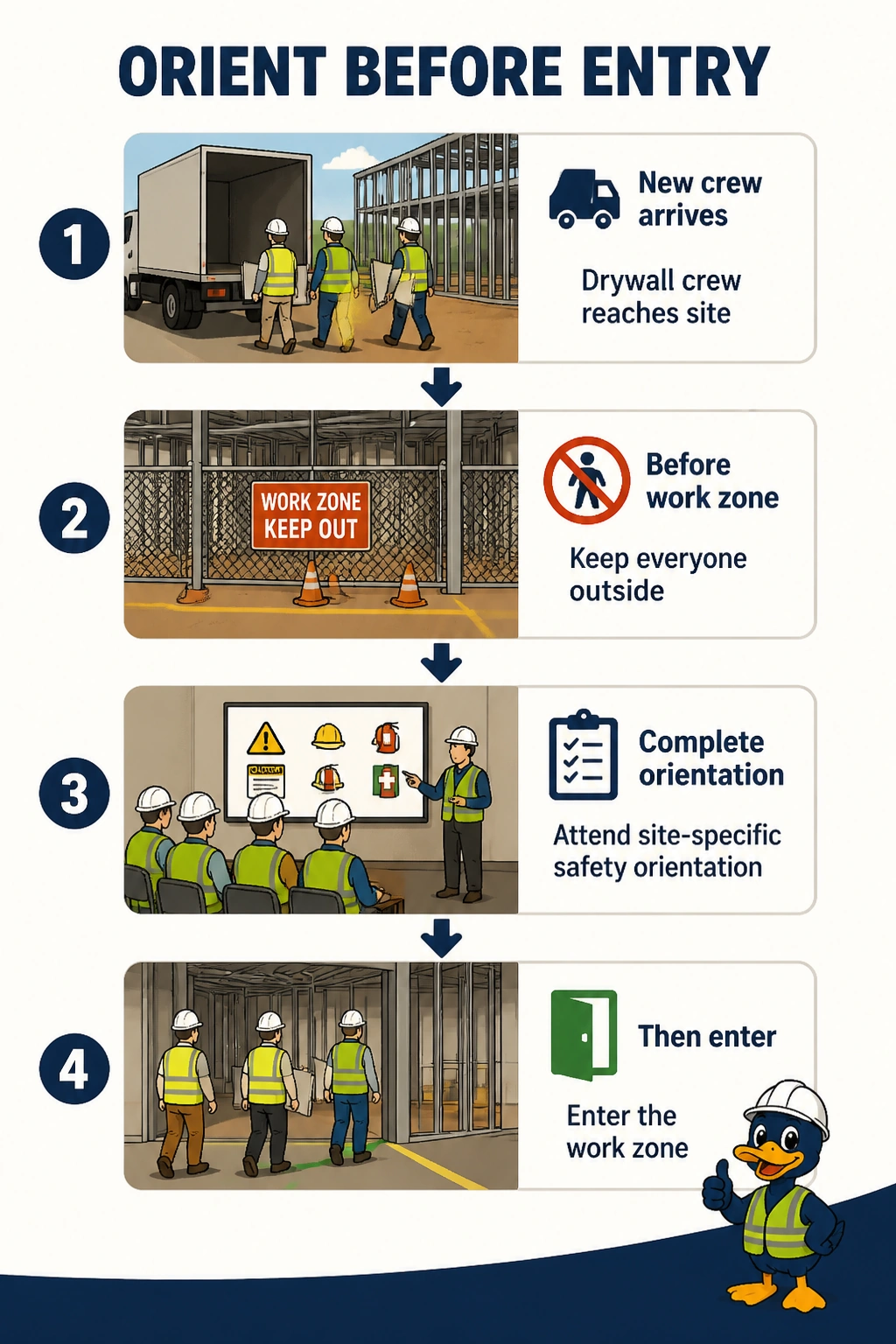
A newly mobilized drywall crew arrives at a hospital renovation site and asks to skip the general contractor's site-specific safety orientation because every worker already holds a 10-hour OSHA construction card. What should the site supervisor require?
Select an answer to reveal the explanation.
Short Explanation
A 10-hour safety card teaches general construction rules, not where your site's active hospital corridors, fire exits, and utility shutoffs are located. If you waive site orientation for credentialed crews, they walk blind into hazards unique to your building.
Full Explanation
The supervisor must require the crew to "Complete the site-specific orientation before anyone enters the work zone" because general safety training never covers project-specific rules, emergency muster points, infection-control barriers, or active utility hazards. Choosing to "Allow experienced crew leads onto the floor while apprentices attend orientation" exposes seasoned workers to unfamiliar site hazards and leaves them unable to guide their crew on local emergency procedures. Choosing to "Accept photocopies of their 10-hour OSHA cards in place of the site orientation" confuses baseline industry awareness with site-specific hazard communication and emergency readiness. Choosing to "Let the crew start hanging drywall and schedule the orientation for Friday afternoon" leaves the crew unprotected during their highest-risk first days on an unfamiliar site. One caveat is that site orientation does not replace task-specific training, such as scissor-lift qualification or silica controls, which must also be verified. As an operational check, issue a dated hard-hat sticker or badge only after each worker completes orientation and signs the roster, and verify stickers at the morning gate.
Prefer to study offline? Printable PDF study book + test engine ($7.50, unofficial). These questions stay free here.