
Before sending a crew into an underground utility vault where initial atmospheric testing shows 17.5 percent oxygen, a foreman considers issuing half-mask air-purifying respirators with organic vapor cartridges. Why must the foreman reject this respirator choice?
Select an answer to reveal the explanation.
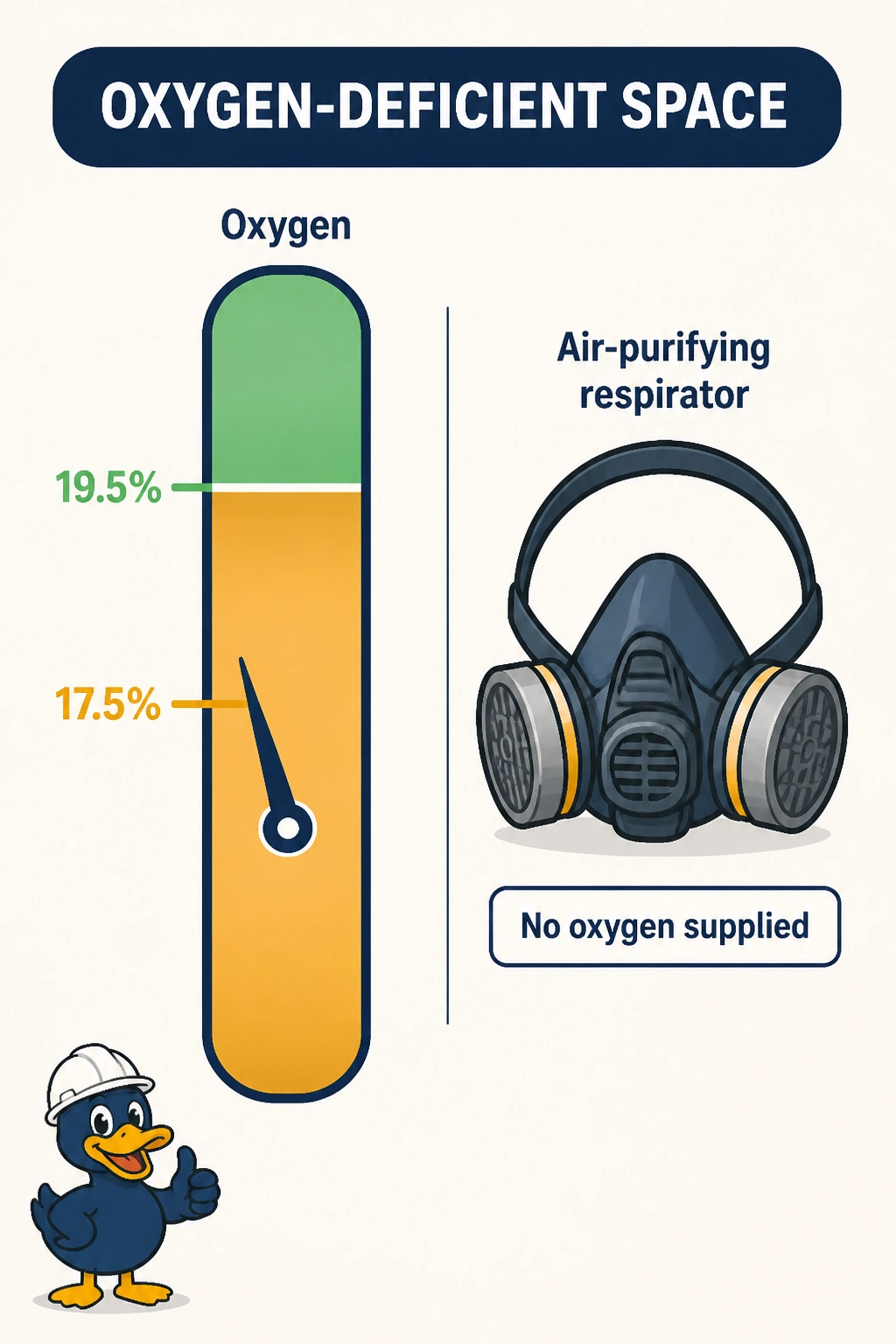
Short Explanation
You’re right to reject the proposed air-purifying respirator: it filters contaminants but cannot add oxygen to the air you breathe. A heavier cartridge or tighter mask won’t correct oxygen deficiency; you need safe ventilation or atmosphere-supplying protection.
Full Explanation
Under OSHA’s respiratory protection standard in 29 CFR 1910.134 and confined-space rules, an atmosphere below 19.5 percent oxygen is oxygen-deficient and may be immediately dangerous to life or health unless proven otherwise. The foreman must reject organic vapor cartridges because an air-purifying respirator filters contaminants from ambient air but does not supply oxygen, leaving the crew at risk of asphyxiation. A claim that organic vapor cartridges expire within thirty minutes in underground vaults is not a reliable explanation: cartridge service life depends on chemical breakthrough, not oxygen concentration. A supplied-air hose is not required only when hydrogen sulfide is present; oxygen deficiency alone calls for atmosphere-supplying protection, whether or not toxic gases are detected. A full-facepiece air-purifying respirator does not solve the problem either: a facepiece upgrade still provides no supplemental oxygen, so it is not the required protection whenever oxygen falls below 19.5 percent. As an exam caveat, if ventilation cannot restore safe oxygen levels, use atmosphere-supplying protection appropriate for the hazard. As a practical check, calibrate the multi-gas meter and verify oxygen readings at every vault depth before selecting respiratory protection or issuing an entry permit.
Prefer to study offline? Printable PDF study book + test engine ($7.50, unofficial). These questions stay free here.