
Two pipefitters spend six hours a day standing in one spot on a bare concrete slab threading and assembling valves at a stationary shop bench, and both report sore feet and lower-back stiffness. Which ergonomic control should the supervisor implement?
Select an answer to reveal the explanation.
Short Explanation
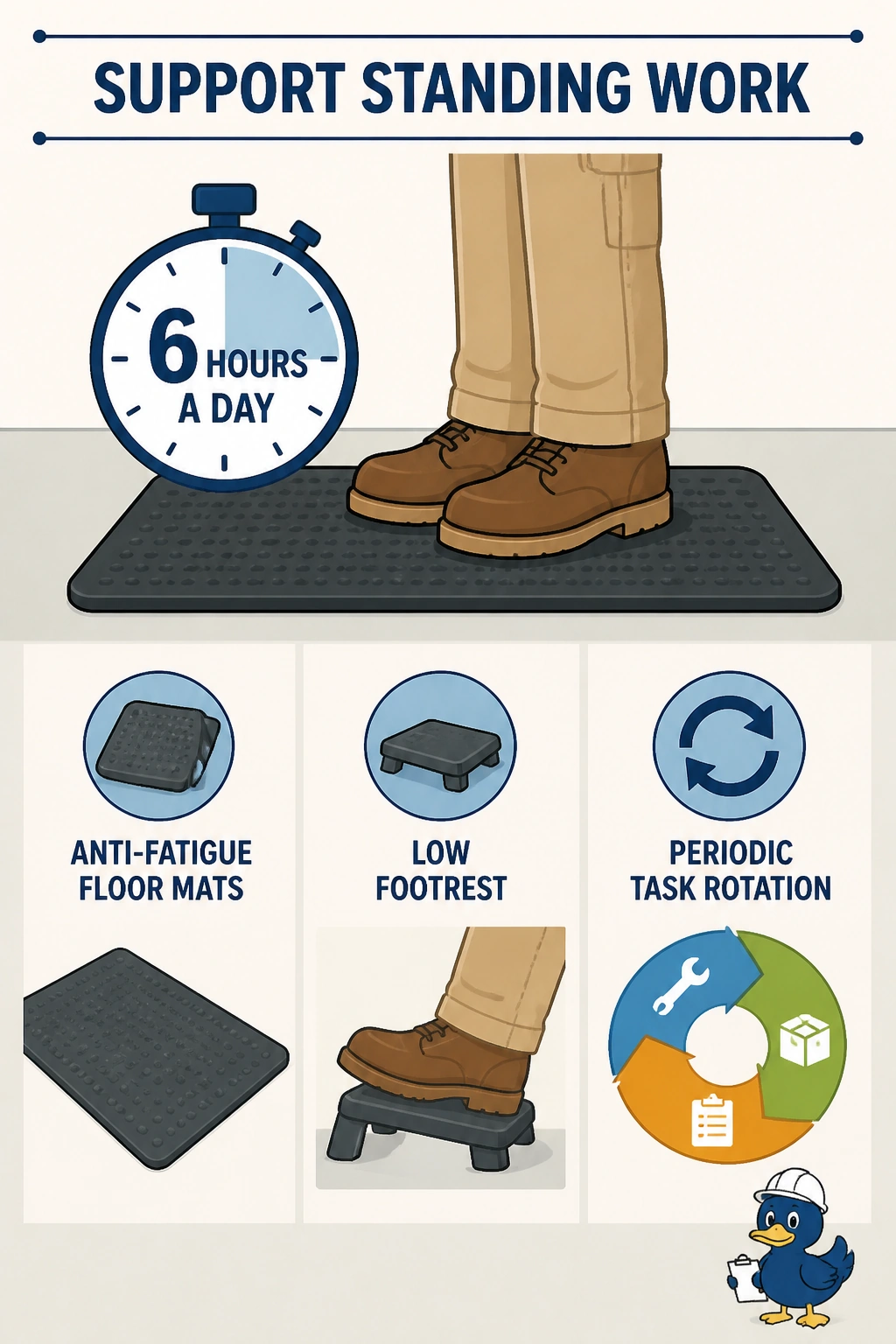
You can ease sore feet and lower-back stiffness by breaking up static standing on hard concrete. Use anti-fatigue mats, a low footrest, and periodic task rotation; thicker socks alone or a bench raised above elbow height won’t solve the problem.
Full Explanation
Prolonged static standing on unyielding concrete restricts venous blood return in the legs and places continuous compressive load on the lumbar spine. Provide anti-fatigue floor mats, a low footrest, and periodic task rotation: cushioned matting encourages subtle muscle micro-movements, a footrest lets workers alternate leg elevation to relieve lower-back curve strain, and rotation breaks up static posture. Requiring steel-shank boots with thicker cotton socks only provides rigid arch support; it does not address the hard floor surface or static muscle fatigue. Raising the workbench six inches above elbow height forces workers to elevate their shoulders and flex their wrists awkwardly, worsening ergonomics. Snug back belts do not relieve static muscle fatigue, and standing with feet together impairs balance. Caveat: anti-fatigue mats in active shops need beveled edges and slip-resistant surfaces to avoid trip hazards. Practical check: inspect the fabrication station to confirm the bench sits near elbow height, the mat lies flat without curled edges, and workers have room to shift stance.
Prefer to study offline? Printable PDF study book + test engine ($7.50, unofficial). These questions stay free here.