
A masonry foreman sees a worker dry-cutting concrete blocks with a handheld saw inside a partially enclosed parking garage, creating a thick dust cloud. What is the foreman's best first corrective step?
Select an answer to reveal the explanation.
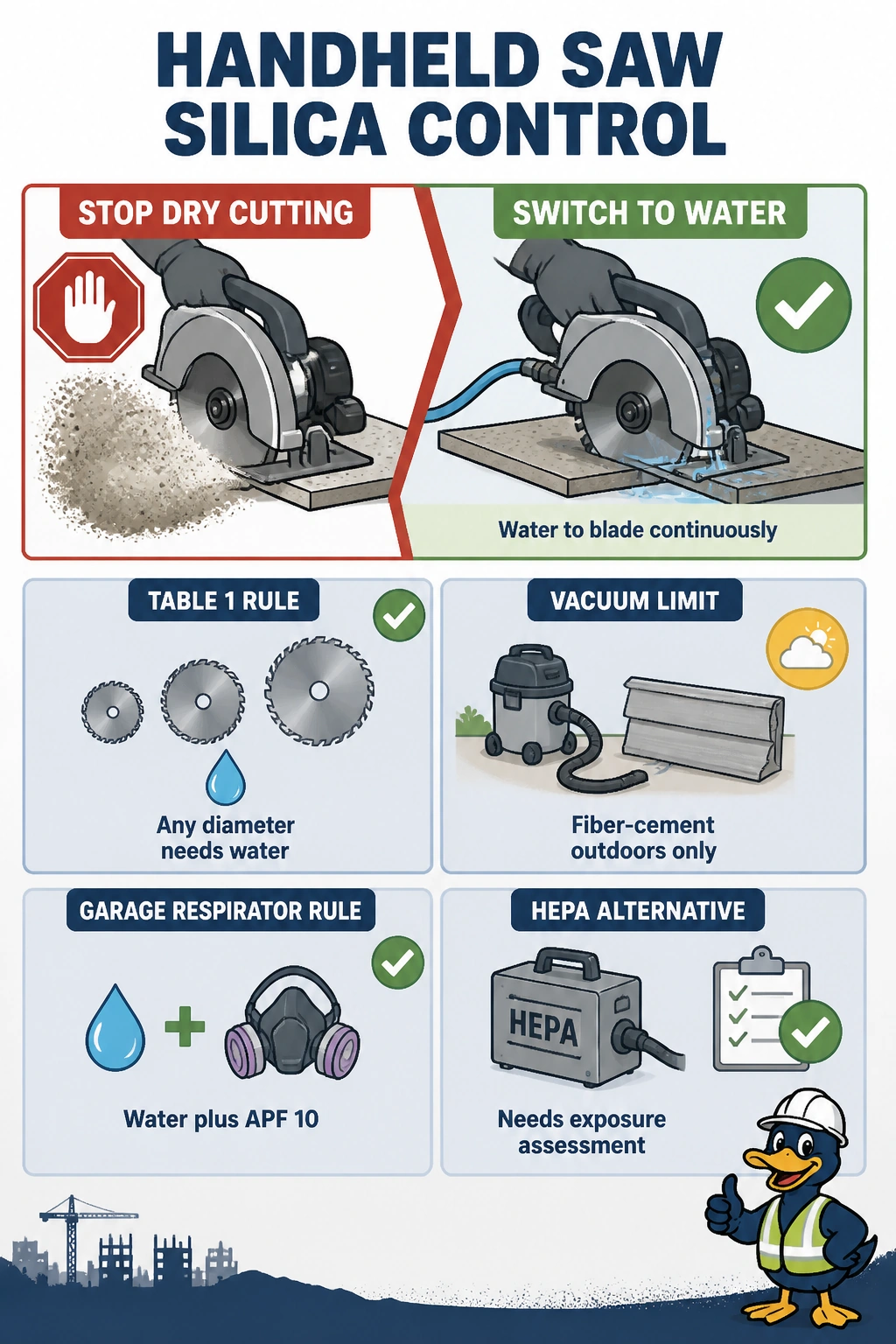
Short Explanation
Chasing silica dust with a cheap mask is like mopping the floor while the pipe is still spraying. The trap is reaching for PPE or moving the crew back first, when you need to stop the dry cut and control the dust right at the saw blade.
Full Explanation
Under OSHA's construction silica standard (29 CFR 1926.1153) and the hierarchy of controls, engineering controls that suppress respirable crystalline silica at the source outrank personal protective equipment. Choosing to "Stop the dry cutting and switch to a saw with an integrated water-delivery system" provides the Table 1 control for handheld power saws of any blade diameter, with water continuously fed to the blade to stop the plume and protect the operator and others. Choosing to "Hand the worker a disposable dust mask and tell them to finish the cut quickly" leaves uncontrolled silica in an enclosed space and skips medical clearance and fit-testing rules if respirators are required. Choosing to "Move the worker outside the garage so the wind disperses the concrete dust cloud" reduces confinement slightly but still exposes the operator to high silica at the breathing zone. Choosing to "Have the rest of the crew step back twenty feet while the worker finishes cutting" leaves the cutter unprotected and lets dust drift through the garage. Caveat: Table 1 vacuum collection is only for fiber-cement 8 inches or less outdoors, not concrete block; a HEPA shroud needs exposure assessment under 1926.1153(d). In this garage, Table 1 with water still requires at least an APF 10 respirator for the whole task. Operational check: confirm water feeds continuously before the first cut.
Prefer to study offline? Printable PDF study book + test engine ($7.50, unofficial). These questions stay free here.